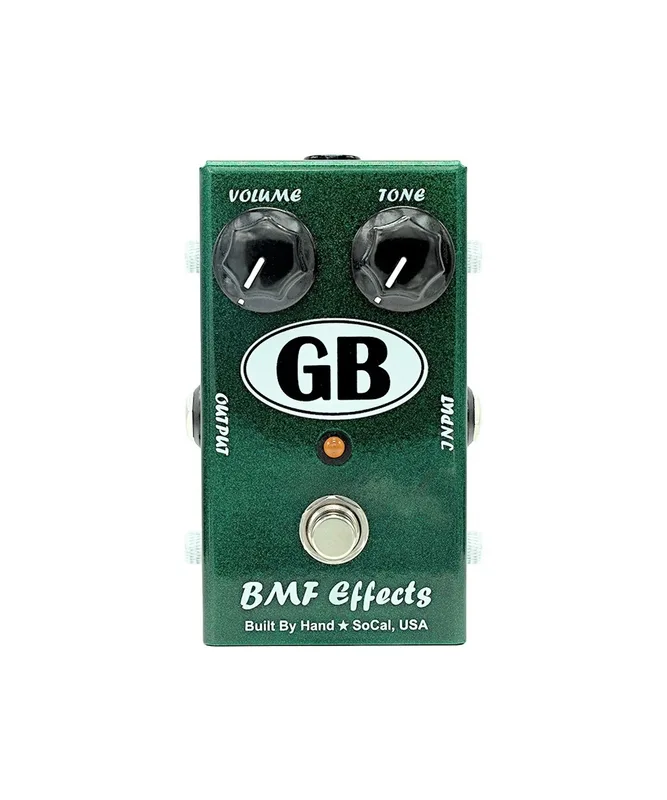


The GB Boost Germanium Booster from BMF Effects is a treble booster pedal built on the classic germanium-fueled treble boost design, with a tone knob added for more control over the boosted sound. BMF Effects describes it as "Not just another pretty-faced treble booster!"1
What it does to a signal
A treble booster lifts the upper frequencies of the guitar signal and pushes whatever comes after it, which is why the design has long been used to drive an amp into breakup. BMF Effects lays out three ways to put the GB Boost to work1:
- Before gain pedals, to create a second channel
- At the end of the signal chain, to push solos
- Straight into an amp on the verge of breaking up, for more drive
The added tone knob shapes the boosted sound further than the classic single-knob treble boost layout allows1.
Controls
| Control | What it does |
|---|---|
| Boost | Sets the amount of treble boost and level push1 |
| Tone | Shapes the boosted sound, beyond the classic single-knob treble boost layout1 |
Versions and power
The pedal is offered with a choice of germanium transistors, and BMF Effects notes that transistor options exist based on parts availability1.
| Version | Ground | What it means for power |
|---|---|---|
| NPN | Negative ground | Works with standard pedalboard supplies1 |
| PNP | Positive ground | Cannot share a standard daisy chain with negative ground pedals1 |
It runs on 9V DC through a DC jack and draws 1mA1.
The PNP version is positive ground. A positive ground pedal cannot share a standard daisy chain supply with negative ground pedals, so plan to power it from its own output.
The GB Boost was listed as sold out on the maker's product page as of 2026-10-26, with a stated lead time of 21 to 28 days1.
Related pedal
BMF Effects has listed the GB Boost as sold out on its own site, where the pedal carries a regular price of £159.00 GBP and dimensions of 2.9" W x 4.5" L (73.7mm x 114.3mm)1. For more pedals in the same family, see Boost Pedals.
Videos
Mike Hermans
roknfnrol
The Official BMF Effects Channel
Questions
Is the BMF Effects GB Boost true bypass?
Yes. BMF Effects states that the GB Boost features true bypass switching, so the pedal is removed from the signal path entirely when it is switched off. The pedal also has a DC jack for power alongside the switching.
What is the difference between the NPN and PNP versions?
The GB Boost is offered with a choice of NPN (negative ground) or PNP (positive ground) germanium transistors. The ground orientation matters for power: a positive ground pedal cannot share a standard daisy chain supply with negative ground pedals. BMF Effects notes that transistor options depend on parts availability.
What voltage does the GB Boost use?
The GB Boost operates on 9V DC, connected through a DC jack on the pedal. Because the PNP version is positive ground, it should be powered on its own rather than from a shared multi-pedal supply.
How much current does the GB Boost draw?
BMF Effects lists the current draw at 1mA, which is very low even by pedal standards. Any 9V DC supply rated well above that figure will run it.
Where does a treble booster go in the signal chain?
BMF Effects suggests several placements for the GB Boost: before gain pedals to create a second channel, at the end of the signal chain to push solos, or straight into an amp on the verge of breaking up for more drive. The right spot depends on what the player wants it to push.
Sources (1)
- GB Boost Germanium Booster, BMF Effects