| Type | Treble booster preamplifier1 |
| Maker | Dallas Musical Ltd., London, incorporated 19591 |
| Designed | 1965, by Ivor Arbiter and Barry Pyatt32 |
| Production | 1965 to 1969; quantity unknown14 |
| Status | Discontinued; originals regularly fetch over £10001 |
| Transistor | Mullard OC44 germanium PNP, long discontinued2 |
| Controls | Volume (Welwyn 10k ohm, sometimes 20k, potentiometer) and ON/OFF sliding switch2 |
| Power | 9V battery only, PNP positive ground27 |
| Voltage gain | 38dB2 |
The Dallas Rangemaster is a germanium treble booster, a small preamplifier built in England in the mid-1960s that lifts the signal strength of the guitar going into the amplifier and boosts the high harmonics on the way1. It was designed to solve a specific problem: British tube amplifiers such as the Vox AC30 or Marshall JTM45 tended to produce slightly dark, muddy tones when overdriven, and a treble booster in front of them restored bite2. Its most famous user was Eric Clapton, who ran one with John Mayall and the Bluesbreakers, where its biting, powerful sound is clearly in evidence on the "Beano" album, and who also used the booster when playing in Cream34.
The circuit itself is about as small as a guitar effect gets: a single germanium transistor and a few components, with a volume control and an on/off switch. That simplicity is why it became one of the most copied circuits in effects history, and why it is still a standard first build for DIYers and a template for commercial pedals more than sixty years after its mid-1960s release562.
Where the Rangemaster came from
The Rangemaster Treble Booster was first made in the 1960s by London company Dallas Musical Ltd., which was incorporated in 19591. GuitarPCB's technical analysis dates the design to 1965, designed in London by Dallas Musical Ltd2, while British Pedal Company's history describes the unit as born in the mid-1960s1. It was designed by Ivor Arbiter, the founder of Dallas Arbiter, together with Barry Pyatt3.
The unit gained notable recognition when Eric Clapton used it with John Mayall and the Bluesbreakers3. BSM's manual for its own Range Master-based booster notes that the British unit was produced between 1965 and 1969, and that Clapton also used the booster in Cream4. Another documented player is Tony Iommi, who Fuzzlord Effects describes as having used a modified Rangemaster8. Rory Gallagher is the other name permanently attached to the unit; British Pedal Company built its relic reissue to the specification of Rory's original Number 1 Rangemaster, with the Gallagher family's authorization9.
How many were built is unknown, and originals are now collector items. British Pedal Company says original examples regularly fetch over £10001; Analog Man reports them selling for thousands of dollars, and much more with the original box10.
A tabletop unit, not a pedal
The Rangemaster was not a pedal at all. It was a tabletop unit with an on/off switch and a volume knob10, a gray metal box designed to sit on top of the amp rather than on the floor as most pedals are today2. Its controls were a simple ON/OFF sliding switch and a potentiometer to adjust the volume2.
The original volume pot was a UK Welwyn 10k ohm unit, sometimes 20k, with two mounting screws and a bakelite body isolated from the chassis2. Among the British boosters of the era, the Rangemaster stood out for having that volume control at all: as General Guitar Gadgets notes, with the exception of the Rangemaster, none of these boosters had one7.
How it works: one germanium transistor and a small input capacitor
GuitarPCB's circuit analysis breaks the Rangemaster down as a typical common emitter amplifier using a bipolar junction transistor, with a voltage divider network setting a stable bias voltage at the transistor base11. The original germanium transistor was the Mullard OC44, long discontinued, and the circuit was built from the parts available in the 1960s, including carbon comp resistors2.
The defining component is the small input capacitor. C1 creates a high-pass filter with a corner frequency of about 2.6kHz, attenuating harmonics below that point2. That is what makes it a treble booster rather than a clean boost: the lows and low mids are rolled off before the gain stage, so what comes out is a thinner, brighter, hotter signal that pushes an amp's front end without flubbing the low end.
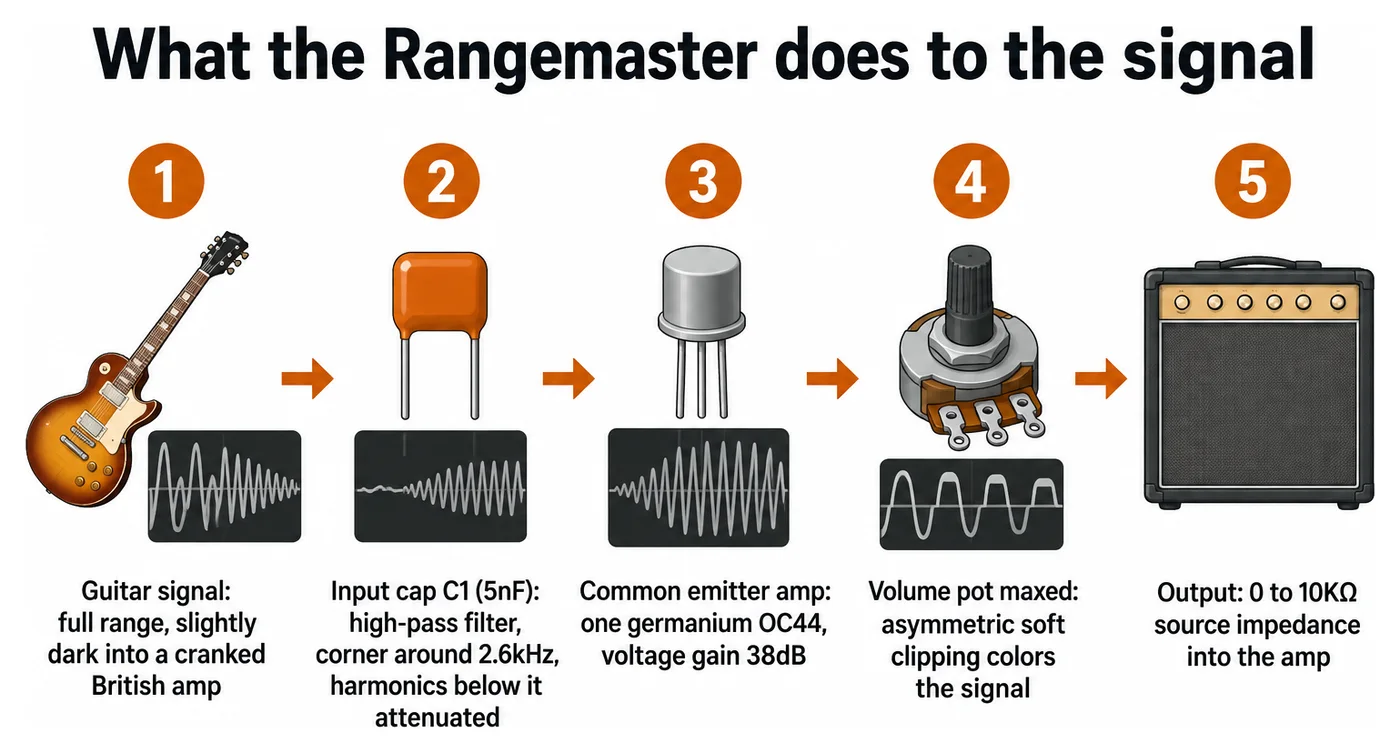
The measured numbers from GuitarPCB's analysis:
| Parameter | Value |
|---|---|
| Input impedance | 10KΩ to 12KΩ approx.2 |
| Output impedance | 0 to 10KΩ2 |
| Voltage gain | 80, or 38dB2 |
| High-pass corner | 2.6kHz2 |
That 38dB figure is worth context: GuitarPCB calls it a high voltage gain for a booster pedal, noting that similar pedals like the MXR MicroAmp have a lower voltage gain of 26dB2. The Rangemaster is not a subtle lift.
It is also not entirely clean. When the Vol control is maxed out, the signal is boosted and driven into soft clipping, which colors the sound; the analysis describes asymmetric soft clipping with the transistor biased off the middle of its swing area2. British Pedal Company's history makes the same point from the player's angle: the vintage components in the Rangemaster circuitry could add characteristic distortion and overtones that color the guitar sound, much in the way of more modern overdrive pedals1. KMA Audio Machines, whose Strokkur is an inspired take on the design, describes the original as known for its power and exploding harmonics when pushing a tube amp on the edge of breakup12.
Gain, bias and transistor selection
Because the circuit is one transistor, the transistor is most of the sound, and builders are picky about it. GuitarPCB's guidance is to find a germanium transistor with an HFE gain of 90, and that any value between 75 and 100 would be great2.
The OC44 itself has a specific story. R2R Electric's comparison of the OC44 against the AC107 explains that OC44s typically measured in the gain range and leakage that is ideal for the Rangemaster circuit, but that the transistor was mainly designed for oscillator and mixer use, not audio13. That happy accident is why the OC44 became the part to have, and why NOS examples command prices today.
Biasing is the other half of the job. It is commonly agreed that the ideal bias point is a Q1 collector voltage of -7.0V, with any value between -6.9 and -7.1 being great; referred to ground on the original supply, that is Vc = +2V, ideally between 1.9 and 2.1V2. General Guitar Gadgets' build document gives working voltages for its replica with a 9V supply: 9.2V at the supply, 7.2V at the Q1 collector and 0.7V at the emitter7.
| Measurement | Target value |
|---|---|
| Q1 collector voltage | -7.0V, or -6.9 to -7.12 |
| Same, referred to ground | +2V, or 1.9 to 2.12 |
| GGG replica, Q1 collector at 9V supply | 7.2V7 |
| GGG replica, Q1 emitter at 9V supply | 0.7V7 |
| Ideal transistor HFE | 90, or 75 to 1002 |
Power and grounding: positive ground, battery only
This is the part every Rangemaster builder has to understand before wiring anything. The original circuit is PNP positive ground: it sounds fantastic, but it works only on batteries, and an external DC adapter would create a short circuit2. The power supply section is simply a single 47uF capacitor, with no protection against reverse polarity connections2. BSM's manuals for its Range Master-based boosters carry the same warning in one line: the positive pole of the battery is ground4.
A positive-ground circuit cannot share a daisy chain with standard negative-ground pedals. Powering an original-style Rangemaster build from a shared supply shorts the supply. Battery only, or a charge pump, or an isolated output with the right polarity.
There are two ways around it, and builders disagree about how well they work:
- PNP negative ground mod: a modern mod that adapts the pedal to a standard daisy chain power supply, but GuitarPCB describes it as very prone to oscillations, hissing and motorboating noise, and does not recommend it2.
- Charge pump: a small converter that inverts the supply inside the pedal. General Guitar Gadgets offers this on its replica, where the addition of a charge pump on the input power gives the ability to daisy chain power to a PNP positive ground build7. GuitarPCB's Pump'd Up Rangemaster Plus includes a charge pump allowing a vintage PNP transistor to share power with standard negative-ground pedals14.
Pedals based on the Rangemaster
The Rangemaster's influence shows up across the whole booster market, in faithful replicas and in looser interpretations:
| Product | Maker | Relationship to the Rangemaster |
|---|---|---|
| Rory Gallagher Ltd Edition Relic Rangemaster | British Pedal Company | 1965 reissue pedal built to the spec of Rory's original Number 1 Rangemaster, family authorized9 |
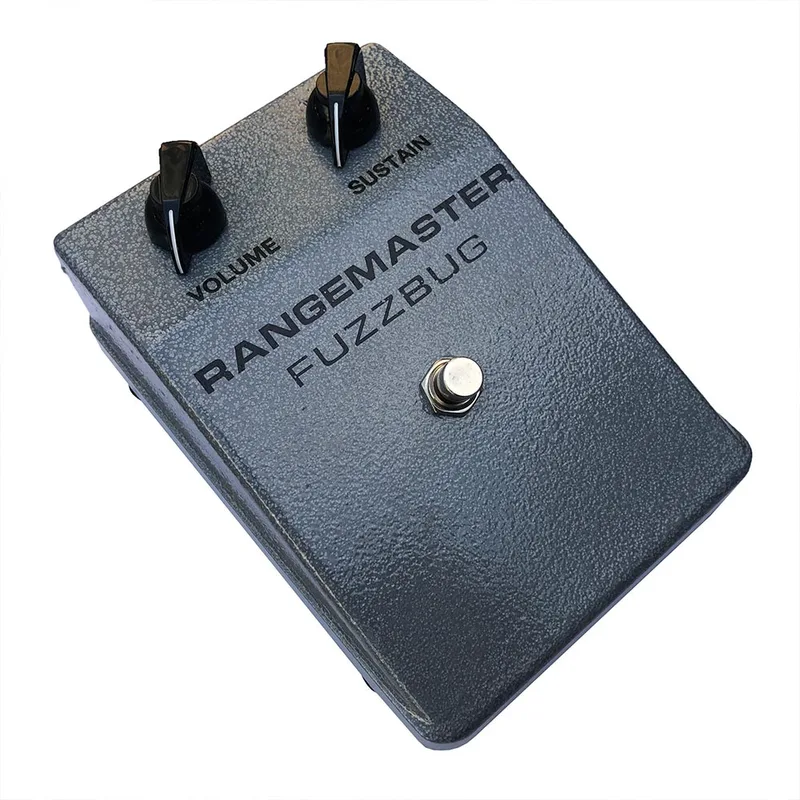
| Rangemaster Fuzzbug | British Pedal Company | Cast aluminum casing with two circuit variants, the MKI.5 two transistor circuit and the MKII three transistor circuit15 |
| R2RGeMaster | R2R Electric | Part for part build of an original Dallas Rangemaster16 |
| One Knob Treble Booster | R2R Electric | True to the original Dallas Rangemaster circuit16 |
| R2RGeMaster with Range control | R2R Electric | Dallas Rangemaster circuit modified with a "Range" control16 |
| Strokkur | KMA Audio Machines | Inspired take on the Dallas Arbiter Rangemaster12 |
| Riff Master OC44 | Fuzzlord Effects | Built around the OC44 as used in the original amp-top units from the 60s8 |
| Rangemaster Vip | RiverTronic | Clone of the Dallas Arbiter Rangemaster Treble Booster, 9V DC center negative17 |
The Rory Gallagher reissue is the closest thing to an official continuation: a pedal, not a tabletop box, with an ON/OFF switch, authorized by the Gallagher family and built to the specification of his original unit9. The Fuzzbug takes the circuit somewhere else entirely, pairing the Rangemaster name with Fuzz Face-style two and three transistor fuzz circuits in a cast aluminum casing15. At the faithful end, R2R Electric's Replica Series is a part for part build of an original, using what was used to build the Rangemaster in the 1960s16.
DIY kits and builds
The Rangemaster is a standard DIY project, and available kits and PCBs show how builders have solved the circuit's power problem in different ways18719:
- General Guitar Gadgets sells a replica kit and PCB project in PNP germanium, NPN germanium, and PNP with charge pump versions, running from a 9V battery or 9V power supply7. Their notes on transistor choice: germanium transistors have a bit more gritty sound, while silicon transistors offer a more stable, reliable sound7.
- GuitarPCB's Pump'd Up Rangemaster Plus (P.U.R.P.) is a DIY effects PCB based on the original treble booster, with Tonmann's modern design changes to the old circuit1118, and includes the charge pump for sharing power with negative-ground pedals14.
For a builder choosing a first version, the GGG kit's three variants map directly onto the power discussion above: the straight PNP version is the original sound with the original battery-only limitation, the NPN version flips the ground, and the charge pump version keeps the PNP transistor while fitting a modern pedalboard supply7.
Pedals on this page
News
Questions
What transistor is in a Rangemaster?
The original Dallas Rangemaster used a Mullard OC44 germanium PNP transistor, which has long been discontinued. GuitarPCB's analysis notes that the ideal HFE gain for the circuit is 90, and that anything between 75 and 100 works well. Modern builds either hunt for NOS OC44s, substitute other germanium types, or use silicon, which is more stable but grittier in the germanium version's case.
What did Eric Clapton use a Rangemaster for on the Beano album?
Clapton ran a Rangemaster into his amp with John Mayall and the Bluesbreakers, and its biting, powerful sound is clearly in evidence on the Beano album. The booster lifted the signal strength and the high harmonics going into a British tube amp being pushed hard, which sharpened a tone that could otherwise turn dark and muddy when overdriven. He also used the booster when playing in Cream.
Can I run a Rangemaster from a pedal power supply?
Not an original-style build. The original circuit is PNP positive ground and works only on batteries; GuitarPCB warns that an external DC adapter would create a short circuit. A negative-ground conversion exists but is described as very prone to oscillation, hissing and motorboating. The practical modern fix is a charge pump, which lets a PNP transistor share a standard negative-ground supply.
Is the Rangemaster true bypass?
No. The original unit was a tabletop box with a simple ON/OFF sliding switch and a volume potentiometer, made before true bypass switching existed as a concept. Players who want clean switching today typically put the booster in a true bypass looper, such as the units Loop-Master Pedals builds for exactly this kind of vintage effect.
What should the collector voltage be on a Rangemaster?
GuitarPCB's analysis states the commonly agreed ideal bias point is a Q1 collector voltage of -7.0V, with anything between -6.9 and -7.1 being great. Referred to ground on the original positive-ground supply, that is Vc = +2V, ideally between 1.9 and 2.1V. General Guitar Gadgets' build document shows 7.2V at the collector and 0.7V at the emitter from a 9V supply.
How much is an original Dallas Rangemaster worth?
Analog Man reports originals selling for thousands of dollars, and much more with the original box for collectors. British Pedal Company's history of the unit says production quantities are unknown and original examples regularly fetch over £1000. Either way, an original is a collector's purchase rather than a practical boost pedal.
What does changing the input capacitor do on a treble booster?
The small input capacitor forms a high-pass filter; in the original, the 5nF cap with the circuit's roughly 10 to 12KΩ input impedance gives a corner frequency around 2.6kHz, cutting harmonics below that point. Sources disagree on mod values: one technical analysis recommends starting between 5nF and 15nF, another says anything above 22nF turns it into more of a full range booster than a treble booster.
Sources (19)
- Dallas Rangemaster History, britishpedalcompany.com
- Dallas Rangemaster Treble Booster Analysis, GuitarPCB
- The Rangemaster, tru-fi.com
- Neutral_neu, treblebooster.net, 2025
- All about fuzz, overdrive, distortion and boost pedals | GuitarPlayer, GuitarPlayer (www.guitarplayer.com), 2026-06-22
- Chasing the Sound in Your Head with Cris Vincent - Premier Guitar, Premier Guitar, 2025-03-05
- Rangemaster™ Clone: Treble Booster Kit, PCB & Schematic, generalguitargadgets.com, 2014-05-12
- Riff Master OC44, Fuzzlord Effects, 2019-02-22
- Rory Gallagher Ltd Edition Relic Rangemaster, British Pedal Company
- aNaLoG.MaN Beano Boost treble booster effects pedal, aNaLoG.MaN (analogman.com), 2025
- Analysis-of-the-PURP.pdf, GuitarPCB, 2023
- Strokkur, KMA Audio Machines
- OC44 vs AC107, R2R Electric
- BD_PURP.pdf, GuitarPCB.com, 2023
- Rangemaster Fuzzbug MKI.5, britishpedalcompany.com
- Boost | R2R Electric, R2R Electric
- Rangemaster Vip by RiverTronic, RockBoard PedalPedia, 2026
- P.U.R.P - The Best Rangemaster PCB available! - GuitarPCB, GuitarPCB
- Range Master | DIY Guitar Effects Pedal Kits, Jed's Pedz (www.jedspeds.co.uk)