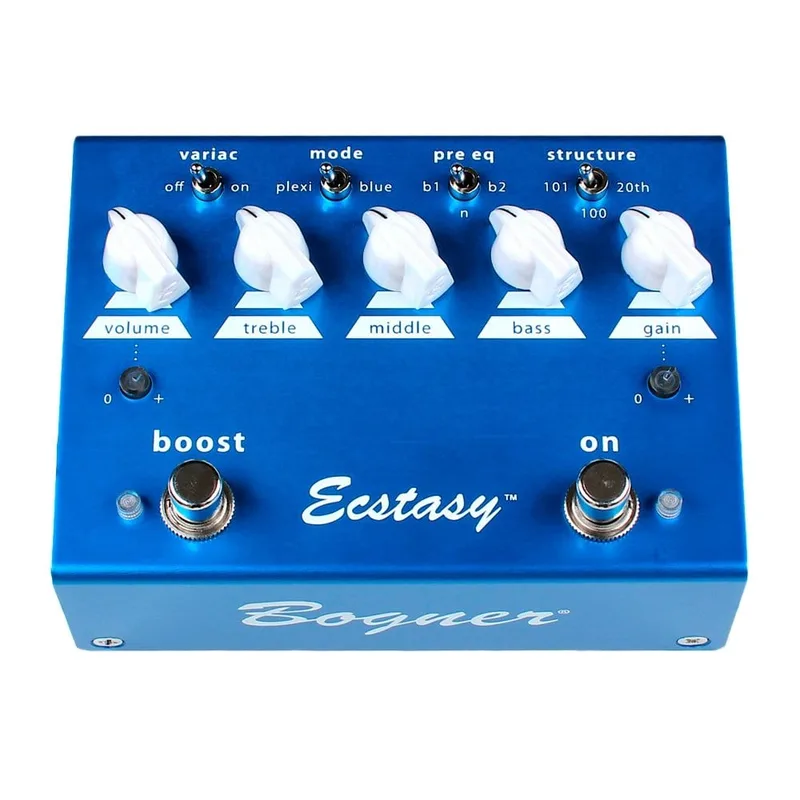


The Bogner Ecstasy Blue is an overdrive pedal from Bogner, the amplifier company founded by Reinhold Bogner. It came out in 2012 as one of a pair of pedals, alongside the Ecstasy Red, each based on a channel from Bogner's Ecstasy amplifier series: the Blue takes its character from the Ecstasy's blue channel123. Guitar World's Paul Riario reviewed it that year as part of the amp maker's then-new line of pedals4.
Premier Guitar's reviewer described what it does for a player: "The Ecstasy Blue excels at producing clear, harmonically rich clean tones, purring low-gain rhythms and biting classic-rock overdrive," with a three-dimensional tone and woody attack that stayed "astonishingly close to the full-size Ecstasy blue channel"1.
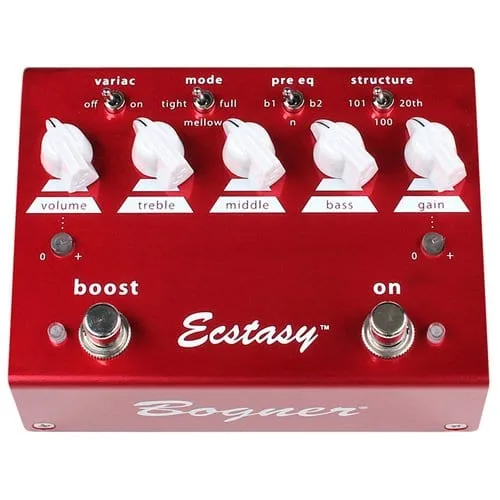
The controls and footswitches
The pedal keeps its control panel familiar to anyone who has used an amp. There are knobs for volume, gain, treble, mids, and bass, which handle the majority of tone-shaping tasks1. A mode switch flips between lower (plexi) and higher (blues) gain modes on the Ecstasy Blue1.
Two footswitches run the show: a true bypass on/off switch and a second switch operating a boost7. The boost mode carries two presets for gain and volume7.
| Control | What it does |
|---|---|
| Volume, gain | Set the overall level and amount of drive1 |
| Treble, mids, bass | The main tone-shaping knobs1 |
| Mode switch | Flips between lower (plexi) and higher (blues) gain modes1 |
| On/off footswitch | True bypass switching7 |
| Boost footswitch | Engages the boost mode, with two presets for gain and volume7 |
Besides the input and output, there is a third jack for remote switching of both functions, so the pedal can be run from a remote switching unit on a larger board7.
Inside the pedal: an analog class A circuit
The Ecstasy Blue is an analog design, and its approach to overdrive is unusual. Premier Guitar notes that the Ecstasy pedals both use class A circuits that eschew diodes or op-amps for overdrive clipping1. In other words, the drive comes from the circuit itself rather than from clipping diodes, the approach most overdrive pedals take.
MusicRadar's review team found the build to match the price. The electronics sit on two high-quality printed circuit boards with gold-plated tracks, using a mix of surface-mount and miniature components, with portions potted in epoxy7. Each board is populated with select components, including Japanese Nichicon and German WIMI capacitors, gold-plated relays, and Carling switches for true bypassing and boosting1.
The enclosure is a tough two-piece aluminum clamshell box fastened by four machine screws7. Power comes from a regular nine-volt DC supply through an external mains connector, and a PP3 battery sits behind a small aluminum flap fastened by a large-slotted machine screw7.
The Blue and the Red
The two 2012 pedals divide the Ecstasy's channels between them. Gearnews describes the Blue as slightly cooler and more crunchy than its sibling, with the Red as the higher-gain option3. Both were modeled on real channels from Reinhold Bogner's own amps, boutique hybrids of classic Plexi-style circuits3.
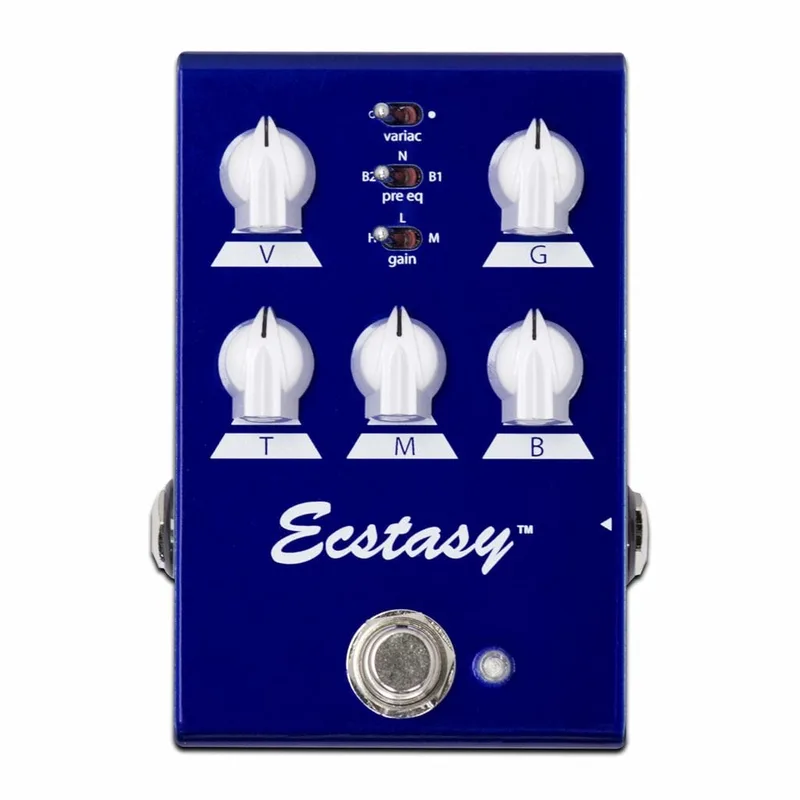
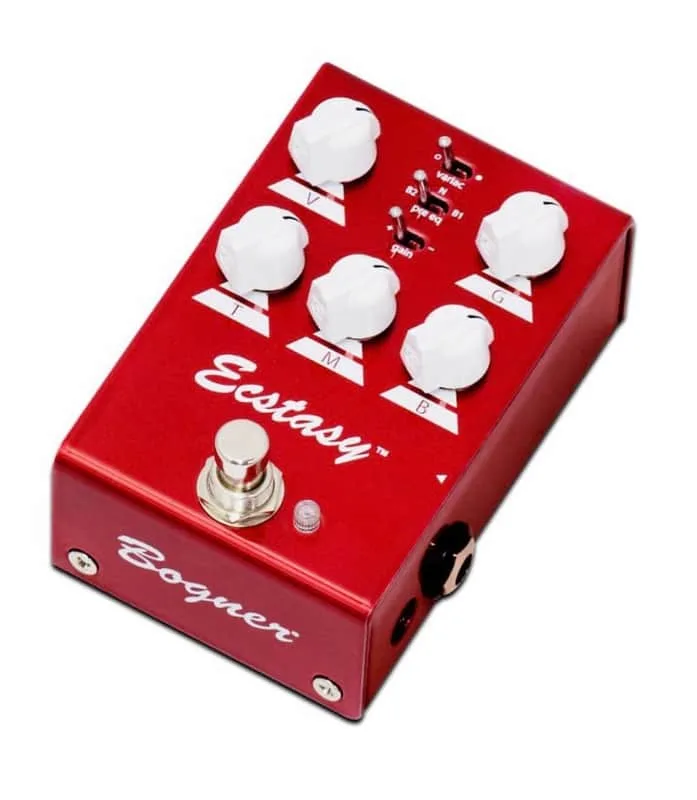
In 2018 Bogner scaled the pair down. The Ecstasy Blue Mini and Mini Ecstasy Red reportedly kept the same circuits as the originals in a smaller box, minus the Boost switch found on the full-size pedals8. Two Minis fit in the space of one previous full-size Ecstasy pedal, as Bogner's own staff demonstrated at Winter NAMM 20189. The Minis added their own switching: a Variac on/off switch that adds a "dropped voltage" dynamic compression to the feel and sound, a pre-EQ switch with B1, N and B2 settings controlling "openness" and the presence of higher range harmonics, and a Plexi/Blue mode switch for vintage lower-gain or modified higher-gain levels2.
If you want the boost function, you need the full-size pedal. The Mini versions drop the Boost switch; everything else is reportedly the same98.
What reviewers said
Premier Guitar's 2026 review was enthusiastic about both the sound and the flexibility, with one reservation1:
"Sounds authentically like the actual Ecstasy blue channel. Three modes sound and feel like three different amps."1
Premier Guitar, September 20261
The same review found the variable boosting super-useful, but noted that the boosts can't be set to cut gain and volume individually1. MusicRadar's review team highlighted the two boost presets for gain and volume that operate in the boost mode7.
On the Mini, Premier Guitar's earlier quick-hit review found it versatile enough for honky-tonk and blues styles at low gain: "I could totally use this on anything from a honky-tonk gig to the Wednesday night blues jam"6. In Sweetwater's Winter NAMM demo, Mitch Gallagher's view was that "they sound great" and that the small board footprint is a big plus9. Guitar Pedal X's Stefan Karlsson later called the Blue variety great in both original and Mini editions10.
Gearnews' Jef, writing as an owner of the Red, called it a very good distortion pedal, so good that he uses it instead of actual amp gain on many occasions3, which speaks to how the family as a whole is used.
Videos
bogneramplification
intheblues
GoGuitarLive
Questions
Is the Bogner Ecstasy Blue true bypass?
Yes. The pedal has a true bypass on/off footswitch, and the switching is handled by gold-plated relays with Carling switches for bypassing and boosting. The smaller Ecstasy Blue Mini is true bypass as well.
What is the difference between the Ecstasy Blue and the Ecstasy Red?
Both pedals came out in 2012 and each is based on a different channel of the Ecstasy amplifier series. The Blue is the cooler, crunchier of the two, aimed at lower-gain classic-rock territory, while the Red is the higher-gain counterpart. Premier Guitar's reviewer found the Blue's three modes sound and feel like three different amps.
How do the boost presets work on the Ecstasy Blue?
A second footswitch operates a boost mode with two presets for gain and volume. The variable boosting is useful, though MusicRadar noted the boosts cannot be set to cut gain and volume individually, so you set one preset combination rather than trimming each control separately.
Can you switch the Ecstasy Blue remotely?
Yes. Besides the input and output jacks there is a third jack for remote switching of both the on/off and boost functions, so the pedal can be integrated with a remote switching unit on a larger board.
Sources (10)
- Bogner Ecstasy Blue & Red Overdrive Pedal Reviews, Premier Guitar, 2013-03-06
- Bogner distills the Ecstasy into Red and Blue Mini pedals, MusicRadar, 2018-11-14
- Bogner Ecstasy Red and Blue Mini pedals: Smaller size, same boutique tone?, gearnews.com, 2018-11-15
- Review: Bogner Ecstasy Blue and Red Preamp Pedals, Guitar World, 2013-04-25
- Bogner Unveils Ecstasy Red and Blue Mini Pedals, Guitar World, 2018-11-14
- Quick Hit: Bogner Ecstasy Blue Mini Review, Premier Guitar, 2019-02-03
- Bogner Ecstasy Blue pedal review, MusicRadar, 2013-03-26
- NAMM 2018: Bogner Mini Ecstasy Red & Blue Overdrive Pedals, gearnews.com, 2018-01-30
- Bogner Mini Ecstasy Red & Blue Overdrive Pedals at Winter NAMM 2018, Sweetwater, 2018-01-27
- Guitar Pedal X, Guitar Pedal X, 2020-04-12
 Justin Derrico