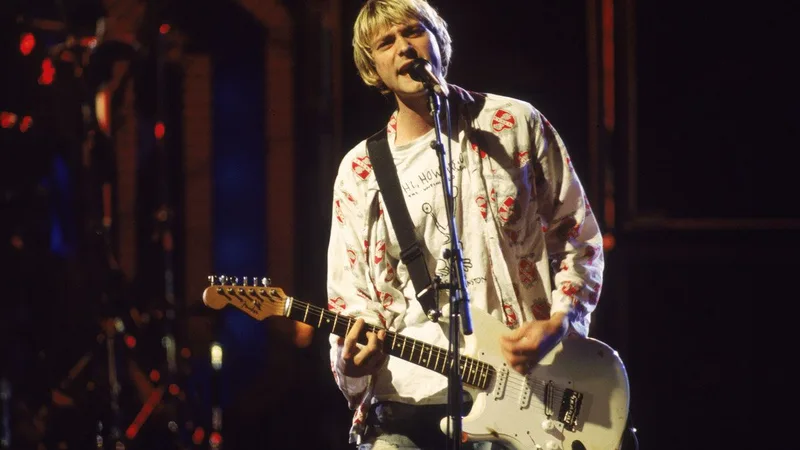
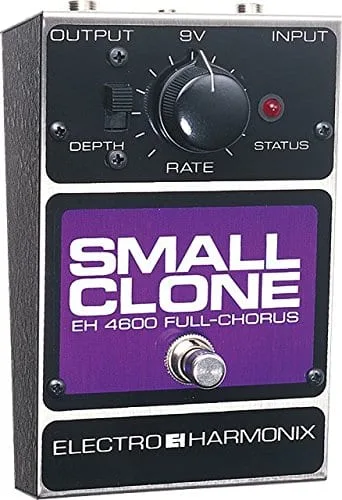
Kurt Cobain, the late Nirvana frontman, built one of the most widely copied guitar tones of the 1990s with remarkably little gear. Across Nirvana's recordings his distortion came from a Boss DS-1 and later a Boss DS-2, and his chorus from an Electro-Harmonix Small Clone, cheap compact pedals run into modest amps. Guitar World describes the DS-1 as "used on most Nirvana tracks and was a mainstay of Cobain's tone"1.
Nevermind: Boss DS-1 and Small Clone
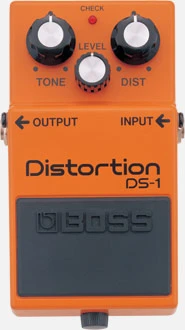
For Nirvana's 1991 breakthrough album Nevermind, Cobain's core pedal pairing was the Boss DS-1 Distortion and the Electro-Harmonix Small Clone. Producer Butch Vig's account of the sessions, relayed in Guitar.com's rig rundown, is direct: "we know Cobain used a DS-1 Distortion and Small Clone"3. Dave Hunter, writing in Guitar Player, points to the DS-1 on the album's biggest single: "An iconic example of distortion can be heard on Nirvana's 'Smells Like Teen Spirit,' where Kurt Cobain used a Boss" DS-17. A ProCo RAT distortion pedal was also allegedly used on some songs on the album3.
The Small Clone carried the chorus side of the record. Mike at aNaLoG.MaN, whose product page documents the pedal's history, says Cobain "used the small clone for the chorus effects on Nevermind and Aneurysm," the latter recorded in 1990 and later the b-side of "Smells Like Teen Spirit"4. Aion FX notes the Small Clone "was most famously used by Kurt Cobain on 'Come As You Are' as well as several other tracks on Nevermind"8. EarthQuaker Devices' Dan Epstein puts the album's influence in perspective:
"Nevermind, Nirvana's breakthrough 1991 album, was positively awash in chorus effects, and sent a whole generation of budding guitarists scrambling to their local guitar shops in order to try and replicate the wobbling, watery sounds they heard on tracks like 'Smells Like Teen Spirit' and 'Come As You Are.'"
One setting detail survives: Cobain "pretty much permanently had the Small Clone Depth slider in the Upper / High position," according to Guitar Pedal X's Stefan Karlsson5.
The amps behind the pedals were as modest as the pedals themselves. In the studio, Vig recalls, "Kurt had a Mesa/Boogie, but we also used a Fender Bassman"3. On the tour that followed, Cobain used a Mesa/Boogie Studio preamp with a Crown power amp through Marshall 4x12 cabinets3, and MusicRadar reports he "reportedly turned the midrange up substantially on his Mesa preamps"10.
His primary studio guitars for the album were a 1969 Lake Placid Blue Competition Fender Mustang and a 1965 sunburst Fender Jaguar3. For the album's closing track, "Endless Nameless," he used a black Strat with a full-sized black humbucker in the bridge3.
| Era | Distortion | Chorus | Notes |
|---|---|---|---|
| Bleach period | Boss DS-1 | Used prolifically around this period10 | |
| Nevermind (1991) | Boss DS-1, ProCo RAT on some songs | Small Clone | Mesa/Boogie and Fender Bassman amps3 |
| After Nevermind | Alternating DS-1 and DS-2 | Small Clone | DS-2 from In Utero on210 |
In Utero and MTV Unplugged: DS-2 into Small Clone
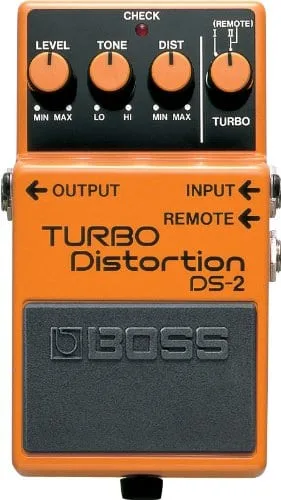
From In Utero onward, Cobain moved to the Boss DS-2 Turbo Distortion while keeping the Small Clone. Rhett Shull, in his review video on the DS-1, puts the switch simply: "Kurt Cobain used this from in utero on when you listen to never mind he's using one of these older DS ones"2. Guitar World's Alex Lynham notes the connection between the two, describing "the tone of players like Kurt Cobain that had owned and used 1980s units" of the DS-111. MusicRadar's history of the pedal records that Cobain was "known for prolifically using the pedal around the period of Bleach and then alternating between DS-1 and DS-2 thereafter"10.
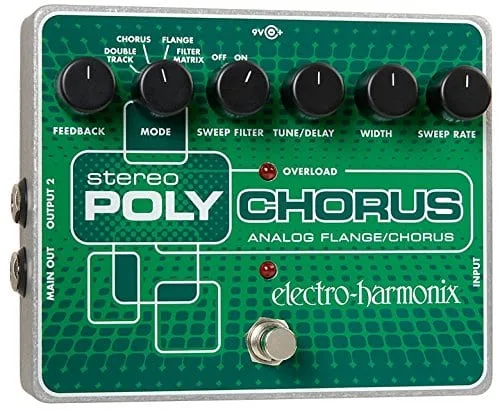
The Small Clone stayed in the chain throughout. aNaLoG.MaN reports that Cobain "began using the Small clone for solos like School, About a Girl, In Bloom, Serve the Servants, etc"4. He also used an Electro-Harmonix Stereo Polychorus, a reissue of the classic flanger/chorus pedal, as reviewed by Barry Rudolph12.
For Nirvana's MTV Unplugged in New York, recorded in 1993 and released as an album in November 1994, the rig barely changed. Guitar.com's rundown of the show, drawing on tech Earnie Bailey's account, reports that "Cobain also used a DS-2 distortion pedal and Electro-Harmonix" Small Clone6. aNaLoG.MaN summarizes the whole chain in one line: "His chain then simply went Guitar - DS2 - Small Clone - Amp. Used on Unplugged too"4.
The guitar was different. Cobain played a newly acquired 1959 Martin D-18E for the duration of the show, "which was actually a very rare guitar, only 300 of them are said to have been made"6. That guitar sold at auction in 2020 for over six million dollars, the most expensive guitar ever sold. On the amplification side, he "was insistent on running his acoustic through his Fender Twin Reverb, which" he essentially used as a monitor for himself6.
The Unplugged rig was not an acoustic-specialist setup. Cobain ran his 1959 Martin D-18E through the same DS-2 and Small Clone pairing as his electric rig, into a Fender Twin Reverb he treated as a personal monitor46.
The signal chain, era by era
Cobain's signal chain stayed short across Nirvana's career, which is a large part of why players copy it with two or three used pedals. In the In Utero and Unplugged era it was, in aNaLoG.MaN's words, "Guitar - DS2 - Small Clone - Amp"4. In the Nevermind era the same slots were filled by the DS-1 and Small Clone3, with a ProCo RAT appearing on some songs3. Guitar World has also highlighted how affordable the setup was, reporting on a Reverb video covering "five of the cheapest pedals from Kurt Cobain's setup and how he used them to craft the band's songs," all under $80 on Reverb at the time13.
A few details round out the picture of how he voiced the rig. Beyond the reported midrange boost on his Mesa preamps10, the Small Clone's depth switch parked in the upper position5 is the one control setting consistently reported, and it is the setting players copying "Come As You Are" reach for first.
Questions
What chorus pedal did Kurt Cobain use?
The Electro-Harmonix Small Clone. He used it for the chorus effects on Nevermind and Aneurysm, and later for solos on songs like School, About a Girl, In Bloom and Serve the Servants. He pretty much permanently kept the depth switch in the upper, or high, position. He also used an Electro-Harmonix Stereo Polychorus, a flanger and chorus pedal.
What distortion pedal did Kurt Cobain use on Nevermind?
A Boss DS-1 Distortion, confirmed by producer Butch Vig's account of the sessions. A ProCo RAT was also allegedly used on some songs on the album. He used the DS-1 prolifically around the Bleach period, then alternated between the DS-1 and the Boss DS-2 from In Utero onward.
What was Kurt Cobain's signal chain?
In the In Utero era it simply went guitar, Boss DS-2, Electro-Harmonix Small Clone, amp. On the Nevermind tour he used a Mesa/Boogie Studio preamp with a Crown power amp through Marshall 4x12 cabinets, reportedly with the midrange turned up substantially on the Mesa preamp. In the studio he also used a Fender Bassman.
What effects were used on Nirvana's MTV Unplugged?
A Boss DS-2 distortion pedal and an Electro-Harmonix Small Clone chorus, the same pairing as his In Utero era rig, with the chain running guitar, DS-2, Small Clone, amp. He ran his acoustic through a Fender Twin Reverb, essentially using it as a monitor for himself.
What guitar did Kurt Cobain play on MTV Unplugged?
A 1959 Martin D-18E, newly acquired at the time, and a very rare guitar with only about 300 said to have been made. He played it for the duration of the show. In 2020 it sold at auction for over six million dollars, the most expensive guitar ever sold.
What chorus pedal did Kurt Cobain use?
Kurt Cobain used the Electro-Harmonix Small Clone. He used it for the chorus effects on Nevermind and on Aneurysm, and later for solos on songs like School, About a Girl, In Bloom and Serve the Servants. He pretty much permanently kept the Small Clone's depth switch in the upper, or high, position. He also used an Electro-Harmonix Stereo Polychorus, a flanger and chorus pedal.
What distortion pedal did Kurt Cobain use on Nevermind?
On Nevermind, Kurt Cobain used a Boss DS-1 Distortion, the orange Boss compact pedal. Producer Butch Vig has confirmed the DS-1 and the Small Clone chorus were part of the recording setup. A ProCo RAT distortion pedal was also allegedly used on some songs on the album. From In Utero onward he switched to the Boss DS-2 Turbo Distortion.
What was Kurt Cobain's signal chain?
In the In Utero era, his chain simply went guitar, Boss DS-2, Electro-Harmonix Small Clone, amp. On the Nevermind tour he used a Mesa/Boogie Studio preamp with a Crown power amp through Marshall 4x12 cabinets, and he reportedly turned the midrange up substantially on his Mesa preamps. In the studio on Nevermind he also used a Mesa/Boogie amp and a Fender Bassman.
What effects were used on Nirvana's MTV Unplugged?
Kurt Cobain used a Boss DS-2 distortion pedal and an Electro-Harmonix Small Clone chorus on MTV Unplugged in New York, the same pairing as his In Utero era rig. His chain went guitar, DS-2, Small Clone, amp. He ran his acoustic guitar through a Fender Twin Reverb, essentially using it as a monitor for himself.
What guitar did Kurt Cobain play on MTV Unplugged?
Kurt Cobain played a 1959 Martin D-18E for the duration of the MTV Unplugged show, a guitar he had newly acquired. It was a very rare model, with only about 300 said to have been made. That same guitar later sold at auction in 2020 for over six million dollars, making it the most expensive guitar ever sold.
Sources (13)
- Best distortion pedals: Our top high-gain stompboxes, Guitar World, 2022-06-09
- This Is WAY Better Than The Tubescreamer (The Boss DS-1 Sound), YouTube (Rhett Shull channel), 2022-11-15
- The Humble Gear Used By Kurt Cobain on Nirvana’s ‘Nevermind’, Guitar.com, 2024-01-09
- Analog Man Chorus Pedals, aNaLoG.MaN (analogman.com), 2026
- Guitar Pedal X, Guitar Pedal X, 2024-10-25
- The Gear Used on Nirvana’s MTV Unplugged in New York album, Guitar.com, 2025-02-04
- All about fuzz, overdrive, distortion and boost pedals, GuitarPlayer (www.guitarplayer.com), 2026-06-22
- Lithium Analog Chorus / EHX Small Clone, Aion FX, 2022-09-24
- How Aurelius Can Help You Sound Like Five Classic Songs, EarthQuaker Devices, 2023-04-25
- The FX files: Boss DS-1, MusicRadar, 2018-11-16
- Boss DS-1 vs Boss DS-2: What's the difference?, Guitar World, 2023-08-11
- Stereo Polychorus from Electro-Harmonix, barryrudolph.com, 2021
- How to Get Nirvana's Guitar Tones with Five Cheap Pedals, Guitar World, 2018-02-20