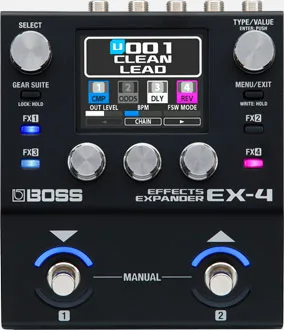


The Boss EX-4 Effects Expander is a compact multi-effects pedal from Boss, announced in late September 2026 and described by the maker as a compact effects processor designed to expand the sonic range of any pedalboard1. Instead of replacing your board, it slots into it: it runs up to four effects at once from a library of 120 Boss effects, including multiple instances of the same effect, and offers mono or stereo connectivity through four audio jacks, two of which can double as an effects send and return12.
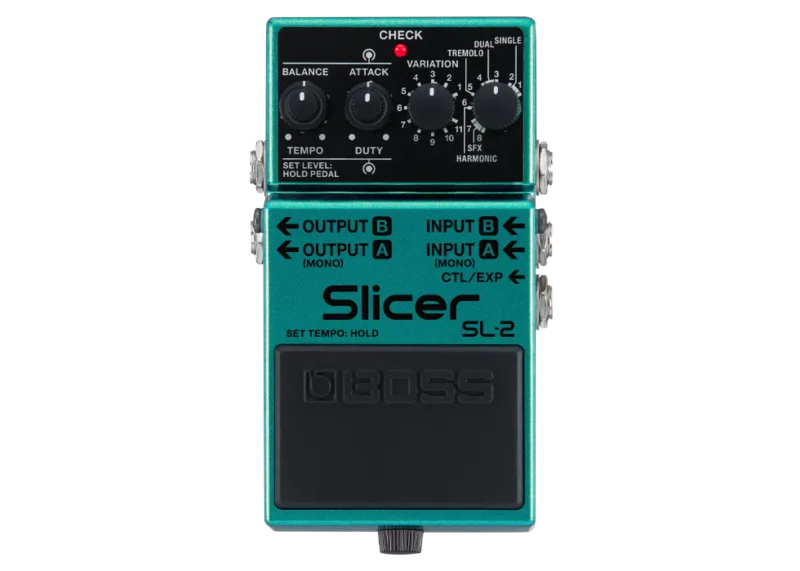
The library covers every major category: overdrive and distortion, modulation, delay and reverb, plus bass-tuned effects and Boss favorites like Slow Gear and Slicer1. Boss says the effects are drawn from its GX series of multi-effects, classic stompboxes and discontinued units like the SG-1 Slow-Gear, according to Guitar World's review3. It is built into the Boss 200 series enclosure, the same housing used across Boss's compact 200-series line4.
What it does
The EX-4 runs up to four simultaneous effects from its 120-effect library, and you can load the same effect into more than one slot12. On top of the four effect slots, Guitar Pedal X's spec listing counts six additional utility blocks: divider/mixer, send/return, foot volume, two noise suppressors and a global EQ, for a maximum of 4 FX plus 6 utility blocks5. Boss says these utility blocks can be placed anywhere within an effect chain1.
Routing is flexible. Guitar.com's review found the four effects can run in old-fashioned serial, as two separate serial chains of one, two or three pedals each, or in three different types of parallel routing4. The unit also has Manual and Memory modes, for stompbox-style or preset-based control, and edited parameters and favorites can be saved in user locations16.
The controls: FX buttons, footswitches and display
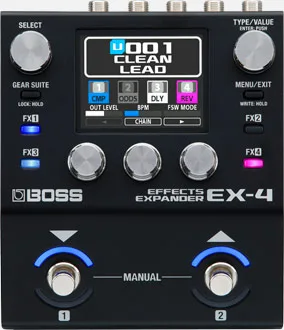
Four dedicated FX buttons sit at the center of the interface. A single press turns an effect block on or off, and a long press accesses that block's editing parameters16. The button colors change dynamically to match each effect's colors on the display, which Boss and Premier Guitar both describe as making blocks easy to identify at a glance176.
The display itself is a full-color 2.4-inch screen showing the complete effect signal chain, individual effect blocks, editing options and menus1. MusicRadar's Jonathan Horsley called it "a full-colour 2.4" LCD display to make your edits easy"8.
| Control | What it does |
|---|---|
| FX buttons (x4) | Single press: effect block on/off. Long press: edit that block's parameters. Button color matches the effect's display color16 |
| Footswitches (x2) | Multi-function, with color LEDs; custom-configurable system-wide or per memory19 |
| Display | Full-color 2.4-inch screen showing the signal chain, effect blocks, editing options and menus1 |
The two footswitches are rugged dual-function units that can be custom-configured either system-wide or per memory1. Guitar World lists example assignments: effect block on/off, memory up/down, master bypass and tap tempo, among others10. Boss also notes that two external footswitches or an expression pedal can be connected for more real-time control1.
Connections, MIDI and the effects loop
The four audio jacks provide mono or stereo connectivity, with the option to use two of them as an effects loop1. Guitar.com's reviewer put it plainly: "you get stereo ins and outs (half of which can double as effects send and return)"4. That means other pedals on your board can be inserted into the EX-4's chain, and the dedicated send/return utility block can be positioned anywhere in that chain15.
For larger rigs, the EX-4 carries low-profile TRS MIDI I/O, which Boss says "unlocks deep integration with other MIDI pedals, switching systems, and external clocking devices"1. There is also a USB Type-C port5.
Power and digital architecture
The EX-4 runs on 9V DC through a DC input jack, and Boss ships it with a PSA-S series AC adaptor54. If you power it from a pedalboard supply instead, Guitar.com's reviewer cautions that "you'll need to make sure you have at least 300mA of juice on tap"4.
With a stated need for at least 300 mA, the EX-4 is a heavier draw than most compact analog stompboxes. Plan a dedicated isolated output rather than a shared daisy-chain tap4.
Internally it is a digital processor with no analog dry-through: the core signal passes through AD and DA conversion5. Guitar Pedal X's spec listing gives the details5:
| Specification | Value |
|---|---|
| Sampling frequency | 48 kHz |
| AD conversion | 24 bits + AF method (Adaptive Focus method) |
| DA conversion | 32 bits |
| Processing | 32-bit floating point |
| Input impedance | 1 M ohm (INPUT L/MONO, INPUT R/RETURN) |
| Nominal input level | -10 dBu |
| Maximum input level | +7 dBu |
| Output impedance | 1 k ohm (OUTPUT L/MONO, OUTPUT R/SEND) |
| Recommended load impedance | 10 k ohms or greater |
| Dimensions | 117 (W) x 138 (D) x 63 (H) mm, 4-5/8 (W) x 5-7/16 (D) x 2-1/2 (H) inches without rubber feet |
| Weight | 800 g / 1 lb 13 oz |
Where it came from and how it compares
Boss announced the EX-4 on September 24 to 25, 2026, with availability from October 2026 at $299.99110. Later reviews list it at $329, so reported pricing varies between sources43. Guitar Pedal X reported it should be available at most international Boss dealers around late September 20265.
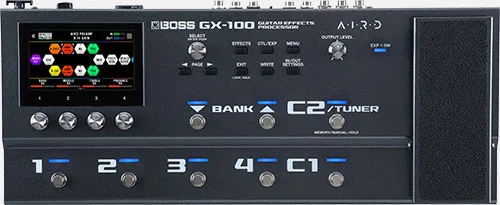
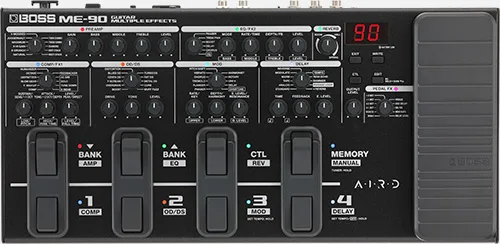
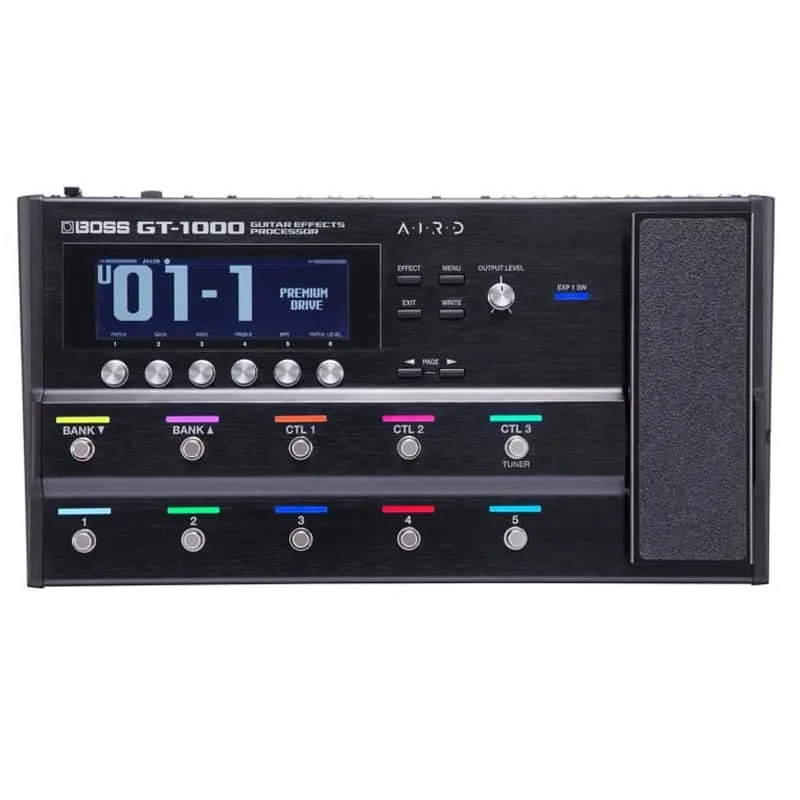
Its effect library is compiled from the GX series of multi-effects, some classic stompboxes and discontinued units like the SG-1 Slow-Gear, according to Guitar World's Lucy Robinson3. Guitar Pedal X's Stefan Karlsson also sees a conceptual influence from the Fractal VP4, which likewise runs four stereo effects at a time from a larger library of about 400 effects at $7005. For players comparing Boss's own range, the EX-4 sits apart from floor processors like the ME-90 and GT-1000 by being built specifically to expand an existing pedalboard rather than replace it1.
What reviewers said
Early coverage was positive about the concept and the sound count. Guitar World's news piece quoted the EX-4 as "an essential toolbox," continuing: "Offering a large selection of classic Boss effects in a space-saving design, there's no better utility pedal than the EX-4"10. Guitar.com's review listed among its pluses a "good variety of onboard sounds, including loads of classic Boss pedals," while also noting the 200-series enclosure is compact "but not that compact"4. Guitar Pedal X called it "a fantastic intuitive Multi-FX Pedal" delivering four stereo effects at a time5.
"Offering a large selection of classic Boss effects in a space-saving design, there's no better utility pedal than the EX-4. It's an essential toolbox."
Videos
Pete Thorn
BOSSchannel
BOSSchannel
News
Questions
How much current does the Boss EX-4 need?
Guitar.com's reviewer notes you need at least 300 mA available from a pedalboard power supply to run it. It takes 9V DC at a center-negative-style DC input jack and ships with a Boss PSA-S series AC adaptor in the box, so it can run straight out of the package without drawing from your board.
Does the EX-4 have MIDI?
Yes. It carries low-profile TRS MIDI I/O, which Boss positions for integration with other MIDI pedals, switching systems and external clocking devices. That means it can sit in a larger MIDI-controlled rig rather than only working as a standalone stompbox on a pedalboard.
Can the EX-4 be used as an effects loop?
Yes. Two of its four audio jacks can serve as an effects send and return, so other pedals on your board can be inserted into the EX-4's signal chain. It also has a dedicated send/return utility block that can be placed anywhere in the chain.
Does the Boss EX-4 have an analog dry-through?
No. Guitar Pedal X's spec listing states there is no analog dry-through and that the core signal goes through AD and DA conversion. The dry path is processed digitally, like the rest of the signal.
How many effects are on the EX-4?
It carries 120 Boss effects covering overdrive and distortion, modulation, delay and reverb, plus bass-tuned effects and Boss favorites like Slow Gear and Slicer. You can run up to four at once, including multiple copies of the same effect, alongside six utility blocks.
When was the Boss EX-4 released?
Boss announced it in late September 2026 and said it would be available in October 2026 for $299.99. Some later reviews list it at $329, so street pricing reported by sources varies. It was reaching international Boss dealers around late September 2026.
Sources (10)
- BOSS Announces The EX-4 Effects Expander, Sonic State, 2026-09-25
- BOSS - EX-4 | Effects Expander, BOSS (www.boss.info)
- Boss EX-4 Effects Expander review, Guitar World, 2026-10-23
- Boss EX-4 Effects Expander review, Guitar.com
- Guitar Pedal X, Guitar Pedal X, 2026-09-24
- BOSS Releases EX-4 Effects Expander, Premier Guitar, 2026-09-24
- BOSS - EX-4 | Effects Expander, BOSS (boss.info)
- Boss launches the EX-4 Effects Expander, MusicRadar, 2026-09-24
- BOSS - EX-4 | Effects Expander, BOSS (boss.info)
- Boss debuts EX-4 Effects Expander: the ultimate pedalboard space saver?, Guitar World, 2026-09-24