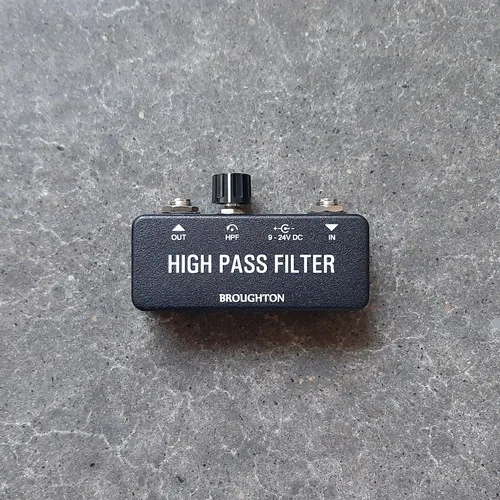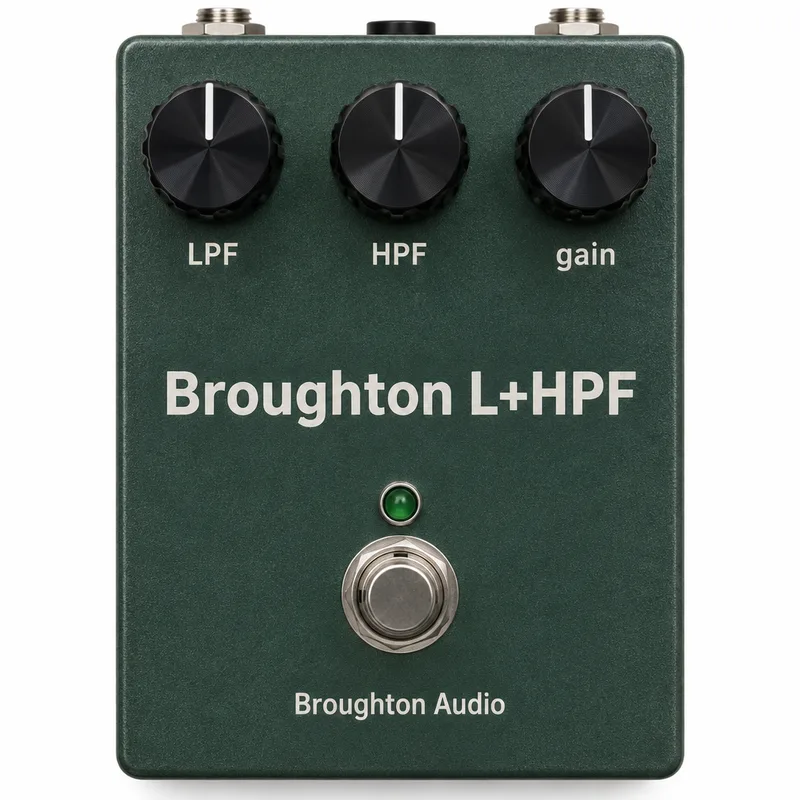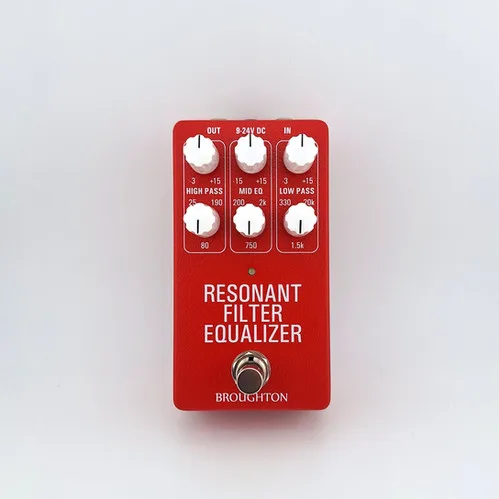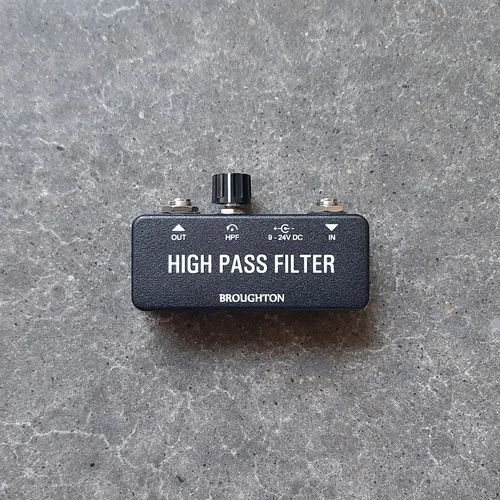
The Broughton Audio High Pass Filter is a compact utility pedal for cleaning up the low end of a guitar or bass signal. It is a 12 dB per octave low frequency filter: everything below the cutoff point you set is rolled off, while everything above it passes through untouched. Broughton Audio describes it as "the perfect utility pedal for cleaning up the low end"1.
For a bass player, that means removing subsonic content that eats amp headroom and muddies a mix without touching the fundamentals you actually play. For a guitar player, it clears out rumble below the instrument's range. The single knob sweeps the cutoff continuously from 25 Hz to 190 Hz, so you can set it anywhere from a gentle subsonic cut to a tighter roll-off that thins the bottom of the tone1.
What a high pass filter does to your sound
A high pass filter is the mirror image of a low pass filter: instead of trimming the treble, it trims the bass. The Broughton High Pass Filter cuts at a slope of 12 dB per octave, which means the signal is attenuated by 12 dB for every octave you go below the cutoff frequency. Broughton Audio describes it as a utility pedal for cleaning up the low end1.
The practical uses are straightforward:
- Removing subsonic rumble and stage noise that a bass amp would otherwise reproduce
- Freeing up headroom in an amp or PA by cutting frequencies below the instrument's range
- Tightening a bass tone by rolling off the lowest content
- Cleaning up a signal before it hits overdrive or distortion pedals, where low content can cause flubby low-end response
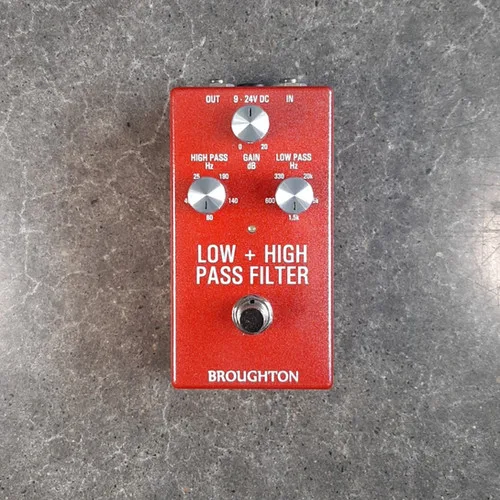
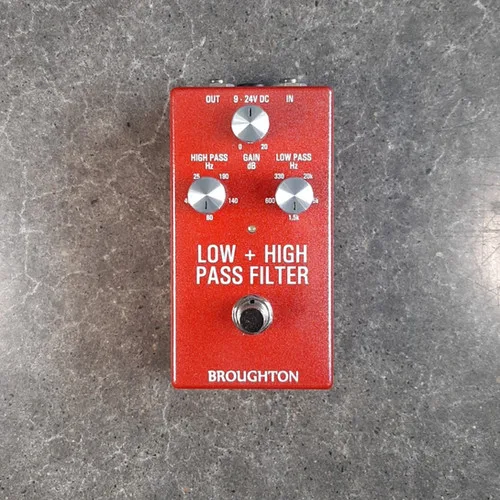
The pedal works with active or passive instruments, and with other devices such as pedals, preamps, or effects loops, a flexibility Broughton also cites for its Low + High Pass Filter2.
The cutoff knob: 25 Hz to 190 Hz
The single control is the cutoff knob, which ranges continuously from 25 Hz to 190 Hz1. At the low end of the range the filter acts mostly as a subsonic cut, removing content below what most instruments produce. As you turn it up toward 190 Hz, the filter increasingly shapes the audible low end of a bass, which is where it becomes a tone-shaping tool rather than just a utility.
For comparison, the same 25 Hz to 190 Hz range appears across Broughton's filter line123:
| Pedal | Cutoff range | Slope | Notes |
|---|---|---|---|
| High Pass Filter | 25 Hz to 190 Hz | 12 dB/octave | True bypass1 |
| Always On High Pass Filter | 25 Hz to 190 Hz | 12 dB/octave | No bypass switch3 |
| Low + High Pass Filter | HPF 25 Hz to 190 Hz, LPF 20 kHz to 330 Hz | 12 dB/octave each | Adds clean gain, unity to +20 dB2 |
| High Pass Filter DI | 25 Hz to 190 Hz | 12 dB/octave | Active DI, plus fixed 25 Hz filter4 |
Power and connections
The High Pass Filter accepts 9 to 24 volts DC through a standard Boss style barrel connector with center negative polarity. The power supply is not included. Current draw is approximately 10 mA, light enough that it places little demand on a pedalboard power supply1.
Broughton Audio notes that higher voltages provide more clean headroom5. If your power supply offers selectable voltages, running the pedal above 9V gives the filter more room before clipping.
The stock input impedance is 1MΩ, the standard value for a passive instrument, and the output impedance is 100Ω1.
Custom input impedance for acoustic pickups
Some acoustic pickups need a different input impedance than the standard 1MΩ to sound right. Broughton handles this directly: if you have an acoustic pickup that requires a specialized input impedance, you write the requirement in the notes during check-out and Broughton accommodates the request at no extra cost1. The same offer applies to the Low + High Pass Filter2.
The High Pass Filter in Broughton's filter line
Broughton Audio makes several filters built around the same circuit ideas, and the differences come down to what is added or removed:
- Always On High Pass Filter: a variant of the Broughton high pass filter built for players who want the cut engaged at all times.
- Low + High Pass Filter: combines a high pass filter and a low pass filter in one pedal, for shaping both ends of the frequency range.
- High Pass Filter DI: the high pass filter in direct box form4.
Warranty
Broughton Audio products, including the High Pass Filter, are covered for one year to the original owner. Warranty repairs are handled by emailing sales@broughtonaudio.com45.
Questions
What does a high pass filter do for a guitar or bass signal?
It rolls off frequencies below its cutoff point, so subsonic rumble and very low content that muddies a mix or wastes amp headroom is removed while the playable low end stays. The Broughton High Pass Filter cuts at 12 dB per octave, with a cutoff you can sweep continuously from 25 Hz to 190 Hz.
Does the Broughton High Pass Filter have true bypass?
Yes. Broughton Audio states that the High Pass Filter has a true bypass switch, so when the pedal is off the signal passes through without the filter circuit in the path.
What power supply does the Broughton High Pass Filter need?
It accepts 9 to 24 volts DC through a standard Boss style barrel connector with center negative polarity. The supply is not included. Current draw is approximately 10 mA, and Broughton notes that higher voltages provide more clean headroom.
Can the input impedance be changed for an acoustic pickup?
Yes. The stock input impedance is 1MΩ, but if your acoustic pickup needs a specialized input impedance you can write the requirement in the notes during check-out and Broughton Audio will accommodate the request at no extra cost.
What is the difference between the High Pass Filter and the Always On version?
The Always On High Pass Filter is a standard Broughton high pass filter with the bypass switch removed, so the filter is permanently in the signal chain. Otherwise it offers the same 25 Hz to 190 Hz cutoff range and 12 dB per octave slope.
How long is the Broughton warranty?
Broughton Audio products are covered for one year to the original owner. Warranty repairs are handled by emailing sales@broughtonaudio.com.
Sources (5)
- High Pass Filter, Broughton Audio
- Low + High Pass Filter, Broughton Audio
- Always On High Pass Filter by Broughton Audio, RockBoard PedalPedia, 2026
- High Pass Filter DI, Broughton Audio
- Always On High Pass Filter, Broughton Audio