The Broughton Audio Low Pass Filter is a small, single-knob filter pedal that removes high frequencies from your signal while leaving the low end alone. It is a 12 dB per octave high frequency filter: everything above the cutoff point you set gets progressively quieter, and everything below it passes through. Broughton Audio positions it as a tool for taming harsh high end such as fret buzz, string noise, and artifacts from other pedals, and for simulating the high frequency roll-off of speaker cabinets1.
Because it is a simple sweep filter rather than a resonant, envelope-driven one, it behaves more like a tone control you can stomp than like an auto-wah or synth-style wah pedal. One knob controls the cutoff frequency, ranging continuously from 15 kHz to 220 Hz, one true bypass switch, and a small 3.7" x 1.6" enclosure1.
What it does to your sound
A low pass filter is the opposite of the more familiar high pass filter: instead of thinning the signal by removing lows, it darkens the signal by removing highs. With the knob fully open at 15 kHz, the filter is effectively out of the way for most of the audible guitar range. As you turn it down toward 220 Hz, more and more of the treble and upper mids fall away until only the bass fundamentals remain1.
Broughton Audio describes the practical uses plainly:
"The Low Pass Filter pedal can be used for taming harsh high end such as fret buzz, string noise, and artifacts from other effects such as distortion pedals."
That last point matters for bass players. At its most extreme setting, the filter can turn a bass guitar signal into a low end dub tone, with the cutoff rolling down to 220 Hz, which is a common trick for reggae and dub-influenced playing. The pedal is also useful for simulating the high frequency roll-off of speaker cabinets: if a drive or fuzz pedal sounds fizzy and artificial, cutting the highs above where a real guitar speaker would roll off can make it sound more like an amp1.
The cutoff control: 15 kHz to 220 Hz
The single knob controls the cutoff frequency, ranging continuously from 15 kHz to 220 Hz1. There are no presets, no resonance control, and no expression input: the knob is the whole interface.
| Setting | What it does |
|---|---|
| Fully clockwise (15 kHz) | Filter is effectively transparent for guitar and bass |
| Midrange settings | Gradual darkening, taming fret buzz and string noise |
| Fully counterclockwise (220 Hz) | Only low fundamentals remain; dub territory for bass |
The 12 dB per octave slope means the roll-off is moderate rather than brick-wall. Frequencies above the cutoff fade over about two octaves rather than disappearing abruptly, which Broughton Audio describes as a 12 dB per octave high frequency filter1.
Power and input
The pedal accepts 9 to 24 volts through a standard Boss style connector with center negative polarity, and draws approximately 10 mA1. A DC power supply is required and not included1.
Broughton Audio states that 9 volts is sufficient for most applications, but higher voltages provide more clean headroom when using the pedal with line level signals1. If you run it in an effects loop or after a hot preamp, a higher voltage supply may keep the signal cleaner.
The stock input impedance is 1MΩ and the output impedance is 100Ω1. The device works with active or passive instruments, as well as with other devices such as pedals, preamps, or effects loops1.
For acoustic players, the maker offers a customization: if your acoustic pickup requires a specialized input impedance, you write it in the notes during checkout and Broughton Audio accommodates the request at no extra cost1. Piezo pickups in particular often want a higher input impedance than a standard guitar input provides, so this option is worth knowing about before ordering.
The Low + High Pass version
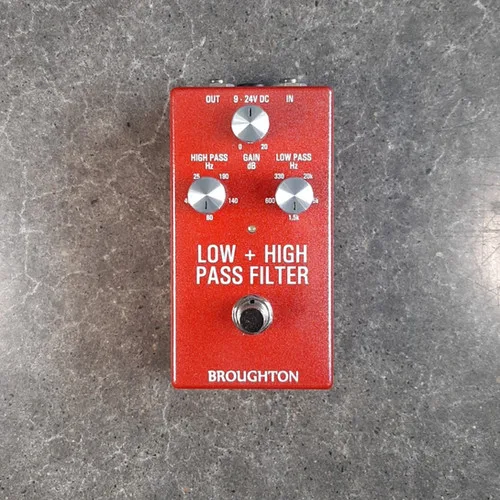
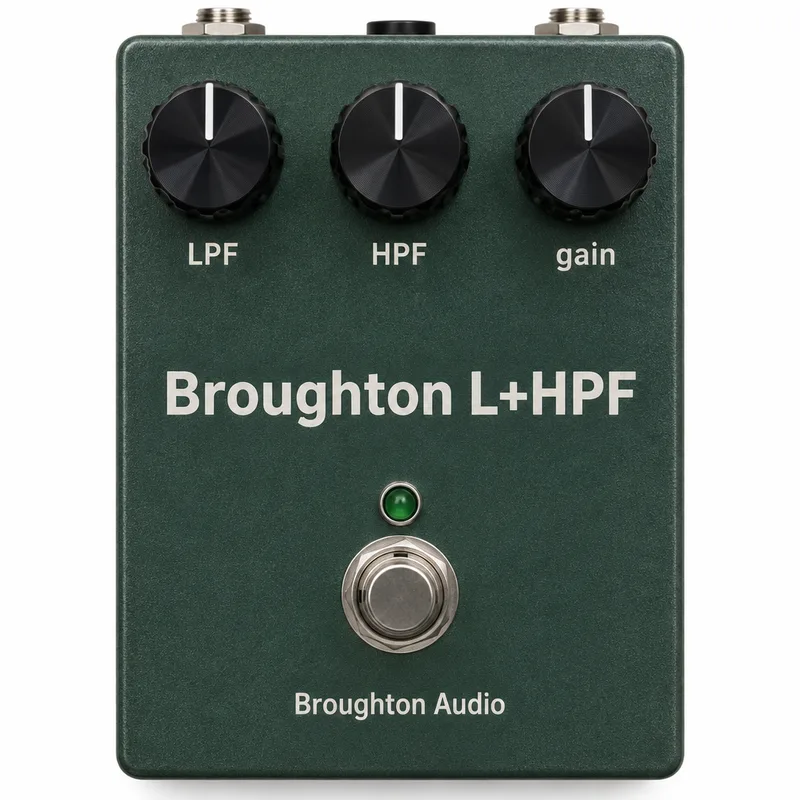
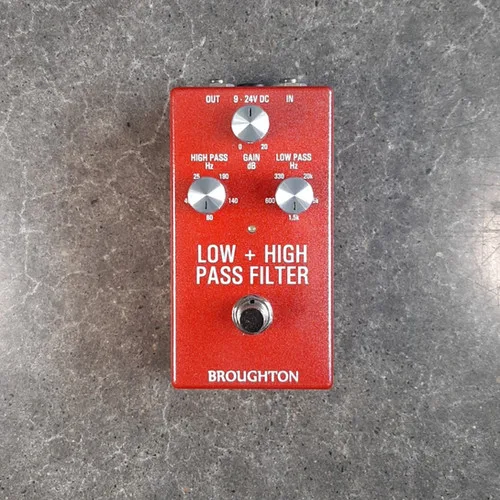
Broughton Audio also makes a Low + High Pass Filter that combines both filter types with a clean gain stage2. It is the pedal to look at if you want to shape both ends of the spectrum at once.
| Low Pass Filter | Low + High Pass Filter | |
|---|---|---|
| Filter type | Low pass only, 12 dB per octave | Low pass and high pass, both 12 dB per octave, plus clean gain2 |
| Cutoff range | 15 kHz to 220 Hz1 | LPF: 20 kHz to 330 Hz; HPF: 25 Hz to 190 Hz2 |
| Gain | None | Unity to +20dB2 |
| Bypass | True bypass1 | True bypass standard; soft touch relay bypass upgrade for an extra $202 |
| Power | 9 to 24 volts DC, supply not included1 | 9V battery or DC supply (not included), 9 to 24 volts2 |
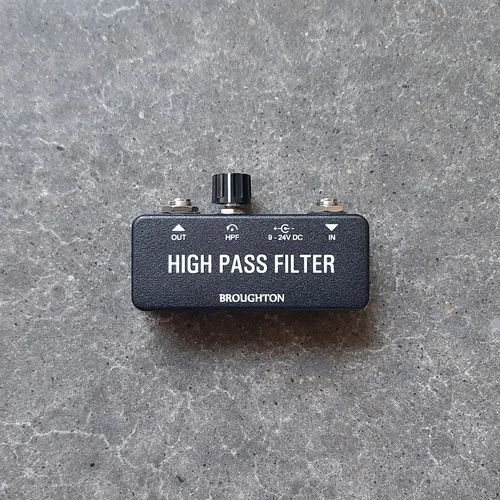
The high pass side of the combination pedal does the opposite job, removing rumble and sub-bass, which is the same function as Broughton Audio's standalone High Pass Filter. The soft touch relay bypass upgrade on the Low + High Pass version is true bypass with no mechanical click when stomped2.
How it compares
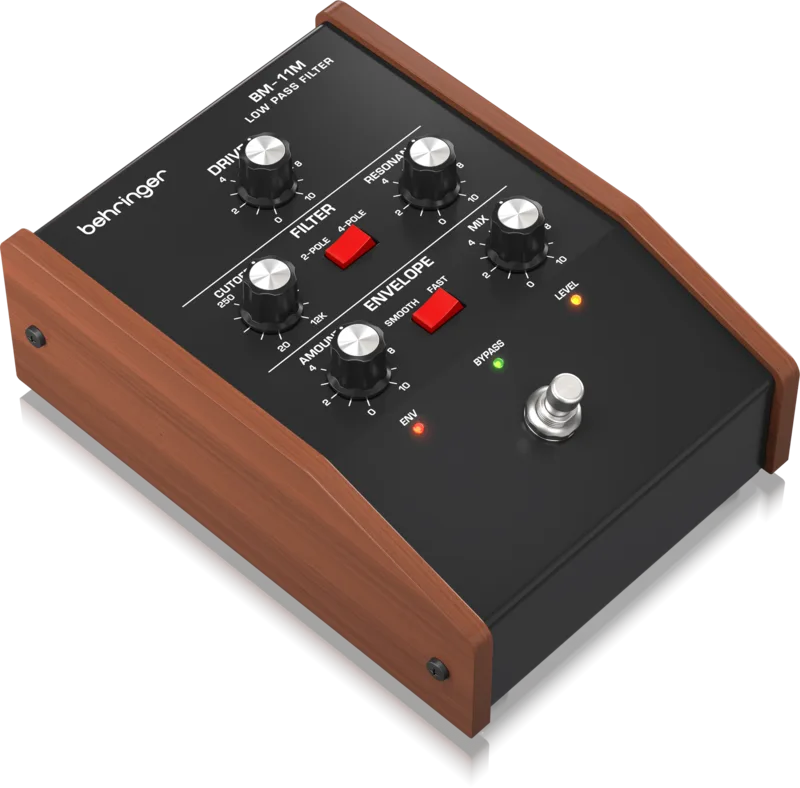
Within the current crop of low pass filter pedals, the Broughton stands out for its simplicity and size. The Behringer BM-11M LOW PASS FILTER is another option that Behringer says plays well with guitar, bass, synth or a drum machine3. The Broughton's 3.7" x 1.6" enclosure1 makes it easy to fit on a crowded pedalboard, and its 1MΩ input impedance means it behaves like a standard guitar pedal input rather than needing special placement in the chain.
Questions
Does the Broughton Audio Low Pass Filter come with a power supply?
No. The pedal requires a DC power supply, which is not included. It uses a standard Boss style connector with center negative polarity and accepts 9 to 24 volts, drawing approximately 10 mA.
Is the Broughton Audio Low Pass Filter true bypass?
Yes. Broughton Audio states the Low Pass Filter has a true bypass switch, so with the pedal off the signal passes through without the filter circuit in the path.
What is the input impedance of the Broughton Audio Low Pass Filter?
The stock input impedance is 1MΩ, and the output impedance is 100Ω. If you have an acoustic pickup that needs a different input impedance, Broughton Audio will customize it at no extra cost if you note it at checkout.
Can the Broughton Audio Low Pass Filter be used with acoustic pickups?
Yes. The pedal works with active or passive instruments, pedals, preamps, or effects loops. For acoustic pickups that require a specialized input impedance, Broughton Audio accommodates the request at no extra cost when you write it in the notes during checkout.
Does the Broughton Audio Low Pass Filter work with bass?
Yes. Broughton Audio says that at its most extreme setting the pedal can turn a bass guitar signal into a low end dub tone, and that it is useful for simulating the high frequency roll-off of speaker cabinets.
Does a higher supply voltage change the sound of the Broughton Low Pass Filter?
Not the filter itself, but Broughton Audio notes that while 9 volts is sufficient for most applications, higher voltages provide more clean headroom when using the pedal with line level signals. The pedal accepts 9 to 24 volts.
Sources (3)
- Low Pass Filter, Broughton Audio
- Low + High Pass Filter, Broughton Audio
- BM-11M LOW PASS FILTER, Behringer