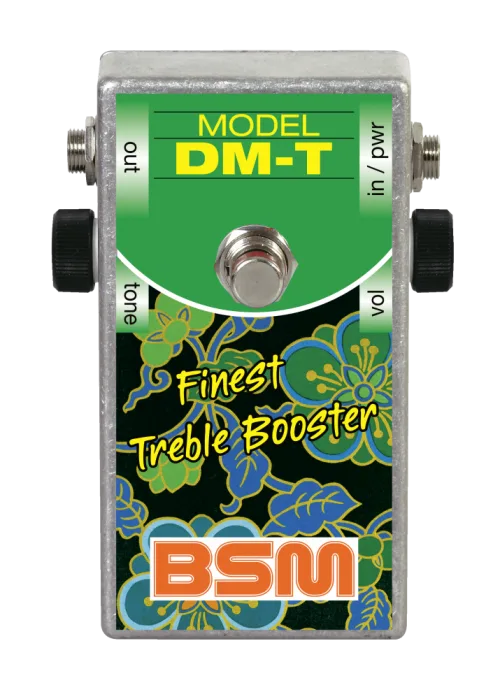
The BSM DM-T Fat Treble Boost is a germanium treble booster pedal from BSM, based on a germanium-fitted special booster from the late 60s1. BSM describes it as "a more variable version of the Hornby Skewes Germanium booster", and says that compared with the company's own Ambassador Treble & Midrange Booster, "the DM-T produces a harder sound without getting shrill"1.
Sound and controls
BSM positions the DM-T against its own Ambassador Treble & Midrange Booster, calling the two technically similar but giving the Ambassador the gentler character and the DM-T the harder edge, one that stays short of shrill2. The DM-T is also listed as a Midrange / Treble Booster rather than a pure treble boost, which points to the tone-control system described below2.
Circuit lineage and the Hornby Skewes connection
The core of the DM-T is a copy of the late 60s germanium booster circuit, but with what BSM calls "a very versatile frankenstein tone-control system"12. That tone section draws on two older designs:
- Treble and mid tone-control: the circuit of the "almost forgotten Apollo booster" is used1
- Bass tone-control: a modified VOX booster circuit, which BSM says "will comfort your ears"1
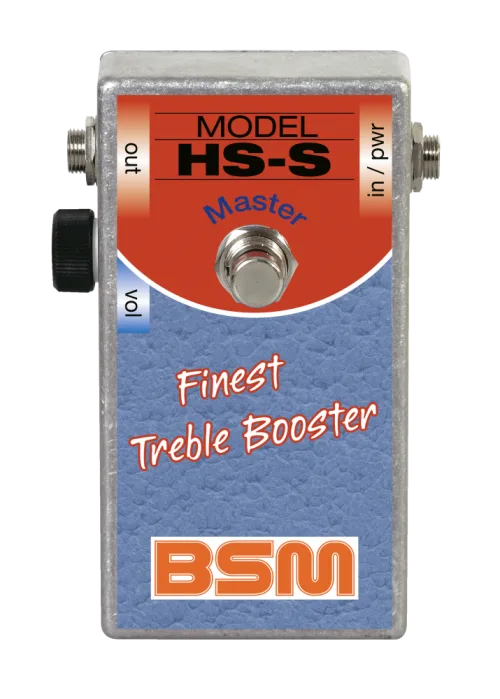
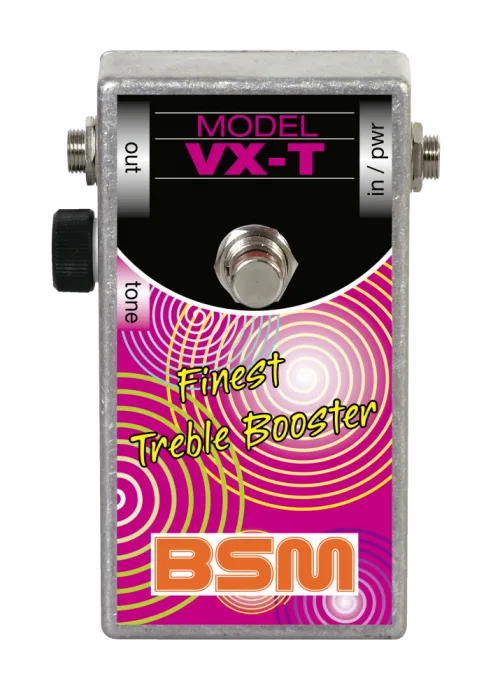
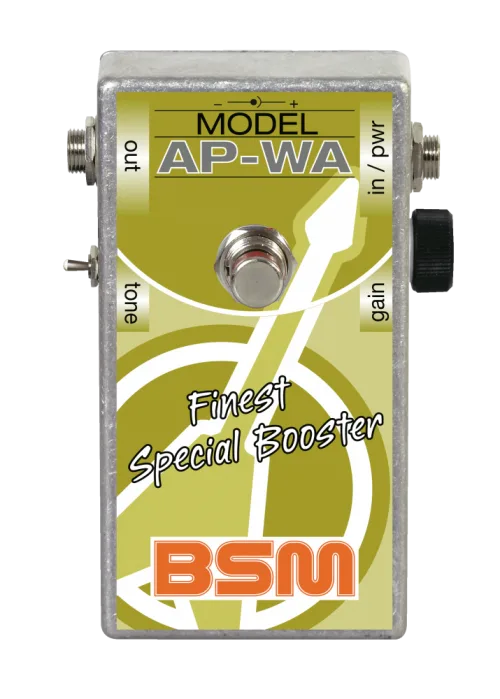
The Hornby Skewes connection runs deeper than a passing reference: BSM describes the whole pedal as a more variable version of the Hornby Skewes Germanium booster, the late 60s British unit the DM-T takes as its starting point1. Players tracing that lineage on a board might also look at BSM's other takes on the era, such as the BSM HS-S Treble Booster, the BSM VX-T Treble/Mid Boost or the BSM AP-WA Treble Booster.
Transistors
The DM-T is loaded with original west European NOS 60s germanium transistors, according to BSM1. NOS, or new old stock, means period transistors that were manufactured in the 1960s and never installed, which is how builders of germanium recreations source parts with the characteristics of the originals.
Power and placement
The unit is powered by a 9V battery, and BSM adds a note that matters for anyone planning external power: "The positive pole of the battery is ground"1. That is the opposite of the center-negative standard most modern pedals use, so a standard daisy-chain supply is not a plug-and-play option here.
The positive pole of the battery is ground1. This reversed polarity is typical of positive-ground germanium circuits and rules out sharing a standard center-negative supply with other pedals without proper isolation.
Placement is equally specific. BSM states: "The DM-T Booster is inserted between guitar and amplifier, not into the FX loop"13. In other words, it goes where a treble booster belongs, ahead of the amp's input, where the boosted signal drives the preamp.
Output figures
BSM gives two output figures for the DM-T: the average output level is 7dBm, and the maximum output voltage when the strings are struck really hard is 5V max12. With a current consumption of approximately 350 uA, the draw is tiny even by battery-powered standards1.
Players
BSM's product page notes that Haiko Heinz used a BSM DM-T Germanium treblebooster for the solo to "Smoke on the Water" (the Machine Head album version) in a new video1.
Questions
Does the BSM DM-T Fat Treble Boost go in front of the amp or in the effects loop?
BSM is explicit on the product page: the DM-T Booster is inserted between guitar and amplifier, not into the FX loop. Like most treble boosters, it is designed to drive the amp's input stage, where the boosted treble interacts with the amp's own gain and voicing. Placing it in an effects loop would put it after the preamp and change what it is meant to do.
What transistors does the BSM DM-T Fat Treble Boost use?
According to BSM, the DM-T is loaded with original west European NOS 60s germanium transistors. NOS means new old stock: transistors manufactured in the 1960s and never used, kept for builds like this one. Germanium parts are central to the pedal's character and to the late 60s circuit it recreates.
How is the DM-T different from the BSM Ambassador Treble and Midrange Booster?
BSM describes the two pedals as technically similar, with the Ambassador sounding more gentle and the DM-T producing a harder sound without getting shrill. The DM-T is also described as a more variable version of the Hornby Skewes Germanium booster, with a tone-control system that shapes treble, mid and bass separately.
How much current does the BSM DM-T draw?
BSM gives the current consumption as approximately 350 uA, which is a very small draw by pedal standards. The unit is powered by a 9V battery, and BSM notes that the positive pole of the battery is ground, a polarity detail that matters for anyone wiring external power.
Sources (3)
- DM-T Fat Treble Boost, BSM (treblebooster.net), 2025
- dm-t.pdf, treblebooster.net, 2025
- DM-T Fat Treble Boost, BSM (treblebooster.net), 2025