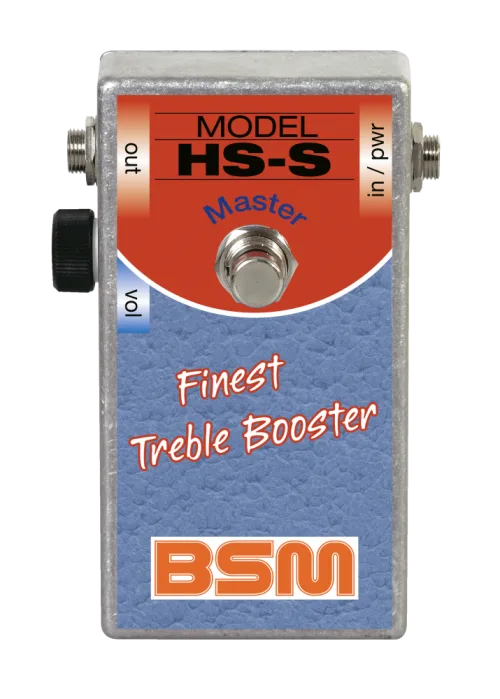

The BSM HS-S Treble Booster is a treble booster made by BSM, built on the 1967 silicon-transistor version of the Hornby-Skewes Treble Booster. The original Hornby-Skewes unit was briefly issued with germanium transistors before the 1967 silicon revision appeared, and BSM now sells that 1967 design under the HS-S name1. It belongs to the broader family of boost pedals, but it is a treble booster in the classic sense: it lifts the treble content of the guitar signal so a tube amplifier's input stage is pushed into overdrive.
BSM describes the HS-S as producing a fat, biting and penetrating lead sound, minus any shrill characteristics, when the guitar's volume control is turned up to maximum. Compared with its forerunner, the maker says the HS-S sounds a tad more aggressive with more mid-range, a little bit similar to a WahWah sound with the guitar's volume pot fully opened2.
Specifications
BSM publishes the following figures for the HS-S:
| Specification | Value |
|---|---|
| Transistor type | Silicon12 |
| Power | 9V battery, positive ground2 |
| Current consumption | approx. 750 uA2 |
| Average output | 5dBm2 |
| Maximum output voltage | 4V max when the strings are struck really hard12 |
Power and placement
The unit is powered by a 9V battery with positive ground, and BSM lists a current consumption of approx. 750 uA2. Positive ground is the polarity used by many vintage-style effects, and it is the reverse of modern center-negative pedal supplies, so a shared daisy chain with negative-ground pedals is not an option.
Because the HS-S uses positive ground, it should not share a standard multi-output adapter with center-negative pedals. A battery or a dedicated isolated supply keeps the polarity issue out of the board.
Placement matters as much as power. BSM is explicit about where the pedal belongs21:
"The HS-S Treble Booster is inserted between guitar and amplifier, not into the FX loop."
The design depends on driving the amplifier's input stage, so it belongs first in the chain, straight after the guitar21.
Pickups and sound
The HS-S has been designed for single coil or humbucking pickups with a relatively low or medium coil inductance, such as pickups in Fender or Gibson guitars12. BSM's own demo pairs a Strat with a Laney LA30BL, described by the maker as almost a JTM 45 copy, with guitar and audio realisation by Haiko Heinz2.
For players working out where it sits on a board, the practical points are:
- It goes between guitar and amplifier, not in the FX loop1.
- It has no volume control of its own; the guitar's volume knob sets how hard the amp is hit1.
- It runs on a 9V battery with positive ground, so it needs its own power arrangement2.
The HS-S Master variant
BSM also offers the circuit as the HS-S Master Treble Booster, with an additional volume control, described by the maker as being like Blackmore's modified unit13. The standard HS-S has no volume control, so the amplifier's input level is set by the pedal's fixed output and the guitar's volume knob; the Master adds a level control for dialing in how hard the front end of the amp is hit.
| HS-S | HS-S Master | |
|---|---|---|
| Circuit | Hornby-Skewes, 1967 silicon version1 | Hornby-Skewes, 1967 silicon version13 |
| Volume control | None2 | Additional volume control2 |
| Power | 9V battery, positive ground2 | 9V battery, positive ground2 |
Videos
WaterBear - The College of Music
Questions
Does the BSM HS-S go in the effects loop?
No. BSM states that the HS-S Treble Booster is inserted between guitar and amplifier, not into the FX loop. Treble boosters of this kind are designed to hit the front end of a cranked amp, where the boosted treble shapes the amp's own overdrive. Placed in an effects loop it would not interact with the preamp the way the design intends.
Which pickups suit the BSM HS-S Treble Booster?
BSM designed the HS-S for single coil or humbucking pickups with a relatively low or medium coil inductance, such as the pickups found in Fender or Gibson guitars. With the guitar's volume control turned up to maximum, the maker describes the result as a fat, biting and penetrating lead sound without shrill characteristics.
Can I use a standard 9V adapter with a positive ground pedal?
Care is needed. The HS-S runs on a 9V battery with positive ground, which is the opposite polarity of most modern center-negative pedal supplies. Sharing a daisy chain or standard adapter with negative-ground pedals can cause a short, so players typically keep it on its own battery or a dedicated isolated supply.
What is the difference between the HS-S and the HS-S Master?
The HS-S Master is the same treble booster with an additional volume control, which BSM describes as being like Ritchie Blackmore's modified unit. The standard HS-S has no volume control of its own, so its output level is fixed by the circuit, while the Master lets the player set how much signal reaches the amplifier.
Sources (3)
- hs-s_master-silicon.pdf, treblebooster.net, 2025
- HS-S Master Treble Booster, treblebooster.net (BSM), 2025
- hs-s_master-silicon.pdf, treblebooster.net, 2025
 Ritchie Blackmore
 Rory Gallagher