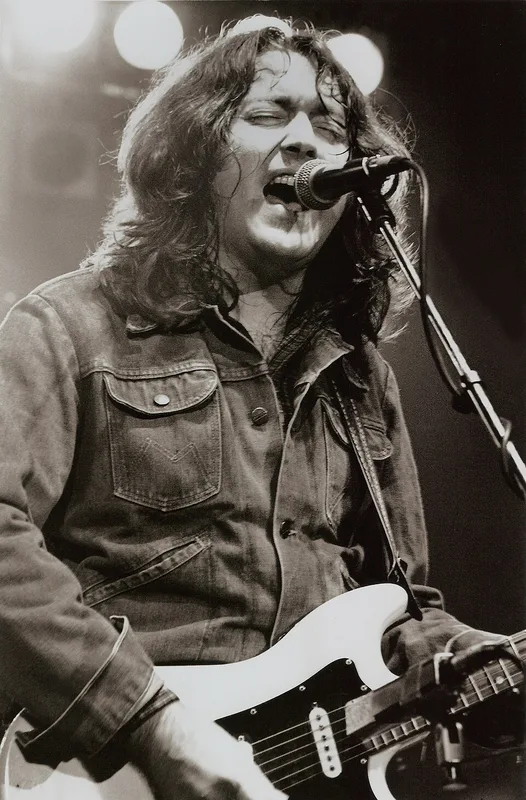
Rory Gallagher, the Irish blues and rock guitarist born in Ballyshannon, County Donegal on 2 March 1948, built one of the most recognized guitar tones in blues rock with almost nothing on his pedalboard. He played a standard Fender Strat into the normal channel of a Vox AC30 top boost amp, and the only stompbox he used was his treble booster12. He sold in excess of 30 million albums worldwide, played in Taste during the late 60s, and died in London on 14 June 19953.
A Strat, an AC30 and a treble booster
Gallagher's rig was about as stripped down as a professional rig gets. From his time in Taste onward he amplified his 61 Fender Strat primarily with a Vox AC30 top boost, and his treble booster was the only effects pedal he ever used on stage2. The Rangemaster paired with the AC30 became a crucial part of his tone, driving the amp harder and adding crunch45.
The Strat at the center of it all was a 1961 Fender Stratocaster in three tone sunburst that he found in a music shop in Cork in 19632. British Pedal Company describes the guitar and the original Number 1 Rangemaster together as the key components in his tone, which they credit with defining the history of Irish blues music67.
His own view of effects was blunt:
Rory Gallagher played a standard Fender Strat into the "normal" channel of a VOX AC30 "top-boost" amp, and the only stompbox he used was his treble booster3. After a Rangemaster he switched to the rare Hawk booster, very similar to the Hornby-Skewes3.
That matches what those around him observed: except for an old phaser pedal, or a chorus he used occasionally, Gallagher didn't use effects at all3. For a player curious about the pedal types he skipped, the site has pages on wah pedals, phaser pedals and chorus pedals.
The Rangemaster and Hawk treble boosters
Gallagher used a Dallas Arbiter Rangemaster for some time, then switched to the rare Hawk booster, a unit very similar to the Hornby-Skewes treble boosters of the era182. Either way, a Rangemaster or a Hawk treble booster was one major aspect of his signature tone3. The Rangemaster itself was an amp top treble booster unit guitarists used in the 1960s to drive their amps harder and get more crunch, and in Flynn Amps' words it was "one pedal that every British lead guitarist knew they needed"59.
Several makers have built boosters aimed squarely at his sound:
| Booster | Maker | What it is |
|---|---|---|
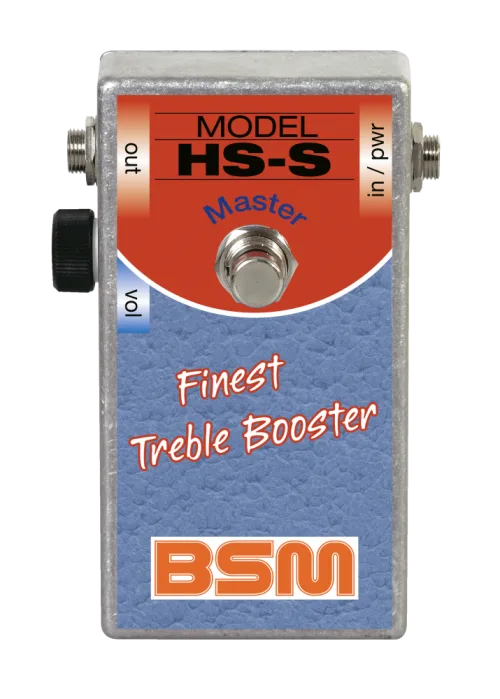
| RG Treble Booster | BSM | A BSM HS-Custom modified to nail Gallagher's signature tone, with a volume control like Ritchie Blackmore's modification; set about halfway it achieves his early records' sound1 |
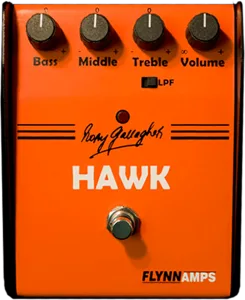
| Rory Gallagher Hawk Booster | Flynn Amps | A booster pedal built after Flynn flew to London in March 2008 and, with Donal Gallagher, Tom O'Driscoll and Daniel Gallagher, photographed and measured every component of Rory's original Hawk10 |
| Rory Gallagher Ltd Edition Relic Rangemaster | British Pedal Company | A signature series relic Dallas Rangemaster treble booster, limited edition of 50 worldwide67 |
The BSM RG is fitted with the same germanium transistors as the original Hornby-Skewes units and is designed for single coil pickups with relatively low coil inductance, such as those in Fender, Rickenbacker, Burns or Vox guitars28. A gitarre & bass review of the tribute model noted its single volume control, one on/off footswitch, and an Eddystone aluminum enclosure2.
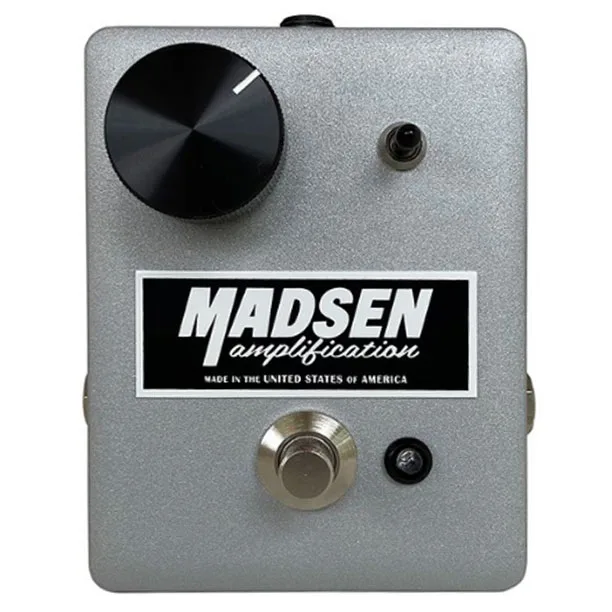
Flynn Amps says of its Hawk booster that "Unbelievable sustain, drive and dynamic range are all controlled from the guitar and the player"10, and recommends Tweed Fender amps such as the Bassman, Tweed Twin, Tweed Deluxe and Concert, as well as Marshall combos and Vox AC30/15 amps, for classic Gallagher tones10. The build uses C&K switches, Switchcraft sockets and tantalum caps11. Madsen Amplification's GE Boost, a Rangemaster style unit, was likewise inspired by Gallagher's playing and tone12.
Amps and guitars behind the sound
Beyond the AC30, Gallagher's amp collection included an Ampeg VT-44, a Fender Tweed Twin from 1954, a Fender Bassman from 1954, a Fender Concert, a Magnatone combo, and Marshall combos and heads3. In the studio, his brother Donal says he particularly liked the old Fender Tweeds3.
His guitars beyond the famous Strat included a '57 Strat with a maple fretboard, a '61 Telecaster, an Esquire Tele and a Duosonic, all Fenders3. Strings were Fender Rock & Roll sets, .010 to .038 or .010 to .040, and he played heavy Herco picks3.
What became of the Number 1 Rangemaster
Gallagher's 1961 Stratocaster sold at auction for $1.16m, and it was revealed that it was to be donated to the National Museum of Ireland4. The Number 1 Rangemaster took a different path: the family withheld it from the mass auction of his gear and gifted it to Joe Bonamassa. Daniel Gallagher, with his father Donal's blessing, presented it to Bonamassa before a Beacon Theater show in New York4.
Bonamassa noticed the pedal had gone missing from the auction a few months earlier:
"I had noticed it had gone missing from the auction a few months back, and I am beyond blown away that this is now in my possession"
Rory Gallagher and Brian May
Gallagher's influence on other players runs through the Rangemaster story. Guitar World reports that Rory showed Brian May how to use one13, and May went on to make the treble booster part of his signature sound with Queen14. MusicRadar describes the Dallas Rangemaster as the pedal Gallagher used "to such devastating effect that May simply had to add one to his rig"15. Both Rory and Brian never stopped using theirs13.
A short career timeline
- Late 60s: tenure in Taste3
- First eponymous album: hired bass player Gerry McAvoy, a relationship lasting twenty years on the road3
- 1972: released Deuce, essentially three piece R&B; voted Melody Maker's Top Musician of the Year, dethroning Eric Clapton3
- 1973 to 1978: the line-up with Rod De'Ath on drums and Lou Martin on keyboards stayed together3
- 1970s: ten albums, including the live albums Live in Europe and Irish Tour '743
- Mid 70s: collaborated with Muddy Waters and Jerry Lee Lewis on their respective London Sessions3
- 1980s: produced Jinx, Defender, and Fresh Evidence3
- 10 January 1995: final performance, in the Netherlands3
- 14 June 1995: died in London3
He was invited to try out with The Rolling Stones following Mick Taylor's resignation, with Canned Heat, and was David Coverdale's second choice, after Jeff Beck, to replace Ritchie Blackmore in Deep Purple3. His final resting place is St Oliver's Cemetery, on Model Farm Road just outside Ballincollig near Cork City3.
Questions
What treble booster did Rory Gallagher use?
Gallagher used a Dallas Rangemaster treble booster for a period in his early career, then switched to the rare Hawk booster, a unit very similar to the Hornby-Skewes treble boosters of the era. The Rangemaster into his Vox AC30 was a crucial part of his guitar tone, and the booster was the only stompbox in his rig.
Did Rory Gallagher use a wah pedal?
No. Gallagher said he did wah-wah effects with the guitar's tone knob and otherwise avoided effects, preferring a naturally overdriven tube amp sound. An old phaser pedal and an occasional chorus were the only other effects he used at all.
What amp did Rory Gallagher use with his Rangemaster?
Live, Gallagher played his Strat into the normal channel of a Vox AC30 top boost amp. He also owned and used a large amp collection including a Fender Tweed Twin and Bassman from 1954, a Fender Concert, an Ampeg VT-44, a Magnatone combo and Marshall 50 watt combos and heads.
Is there a Rory Gallagher signature Rangemaster?
Yes. British Pedal Company built a Rory Gallagher Ltd Edition Relic Rangemaster, a limited edition of 50 units worldwide, authorized by the Gallagher family and built to the specification of his original Number 1 Rangemaster, complete with 1960s style packing carton, labels and Dallas guarantee card.
Who owns Rory Gallagher's Rangemaster now?
The Gallagher family withheld the Number 1 Rangemaster from the mass auction of his gear and gifted it to Joe Bonamassa. Daniel Gallagher, with his father Donal's blessing, presented it to Bonamassa before a Beacon Theatre show in New York in February 2025.
What strings and picks did Rory Gallagher use?
His strings were Fender Rock & Roll sets, .010 to .038 or .010 to .040 gauge, and he used heavy Herco picks. Both suited the aggressive single coil attack of his 1961 Stratocaster.
Did Rory Gallagher show Brian May the Rangemaster?
Yes. Guitar World reports that Rory showed Brian May how to use a Rangemaster, and May went on to make the treble booster part of his signature sound with Queen, never stopping using his.
Sources (15)
- RG Treble Booster, treblebooster.net, 2025
- rory gallagher toys, gitarre & bass, 2011-01
- Rory Gallagher, treblebooster.net, 2025
- Joe Bonamassa now owns Rory Gallagher's Number 1 Rangemaster, Guitar World, 2025-02-28
- JHS Pedals harvests super-rare transistors for limited run Germanium Boost pedal and it sells out within an hour, MusicRadar, 2022-12-12
- Rory Gallagher Ltd Edition Relic Rangemaster, British Pedal Company
- Rory Gallagher Ltd Edition Relic Rangemaster, British Pedal Company
- untitled, BSM, 2008-04-02
- Classic OC44 Booster, Flynn Amps, 1960
- Rory Gallagher Hawk Booster, Flynn Amps, 2023-02-20
- Rory Gallagher Hawk Booster, Flynn Amps, 2022-01-04
- Madsen Amplification GE Boost (RangeMaster-Style), Delicious Audio, 2022-11-15
- Boost pedals: the history of the stompbox that supercharged the sound of rock 'n' roll, Guitar World, 2023-07-26
- Tony Iommi on the modified treble booster his tech threw out, GuitarPlayer (www.guitarplayer.com), 2025-06-30
- “Heard on recordings by icons like Rory Gallagher, Brian May, and Marc Bolan, this pairing helped define the sound of rock's formative years”: Vox unveils “re-engineered” treble booster with all the tone and none of the inconsistency of vintage units, MusicRadar, 2026-01-20