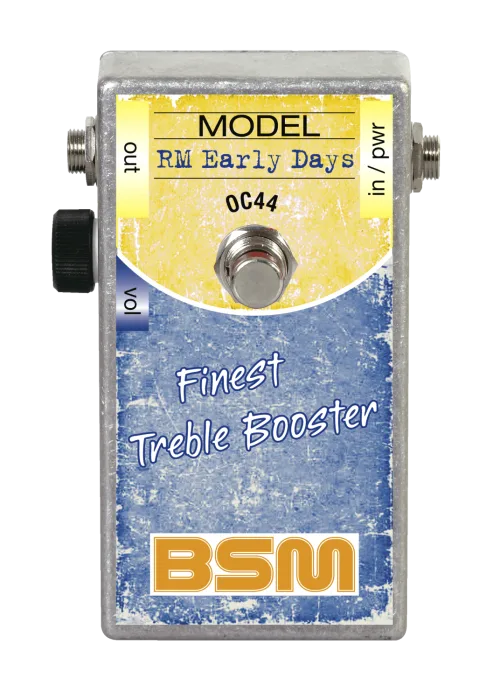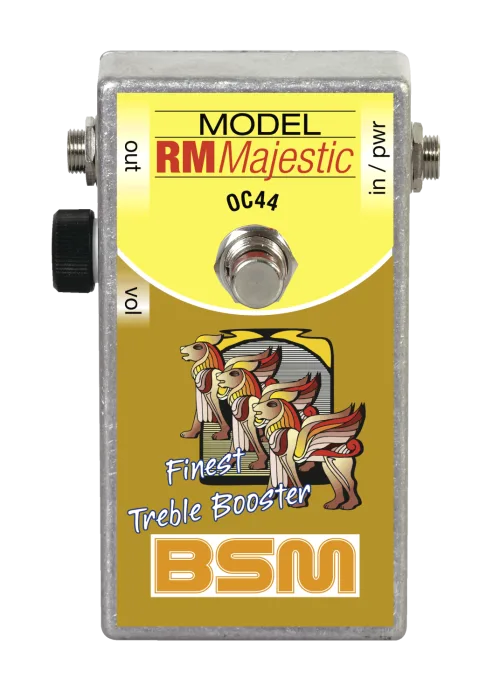


The BSM RM Treble Booster is a pedal reproduction of the British Range Master, a treble booster unit produced between 1965 and 1969 that players used to push tube amps into saturated lead tones. BSM states the RM is based directly on that circuit and includes the same OC44 germanium transistors as the original 1965 version1. It is a boost pedal in the classic sense: one knob, no switching, and a job that is entirely about driving the front end of an amplifier harder while lifting the high end.
With the guitar's volume control turned up to the max, BSM says the RM produces "a fat, biting and penetrating lead sound, minus any shrill characteristics"1. The average output level is 10dBm, and the maximum output voltage when the strings are struck really hard is 7V1.
A Range Master-style treble booster
The Range Master circuit is the ancestor of a whole family of boost and drive pedals. BSM notes that overdrive circuits such as the Tube Screamer were based on the old treble boosters and therefore had a very similar frequency response1. What the RM does is the original recipe: a germanium single-stage boost that emphasizes the upper mids and highs so a tube amp, already running hot, breaks up earlier and cuts through.
The RM has been specifically designed for single coil and humbucking pickups with a relatively low to medium inductance, such as pickups in Fender, Gretsch, Burns or Gibson guitars1. BSM's Tom Riepl recommends using it with any Strat-style single coil guitar in combination with a small 15 to 30 watt combo tube amp3.
The RM goes between guitar and amplifier, not into the FX loop. BSM is explicit about this for every model in the RM family: the circuit is meant to interact with the pickups and the amp's input stage, not with a line-level loop1.
The volume control
The RM has a single control, the volume pot. BSM describes its behavior in the original's terms145:
"By turning the volumepot, the specially circuit design makes noise, like the orginal!"1
The other half of the control scheme is on the guitar itself. BSM says that by lowering the guitar's volume control, many shades of crunch can be easily dialed in45. That is the intended way to work the pedal: set the boost high, then ride the guitar's volume knob to move between clean-ish and fully saturated.
Power: 9V battery, about 250mA
The unit is powered by a 9V battery with a current consumption of aprox. 250 mA1. One detail matters for anyone thinking about adapters or a shared supply: the positive pole of the battery is ground1. That is the opposite of the center-negative convention most modern pedals use, so a standard daisy chain or typical 9V adapter is not a drop-in match for this circuit.
Because the positive battery pole is ground, the RM's power arrangement differs from the center-negative standard of most modern pedals. BSM specifies battery power for the unit1.
Metal, Velvet and Recording versions
The RM name covers several versions in BSM's range, each aimed at a different corner of the Range Master lineage642.
| Version | What it is |
|---|---|
| BSM RM Treble Booster | A Treble Booster based on the British Range Master unit produced between 1965 and 1969, designed for single coil and humbucking pickups with relatively low/medium inductance, such as those in Fender, Gretsch, Burns or Gibson guitars1 |
| BSM RM Metal Treble Booster | A modified '69 RM model like Mr. Iommi's unit2 |
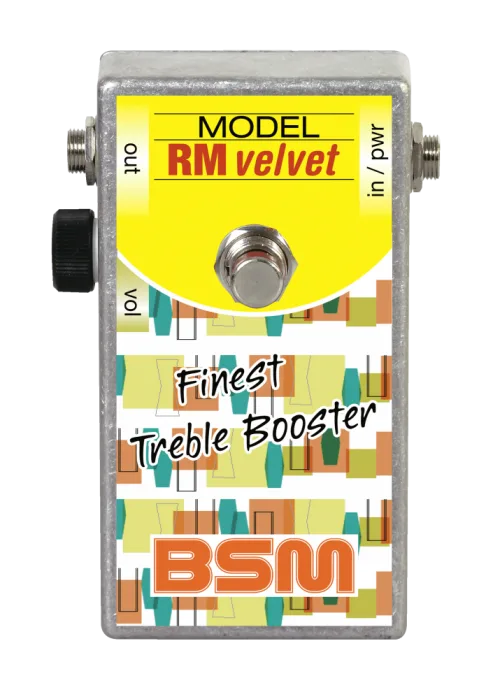
| BSM RM Velvet Treble-Booster | A Treble Booster pedal from BSM, inserted between guitar and amplifier, not into the FX loop5 |
The RM Metal is the variant for players chasing the modified late-'60s Range Master setup associated with Mr. Iommi: BSM describes it as a modified '69 RM model like Mr. Iommi's unit2. The RM Velvet is likewise a Treble Booster pedal, and BSM notes it is inserted between guitar and amplifier, not into the FX loop5.
All of these versions share the same placement rule: between guitar and amplifier, not into the FX loop564.
Videos
Benedikt Schlereth
Benedikt Schlereth
Fretboard Playground
Questions
Does the BSM RM Treble Booster use germanium transistors?
Yes. BSM states the RM includes the same OC44 germanium transistors as the original 1965 Range Master version it is based on. Germanium transistors are part of what gives these old treble booster circuits their character, and BSM has kept them in the reproduction.
Does the BSM RM Treble Booster go in the effects loop?
No. BSM is explicit that the Treble Booster is inserted between guitar and amplifier, not into the FX loop. The circuit is designed to see the guitar's pickups directly and to push the front end of a tube amp, so it belongs at the start of the signal chain.
What guitars suit the BSM RM Treble Booster?
BSM designed the RM for single coil and humbucking pickups with relatively low to medium inductance, naming Fender, Gretsch, Burns and Gibson guitars as examples. BSM's Tom Riepl recommends it with any Strat-style single coil guitar into a small 15 to 30 watt combo tube amp.
What is the difference between the BSM RM and the RM Recording?
The RM is the standard Range Master reproduction. The RM Recording, released in March 2020, is BSM's top-of-the-line model for studio and recording purposes, described as ultra-low-noise, and at an amp's full tilt it lets a more transparent tone covering the entire frequency range come through.
Where is the BSM RM Treble Booster made?
The BSM RM family is made in Germany. BSM's manuals for the RM Metal and RM Velvet versions both state Made in Germany, and the company's products are built around reproductions of vintage British booster circuits.
Sources (6)
- rm.pdf, BSM (treblebooster.net), 2025
- Neutral_neu, treblebooster.net, 2025
- Rory Gallagher, treblebooster.net, 2025
- geraeteblatt_2020_rm-recording_klein.pdf, treblebooster.net, 2020
- Neutral_neu, treblebooster.net, 2025
- RM Majestic Treble Booster, treblebooster.net, 2025