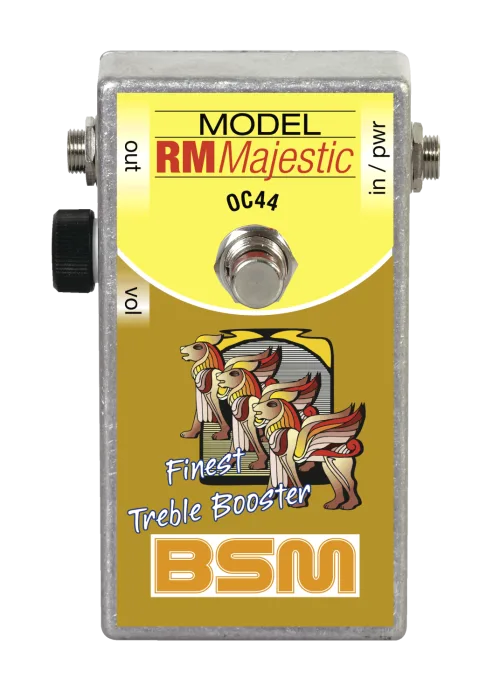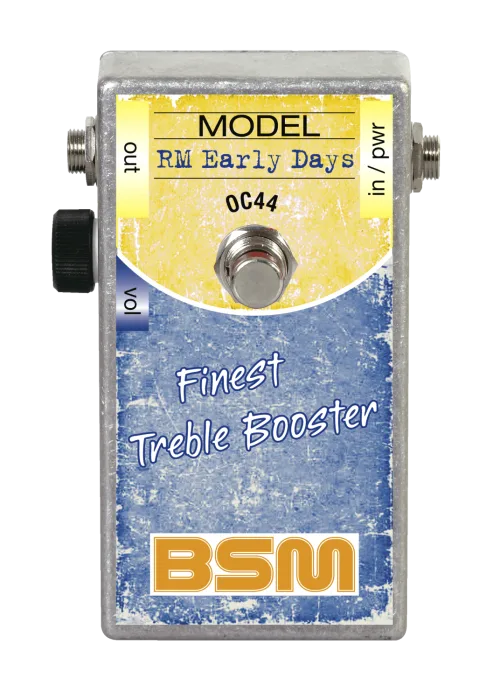
The BSM RM Early Days is a treble booster pedal from BSM, based on the British Range Master unit produced between 1965 and 1969. BSM developed it after many customers asked for the early RM sound, and the maker describes its character as a little clearer and brighter in the treble and tighter in the bass response than the stock BSM RM Treble Booster.1
Power and signal level
The unit is powered by a 9V battery, and BSM notes that the positive pole of the battery is ground. The maker gives the current consumption as aprox. 250 A. The average output level is 10dBm, and the maximum output voltage when the strings are struck really hard is 7V max.1
The positive pole of the battery is ground, which is the opposite polarity to most modern negative-center pedals. Do not share a daisy chain with negative-ground pedals.1
Placement matters with this kind of circuit. BSM's manual is explicit: "The Treble Booster is inserted between guitar and amplifier, not into the FX loop."2 In other words, it goes first in the chain, straight from the guitar, so that the boosted signal hits the amplifier's input stage.
How it sounds and how it is used
BSM designed the RM Treble Booster specifically for single coil and humbucking pickups with a relatively low or medium inductance, such as the pickups found in Fender, Gretsch, Burns or Gibson guitars. On those pickups, with the guitar's volume control turned up to the max, the maker says the RM produces "a fat, biting and penetrating lead sound, minus any shrill characteristics."1
Lowering the guitar's volume control is part of how the pedal is played. BSM says that by lowering the guitar's volume control, many shades of crunch can be easily dialed in.1
The pedal's only control is the volume pot, and turning it is deliberately not silent. BSM states: "By turning the volumepot, the specially circuit design makes noise - just like the orginal!"12
How it differs from the stock RM
The RM Early Days sits alongside BSM's stock RM Treble Booster and shares its core component: BSM says it is loaded with the same highly selected OC44 transistor used for the famous stock RM model. The difference is the voicing. Compared to the stock RM, BSM describes the RM Early Days as sounding a little clearer and brighter in treble and tighter in the bass response, aimed at players looking for the early RM sound.1
Who used the Range Master
The original Range Master units that this pedal is modeled on have a well-documented place in British guitar tones, according to BSM's product page1:
- Eric Clapton used the original Range Master in John Mayall's Bluesbreakers, and also used the booster when playing with Cream. With the Bluesbreakers he used a new 2 x 12" Marshall combo, Model #1962 with KT66 output tubes, and with Cream he used 100 Watt Plexi heads.1
- Brian May used a couple of VOX AC30 combos with the RM in front of the "Normal" channel.1
Videos
guitarwwworld
Questions
Does the BSM RM Early Days go in the effects loop?
No. BSM's manual states that the Treble Booster is inserted between guitar and amplifier, not into the FX loop. Like the original Range Master units it is modeled on, it is designed to drive the front end of a tube amplifier, where the boosted treble interacts with the amp's input stage.
What pickups is the BSM RM Early Days designed for?
BSM designed it for single coil and humbucking pickups with a relatively low to medium inductance, such as the pickups found in Fender, Gretsch, Burns or Gibson guitars. With the guitar's volume control turned up, the maker describes the result as a fat, biting and penetrating lead sound without shrill characteristics.
How is the BSM RM Early Days different from the stock RM?
According to BSM, the RM Early Days sounds a little clearer and brighter in the treble and tighter in the bass response compared to the stock RM. It was developed after many customers asked for the earlier Range Master sound, and it uses the same highly selected OC44 germanium transistor as the stock model.
Does the RM Early Days make noise when you turn the volume pot?
Yes. BSM says that turning the volume pot makes noise, just like the original, and attributes this to the pedal's special circuit design. It is a deliberate part of the recreation rather than a fault.
Sources (2)
- RM Early Days Treble-Booster, treblebooster.net, 2025
- untitled, BSM, 2025
 Eric Clapton
 Brian May
 Pete Townshend