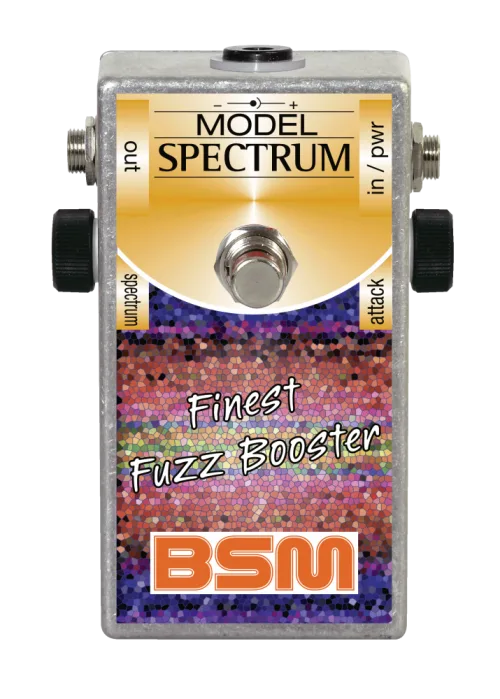

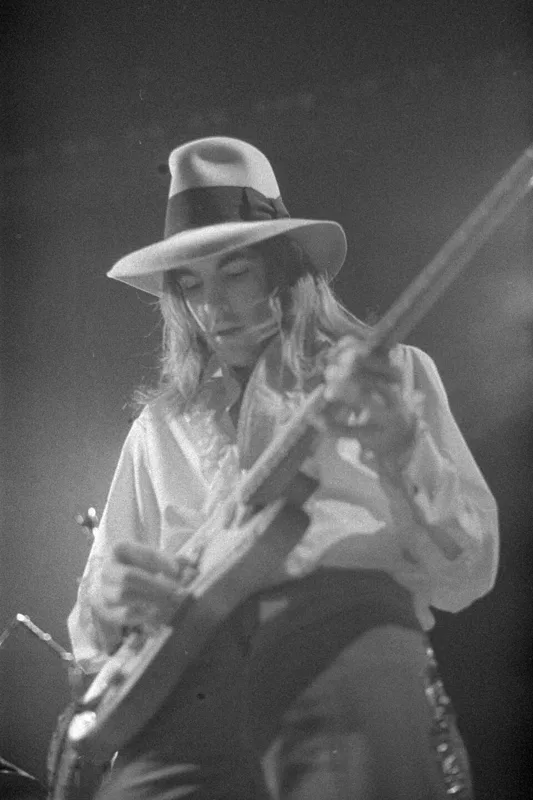
The BSM Spectrum is a fuzz-booster pedal made by BSM, and the company describes it as a tribute to Tommy Bolin, the guitarist who joined Deep Purple after Ritchie Blackmore and who also played as a studio guitarist on Billy Cobham's 1973 jazz fusion album "Spectrum", the record that gives the pedal its name1. It is a copy of the Sam Ash Fuzz that Bolin used, and it sits between a boost pedal and a fuzz in the way it behaves: one control moves the sound from a clean treble boost all the way to a full fuzz attack2.
The heart of the pedal is what BSM calls the attack control, which "can smoothly blend from treble boost to fuzz"2. With the guitar's volume control turned up to the max, BSM says the Spectrum produces a fat, biting and penetrating lead sound, minus any shrill characteristics, and that by lowering the guitar's volume control, many shades of crunch can be easily dialed in1. That volume-knob responsiveness is the classic behavior of boost-style circuits: the pedal adds gain and character, and the guitar's own controls set how much of it hits the amp.
A fuzz-booster that blends from treble boost to fuzz
The Spectrum is not a pure fuzz in the modern sense. BSM builds it as a fuzz-booster, a circuit type descended from the treble boosters of the late 1960s and early 1970s, and the attack control is what lets one pedal cover that whole range. Rolled back it works like a treble booster, pushing the amp harder in the upper frequencies; turned up it becomes a fuzz, clipping the signal into a saturated lead tone2.
BSM says the tone control on the Spectrum was expanded up to almost 6 octaves compared with the original circuit, which gives the player more room to shape where the boosted and fuzzed frequencies sit4. As with other boost-derived pedals, the intended way to work it is with the guitar volume: full up for lead, rolled down for crunch1.
Power and connections
The Spectrum runs on a 9V battery, and it also accepts an external "Boss style" DC jack, meaning a 2.1mm plug with tip negative polarity2. That is the same connector and polarity as the vast majority of 9V pedalboard power supplies, so it drops onto a powered board without an adapter cable.
Current consumption is listed at approximately 800 uA, a fraction of a milliamp2. For comparison, most digital pedals draw tens or hundreds of milliamps; at 800 microamps the Spectrum is gentle on both a battery and a power supply. On the output side, BSM lists an average output level of 0dBm and a maximum output voltage of 2V when the strings are struck really hard12.
The Sam Ash Fuzz behind it
The name ties the two threads together. BSM points to Bolin's guitar playing as a studio guitarist on Billy Cobham's "Spectrum" jazz fusion album from 1973 as the playing the pedal honors, while the circuit itself follows the fuzz he later used with Deep Purple1. Premier Guitar made the same connection in its September 2007 review of four BSM pedals:
"The Spectrum Fuzz-Booster ($279.99) is BSM's tribute to the other guitar hero in Deep Purple: Tommy Bolin."
That review tested the Spectrum alongside the BSM HS-C, HS-S and FireBall, tracing their lineage to the Hornby-Skewes treble boosters associated with Ritchie Blackmore and to Bolin's Sam Ash Fuzz3.
Pickups and matching the pedal to a guitar
BSM designed the Spectrum for single coil or humbucking pickups with relatively low to medium coil inductance, and names Fender and Gibson style pickups as examples2. Coil inductance affects how hot and how dark a pickup's output is; low and medium inductance pickups, typical of vintage-style single coils and PAF-style humbuckers, are the match BSM built the circuit around. The fat, biting lead sound the company describes is stated for that pickup type with the guitar volume maxed1.
Players with questions about matching the pedal to their setup can contact the designer directly, at info@treblebooster.net or through the contact form on the BSM site1.
Videos
Haiko Heinz
Questions
What is the Sam Ash Fuzz that Tommy Bolin used?
The Sam Ash Fuzz was a vintage fuzz pedal that Tommy Bolin used, in modified form, during his time with Deep Purple. BSM describes the Spectrum as a copy of that pedal, built as a tribute to Bolin, whose studio guitar work on Billy Cobham's 1973 jazz fusion album Spectrum gave the pedal its name.
Who designed the BSM Spectrum?
The Spectrum was designed by Bernd C. Meiser, whom BSM describes as its tech-head and mastermind. Players with questions about the pedal can reach him directly at info@treblebooster.net or through the contact form on the BSM site.
Does the BSM Spectrum run on a battery or an adapter?
Both. The pedal is powered by a 9V battery, and it also accepts an external Boss-style DC jack, meaning a 2.1mm plug with tip negative polarity, the same arrangement as most standard pedalboard power supplies.
What pickups is the BSM Spectrum designed for?
BSM designed the Spectrum for single coil or humbucking pickups with relatively low to medium coil inductance, giving Fender and Gibson style pickups as examples. With the guitar volume on max, BSM says the pedal produces a fat, biting and penetrating lead sound without shrill characteristics.
How much current does the BSM Spectrum draw?
BSM lists a current consumption of approximately 800 microamps, which is far below what most modern pedals draw. That low draw means a battery lasts a long time and the pedal places almost no demand on a pedalboard power supply.
Sources (4)
- SPECTRUM Fuzz-Booster, BSM (treblebooster.net), 2025
- SPECTRUM Fuzz-Booster, BSM (treblebooster.net), 2025
- review8.pdf, Premier Guitar, 2007-09
- Special Units, BSM (treblebooster.net), 2025
 Tommy Bolin