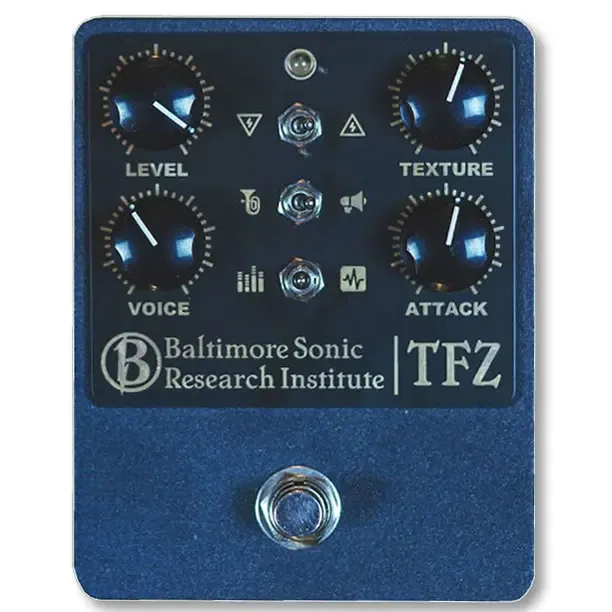


The TFZ Fuzz is a vintage transistor-based fuzz from BSRI Audio, the pedal company formally known as the Baltimore Sonic Research Institute. It is built around tested and selected vintage transistors, which the maker reserves for this pedal alone, and it is designed to cover a wide stretch of dirt tones in one box: overdrive, distortion, and on into compressed, splattery fuzz with hints of octave, ghost tones and horn emulation1. Designer David Gill's stated aim, as Delicious Audio reports it, was a single pedal covering that whole range, and the control set goes well beyond the usual Volume and Fuzz knobs of a fuzz pedal.
The controls
The TFZ Fuzz carries three knobs and two switches, each shaping a different part of the circuit1:
| Control | What it does |
|---|---|
| Level | Sets the output volume. Ample boost above unity is available. |
| Attack | Sets the input gain of the circuit, from light boost to heavy clipping. |
| Voice | Tilt EQ control combining a low pass and high pass filter for frequency compensation. |
| Texture | Adjusts the voltage fed to a portion of the circuit, changing both the dynamic range of the clipping amp and the character of the clipping. |
| Voltage switch | Sets the range of the Texture control. To the right lie punchier and clearer tones; to the left lie compressed, starved and glitchy soundscapes. |
| Tuba/Megaphone switch | Selects between two frequency ranges feeding the clipping circuit, which alters the feel and response of the pedal. |
The Texture and Voltage controls work as a pair: the Voltage switch defines the territory, and Texture moves within it. With Voltage to the right the pedal stays punchier and clearer; to the left it heads into starved, glitchy sounds that come from deliberately restricting the voltage reaching part of the circuit1.
The clipping switch
A three-position clipping switch rounds out the panel, and its positions map neatly onto the pedal's range1:
- Center: the cleanest and most dynamic range.
- Left: a higher-gain, smooth overdrive tone.
- Right: the most distortion.
At the low end of the Attack control the pedal works as a light boost, which makes the center clipping position a usable clean-ish setting; the left position reaches toward overdrive territory and the right into distortion1.
Tuba or Megaphone
The Tuba/Megaphone switch is the pedal's most distinctive control. It selects between two frequency ranges feeding the clipping circuit, and the choice changes the character of the fuzz entirely. Megaphone keeps things tight and guitar-like, while Tuba delivers horn-like sounds and suboctaves, especially at low Texture settings1. Players after a bass-adjacent fuzz voice will find it on the Tuba side; the Megaphone side sits closer to a conventional guitar fuzz.
Oscillation: what to know
Some combinations of settings may cause the TFZ Fuzz to oscillate. Raising the Attack control setting will usually cut off the oscillation while keeping the sound, per Delicious Audio's write-up of the pedal1.
This is a behavior of the circuit rather than a fault, and it is the kind of instability voltage-starved fuzz designs can exhibit. If the pedal starts squealing at an extreme setting, turning Attack up is the first move.
Design and background
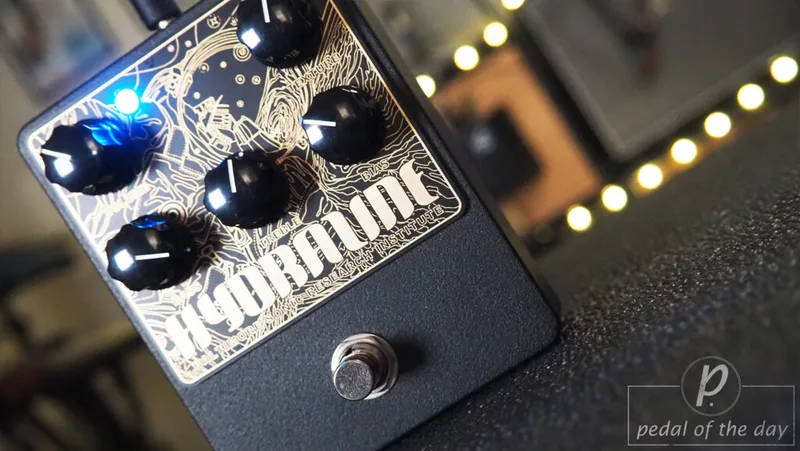
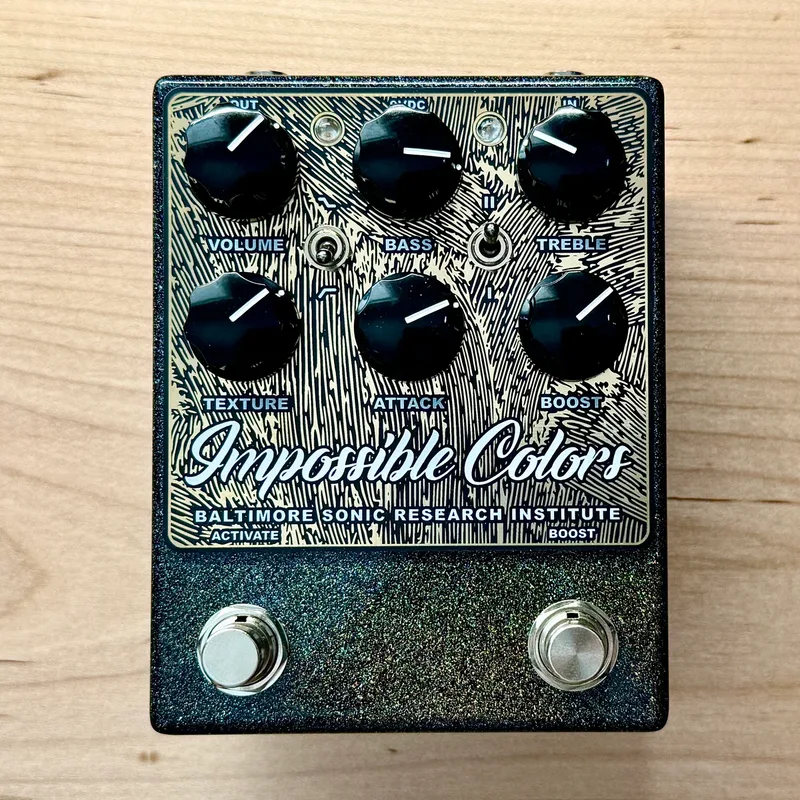
The TFZ is unique among BSRI Audio products in using vintage transistors, tested and selected for each unit, to achieve its complex blend of tones1. David Gill designs and builds the pedals himself; Delicious Audio describes him as "actually just one dude called David Gill who is into Doom Metal"1. BSRI's range has since grown to include pedals such as the Hydrazine, a Harmonic Percolator-inspired fuzz, and the Impossible Colors II1.
Videos
Demos In The Dark
Joel Gilardini
Questions
Who designed the BSRI Audio TFZ Fuzz?
The TFZ Fuzz was designed by David Gill, the builder behind Baltimore Sonic Research Institute (BSRI). Delicious Audio's profile of the pedal describes him as a one-man operation with an interest in doom metal, and quotes his aim of making a single pedal that could cover dirt tones from overdrive through distortion into compressed, splattery fuzz.
Does the TFZ Fuzz use germanium or silicon transistors?
BSRI does not specify the transistor type. What the maker's materials do say, as reported by Delicious Audio, is that the TFZ is unique among BSRI Audio products in using vintage transistors, tested and selected for each individual unit, to achieve its blend of tones.
Why does the TFZ Fuzz oscillate and how do you stop it?
Some combinations of the pedal's settings may cause the circuit to oscillate. Delicious Audio notes that raising the Attack control setting will usually cut off the oscillation while keeping the sound, so the fix is simply to turn the Attack knob up when it starts.
What does the Tuba/Megaphone switch do?
The Tuba/Megaphone switch selects between two frequency ranges feeding the clipping circuit, which changes the feel and response of the pedal. Megaphone stays tight and guitar-like, while Tuba delivers horn-like sounds and suboctaves, particularly at low Texture settings.
Can the TFZ Fuzz be used as a clean boost?
Yes, at the low end of its range. The Attack control sets the input gain from light boost to heavy clipping, and the Level control offers ample boost above unity, so with Attack low the pedal can act as a boost. The clipping switch's center position also gives the cleanest, most dynamic range.
Sources (1)
- BSRI Audio TFZ Fuzz, Delicious Audio, 2021-09-23