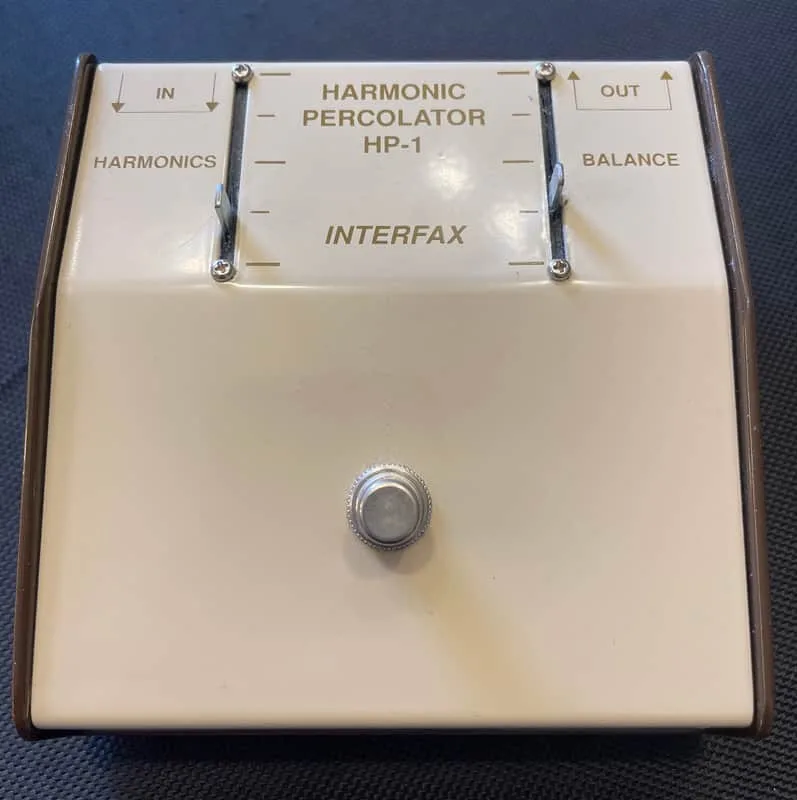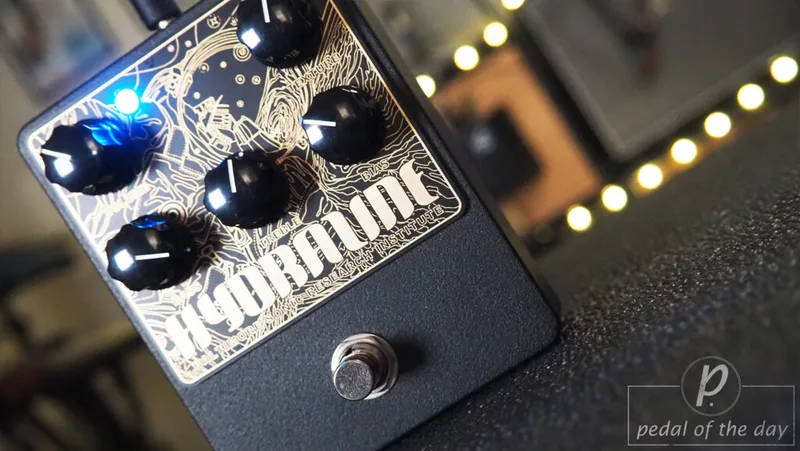


The BSRI Audio Hydrazine is a fuzz pedal from BSRI Audio, described by Delicious Audio as an emerging Baltimore-based builder. It is a modern take on the Harmonic Percolator fuzz circuit, built with period-correct NOS germanium and silicon transistors and germanium diodes1. Pedal of the Day reviewed it in April 2026 as the Hydrazine Harmonic Percolator Fuzz, in a black and gold enclosure2.
The circuit it comes from
The original is the Interfax HP-1 Harmonic Percolator, a two-transistor fuzz that used a PNP germanium transistor paired with an NPN silicon transistor, allowing it to run in a standard negative-ground configuration3. Guitar Pedal X notes the original featured 2N404 germanium and 2N3565 silicon transistors4. Unlike most germanium fuzzes, the Harmonic Percolator uses clipping diodes3, which is central to how the design behaves.
The Hydrazine follows that blueprint with its own NOS germanium and silicon transistor pairing and germanium diode clipping2. Pedal of the Day describes it as "a modern interpretation of the Interfax Harmonic Percolator with updates to give players a wider range of tones"2.
Controls
| Control | What it does |
|---|---|
| Texture | Continuous adjustment of the clipping threshold, for a wide range of tones between transistor overdrive and compressed full diode clipping distortion2 |
| Tone | Basic tone sculpting; not present in the original1 |
The Texture knob is the Hydrazine's distinguishing control. Delicious Audio's Paolo De Gregorio wrote that it "allows to vary the clipping threshold, producing a wide range of tones 'between transistor overdrive and compressed full diode clipping distortion'"1. In practice that means one knob sweeps the pedal's character from a softer, transistor-driven edge to a harder, fully clipped distortion, which is a wider span than the original circuit offered on its own.
The Tone knob is an addition rather than a restoration: "The Tone, knob, not present in the original, delivers basic tone sculpting"1. The core amplifier circuit has also been modified for improved clarity and punch1.
How it sits among other Percolators
The Harmonic Percolator has attracted several modern builders, and the Hydrazine's approach of NOS parts with circuit updates is a common one21:
- Fredric Effects builds a Harmonic Percolator that "uses the correct vintage transitors (NOS 2N404 Germanium and 2N3565 Silicon)"5, and also offers a silicon version using an East German diode array paired with NOS silicon transistors.
- Bowman Audio Endeavors makes a Harmonic Percolator that, "Based specifically off of the original... uses the same NOS NPN and PNP transistors as the vintage models"6.
What sets the Hydrazine apart within that field is the Texture control's continuous clipping-threshold adjustment and the modified core amplifier aimed at clarity and punch2.
Videos
collector//emitter
Pedal of the Day and PedalxChange
Questions
What circuit is the BSRI Audio Hydrazine based on?
The Hydrazine is a modern interpretation of the Interfax Harmonic Percolator, the two-transistor fuzz from the early 1970s that paired a PNP germanium transistor with an NPN silicon transistor. BSRI Audio's version modifies the core amplifier circuit for improved clarity and punch and adds a Texture control for a wider range of tones than the original offered.
Does the Hydrazine use germanium or silicon transistors?
Both. The Hydrazine is built with period-correct new-old-stock germanium and silicon transistors, matching the transistor pairing of the original Interfax Harmonic Percolator, which used a 2N404 germanium and a 2N3565 silicon.
What does the Texture knob do?
The Texture knob allows continuous adjustment of the clipping threshold. Across its travel it produces a wide range of tones, from transistor overdrive at one end to compressed, full diode clipping distortion at the other, which is what gives the Hydrazine its range beyond a straightforward Percolator clone.
What type of clipping diodes does it use?
The Hydrazine uses germanium diodes for clipping, along with its NOS germanium and silicon transistors. Clipping diodes are a defining trait of the Harmonic Percolator design, which used them unlike most germanium fuzzes of its era.
Sources (6)
- BSRI Audio Hydrazine Fuzz, Delicious Audio, 2022-02-03
- BSRI Audio + PEDALXCHANGE.com Hydrazine Harmonic Percolator Fuzz, Pedal of the Day, 2026-04-25
- Particle Vintage Fuzz / Interfax Harmonic Percolator, Aion FX, 2021-02-19
- Guitar Pedal X, Guitar Pedal X, 2024-05-13
- Interfax Spec Harmonic Percolator, Fredric Effects
- Bowman Audio Endeavors Harmonic Percolator, Pedal of the Day, 2020-12-12