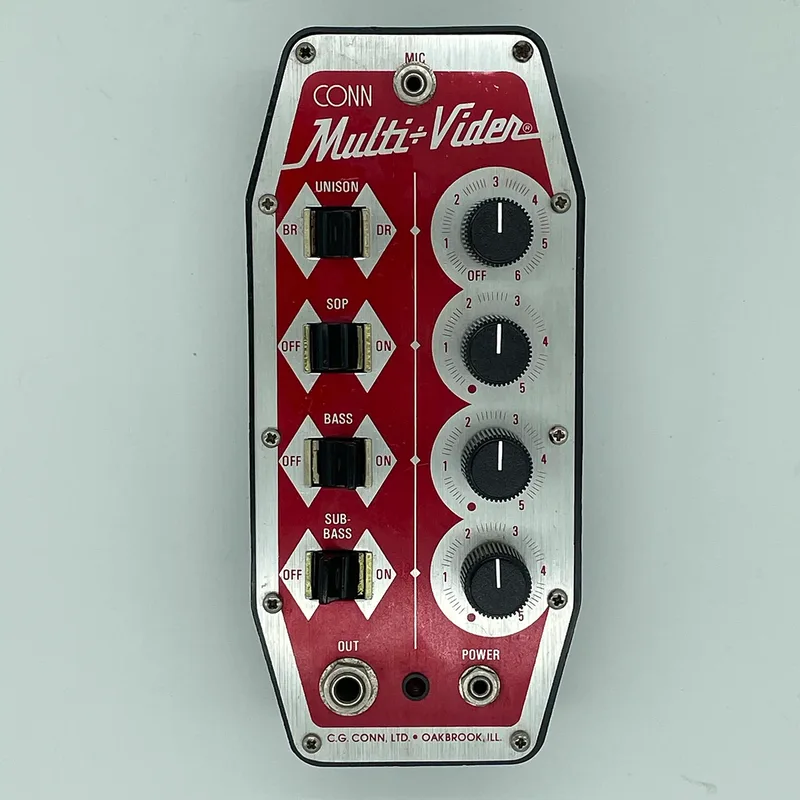


The Conn MultiVider is an octave effect for wind instruments, released in 1967 by horn maker C.G. Conn. Conn partnered with Jordan Electronics of Alhambra, California to build it, and Catalinbread's history of the unit calls the result the first-ever octave effect for an electronic instrument1. It was not made for guitar: the MultiVider is a horns-only instrument, meant to be used with Conn's proprietary woodwind pickup and a microphone input1. It belongs to the wider family of octave and pitch effects, but its origins are entirely in the horn world.
Who made it, and when
C.G. Conn wanted in on the nascent effects scene in 1967 and partnered with Jordan Electronics to release the octave effect for wind instruments1. Conn later went into manufacturing itself, ending the Jordan partnership, which is why there are two different MultiViders1. In a JHS Pedals demo video, Josh Scott noted the company dates back to around 1967 and described the unit as made by C.G. Conn Limited of Brook, Illinois2.
The MultiVider has a documented connection to a famous act: Catalinbread notes that the MultiVider was used by Zappa's band, the Mothers of Invention1.
The two versions
The first model is gray and looks like a piece of dictation equipment, and it came with what Catalinbread describes as a plethora of battery gadgets1. The later model, the 914, did away with the frequency selector and added a switch called Unison along with a power supply input1.
| Feature | Gray box model | 914 |
|---|---|---|
| Input modes | "Bright" and "dark" input modes | Frequency selector removed |
| Sensitivity | Top-mounted Sensitivity control | Not described |
| Voice switches | "Soprano," "Bass" and "Sub Bass" switches with corresponding volume for each | Same switches |
| Extra control | None described | Unison switch, essentially a dry signal control |
| Circuit | Duo of ersatz flip-flop circuits for octave down | CD4013 chip, an all-in-one CMOS device |
| Power | Battery gadgets | Adapter-only, 12-volt eighth-inch style phone plug |
Both models contain the "Soprano," "Bass" and "Sub Bass" switches, and corresponding volume for each1.
The controls
The gray box model offers "bright" and "dark" input modes and a top-mounted Sensitivity control1. On both models, the "Soprano," "Bass" and "Sub Bass" switches each have a corresponding volume control1. On the 914, the Unison switch is essentially a dry signal control1.
One caution from the JHS Pedals demo: on the unit they examined, the switches for octave up, octave down and sub bass did not do anything2.
"these switches which are supposed to be an octave up octave down and a sub bass do not do anything"
Inside the 914
The 914's circuit differs from the original. In the later 914 model, much of the circuit is switched to a CD4013 chip, an all-in-one CMOS device, where the gray box relies on a duo of ersatz flip-flop circuits for its octave down effects1. Catalinbread also notes there is a wah inductor on the 914, connected to the sub-octave circuit somehow1.
Power
The 914 is adapter-only, and the requirement is unusual: only a 12-volt eighth-inch style phone plug will do1. That is not the standard barrel connector players are used to, so a typical pedalboard power supply will not fit.
The 914's power input is a 12-volt eighth-inch style phone plug, not a standard pedal connector1. Do not assume a normal adapter will work.
Using one with a guitar
The MultiVider was built for horns, with a microphone input you would hook up to a clarinet or similar2. In the JHS Pedals video, Josh Scott said you can put a guitar, or anything, through it, but that you need to use a big preamp2. Players experimenting with one today should plan on that preamp stage ahead of the unit.
Videos
vatrouz
Sean Mason
Francisco Sánchez de la Vega
Questions
Who made the Conn MultiVider?
The MultiVider was made by C.G. Conn, a company better known for horns. In 1967 Conn partnered with Jordan Electronics of Alhambra, California to release the octave effect for wind instruments. Conn later went into manufacturing itself, ending the Jordan partnership, which produced two different MultiViders: the original grey box model and the later 914.
Can you use a guitar with the Conn MultiVider?
The MultiVider was designed as a horns-only instrument, meant to be used with Conn's proprietary woodwind pickup and a microphone input. In a JHS Pedals demo video, Josh Scott noted that you can put a guitar or anything through it, but that you need to use a big preamp to make it work.
What power supply does the Conn MultiVider 914 need?
The 914 is adapter-only and takes an unusual power supply input: according to Catalinbread's history of the unit, only a 12-volt eighth-inch style phone plug will do. That is not a standard pedal power connector, so players will need the correct adapter rather than a typical pedalboard supply.
What chip does the Conn MultiVider 914 use?
In the later 914 model, much of the circuit is switched to a CD4013 chip, an all-in-one CMOS device. The original grey box model instead relies on a duo of ersatz flip-flop circuits for its octave down effects. The 914 also carries a wah inductor connected to the sub-octave circuit.
Did Frank Zappa's band use the MultiVider?
Yes. According to Catalinbread's history of the unit, the MultiVider was used by Zappa's band, the Mothers of Invention.
Sources (2)
- Conn MultiVider, Catalinbread Effects, 2021-12-10
- Totally Normal Behavior (Ep. 4), Featuring an early Death by Audio unit and the Conn Multi-Vider, JHS Pedals (YouTube), 2022-06-17