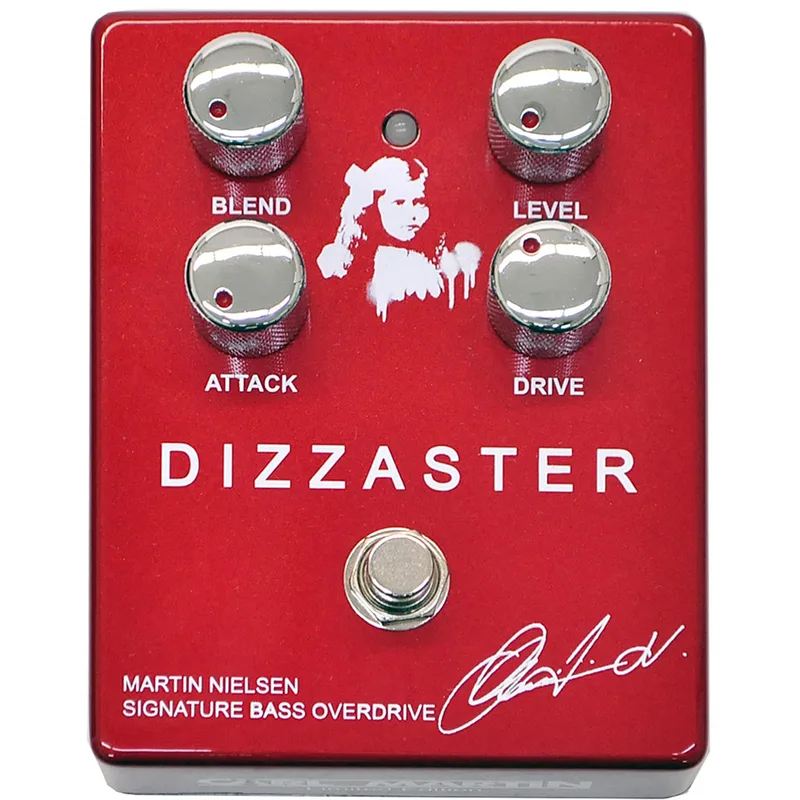

The Carl Martin Dizzaster is a bass overdrive pedal that combines compression, overdrive, and EQ in a single box, developed to the specifications of Martin Nielsen, bassist of Dizzy Mizz Lizzy1. Carl Martin describes it as a limited edition of 250 pieces worldwide1.
What it does to a bass signal
The Dizzaster is built around a special EQ filter designed specifically for the bass frequency spectrum, working in conjunction with the Drive control. Carl Martin states that this filter is what sets the pedal apart from conventional bass overdrives1.
According to the maker, the pedal is designed to preserve low-end integrity while adding harmonic content, so the bass stays defined and controlled rather than collapsing into fuzz. The internal compression and filtering are what keep that low end intact as the overdrive pushes harder1.
Controls
| Control | What it does |
|---|---|
| Drive | Controls the amount of harmonic content and overdrive saturation, working with the special bass EQ filter1 |
| Attack | Determines how quickly the built-in compressor engages, from fast, tight compression to slower, more transparent compression1 |
| Level | Controls the output volume of the processed signal before it reaches the Blend control1 |
| Blend | Mixes processed signal with dry signal, retaining fundamental clarity while adding overdrive character1 |
The Blend control is the one bass players will care most about: because it mixes the clean bass tone back in, you can add overdrive character on top while the fundamental stays clear underneath1.
Power
The Dizzaster runs on a standard 9V DC power supply, which is not included with the pedal1.
The Dizzaster is a limited edition of 250 pieces worldwide1. As a small-run pedal, it is not a standard catalog item, so finding one means looking at dealers or the secondhand market.
Related pedals
The Carl Martin Dizzaster gives bass players three main controls: Level controls the output volume of the processed signal before it reaches the Blend control, Drive sets the amount of harmonic content and overdrive saturation through a special EQ filter designed for bass frequencies, and Blend mixes the processed signal with the dry tone so the fundamental stays clear while the overdrive sits on top1. Carl Martin describes the design as preserving low-end integrity while adding harmonic content, keeping the bass defined rather than collapsing into fuzz1. For other options in this territory, see Bass Pedals, Overdrive Pedals, and Compressor Pedals.
Videos
Guitar Hunter
Questions
How many Carl Martin Dizzaster pedals were made?
The Dizzaster is a limited edition bass overdrive pedal, with 250 pieces made worldwide according to Carl Martin's product page. That makes it a small production run rather than a standard catalog pedal, so availability depends on whether units are still with dealers or previous owners when you go looking.
Who designed the Carl Martin Dizzaster?
Carl Martin developed the Dizzaster to the specifications of Martin Nielsen, the bassist of the Danish rock band Dizzy Mizz Lizzy. The pedal was designed specifically for him, and its compression, overdrive, and EQ circuitry was built around what he needed from a bass overdrive.
What does the Attack knob control on the Dizzaster?
Attack determines how quickly the Dizzaster's built-in compressor engages. Turned one way it gives fast, tight compression; turned the other it gives slower, more transparent compression. It shapes how the internal compression section responds to your playing dynamics before the overdrive stage.
What power does the Dizzaster use?
The Dizzaster is powered by a standard 9V DC supply, which is not included with the pedal. Use a supply with the usual center-negative polarity and avoid sharing it on a daisy chain with high-draw digital pedals.
Sources (1)
- Dizzaster, Carl Martin, 2026