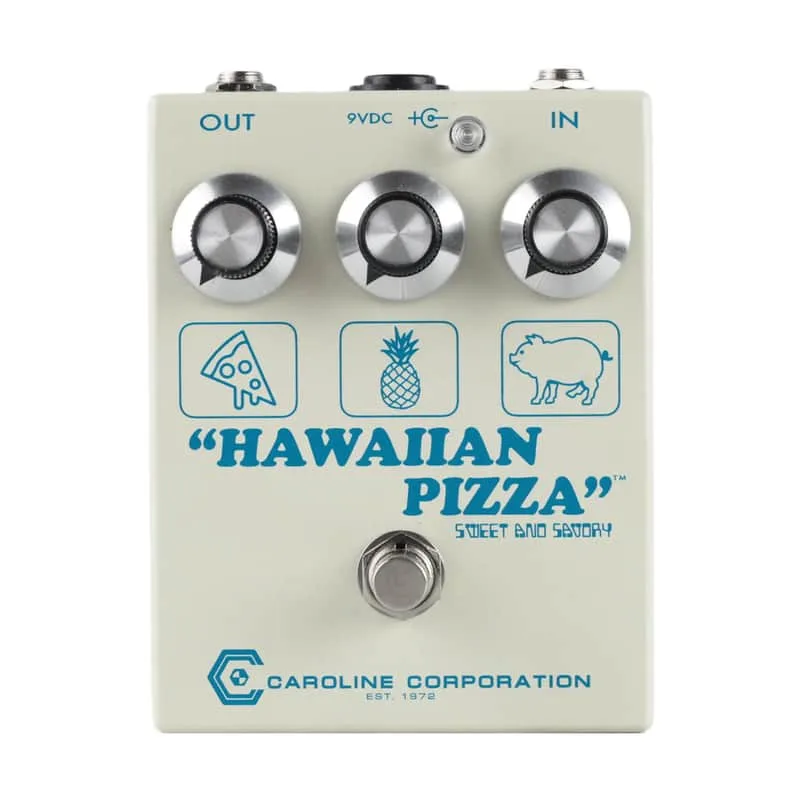


The Hawaiian Pizza is a fuzz and drive pedal from Caroline Guitar Co., a maker run by Philippe Herndon out of Columbia, South Carolina. Presented as a "Drive/Fuzz" with the subtitle "Sweet and Sour," it sits in the overlap between overdrive and fuzz: lower input settings produce overdriven tones, while higher levels deliver a more fuzz-like sound1.
Under the hood it is a Fuzz Face-derived circuit, originally with some significant changes, typically built around two 2N5088 silicon transistors2. Delicious Audio describes it as an elaboration on a classic fuzz circuit with special twists from designers Philippe of Caroline and John Snyder of Electronic Audio Experiments1.
Where it came from
The Hawaiian Pizza was originally released as a one-day-only limited edition pedal to help raise money for Girls Rock3. In October 2018, Caroline Guitar Company re-released it, with Gearnews calling it "more of a re-release than a re-heat" and noting it was "back on the menu to enjoy and savour once more" at a recommended price of USD 169.993. By December 2018, the first run of the re-release had already sold out1. A 2021 limited CCCP Edition followed, listed at $1692.
The project was built with help from Electronic Audio Experiments, the pedal maker of designer John Snyder, who collaborated on the circuit3. JHS Pedals' Josh Scott later name-checked the pedal as "the Hawaiian Pizza fuzz pedal, made by my friend Philippe Herndon at the Caroline Guitar Company" in a piece on pedals named after food4.
The controls
The pedal keeps things to three knobs, which Gearnews describes as controls that interact heavily with one another, so players will want to experiment with various settings to get the most out of it3.
| Control | What it does |
|---|---|
| Output Level (pizza symbol) | Controls the overall volume of the Hawaiian Pizza circuit3 |
| Voltage Cut / Starve | Controls the bias of the fuzz, from medium-crunchy tones all the way through to lo-fi dirty fuzz tones3 |
| Input Trim (Clean-Up) | Sets the input level; lower "in" volumes produce overdriven tones, higher levels deliver a more fuzz-like sound1 |
Delicious Audio found "a myriad of rad sounds available from just three interactive controls," which are as simple as it gets: input, output and voltage1. The Out knob adds an extra variation in the way the amp interacts with the pedal's output level1.
The Starve knob and the sound
The Starve control is the pedal's signature twist. Because it controls the bias of the fuzz, it lets a player move from medium-crunchy drive tones through to lo-fi dirty fuzz tones, including gated-fuzz territory pushed to the extremes3. Gearnews characterizes the pedal as having a distinctly British voicing, with a gated-fuzz tone pushed to the extremes3.
"…an unbelievable sounding and versatile fuzz-drive"
The pickup simulator
Inside the pedal is an internal passive guitar pickup simulator. Delicious Audio notes this lets the Hawaiian Pizza handle being placed anywhere in the signal chain1. That matters for a Fuzz Face-style circuit, which is normally happiest first in the chain, directly after the guitar's pickups.
The Fuzz Face lineage
The Fuzz Face is a classic guitar effects pedal known for its distinctive fuzz and distortion sound5, and its design was inspired by other contemporary fuzzes like the Maestro Fuzz Tone and the Sola Sound ToneBender56. The Hawaiian Pizza takes that lineage and reworks it with silicon transistors, a bias-starve control and an input trim, rather than copying the original topology outright2.
On video
The Hawaiian Pizza sits in the territory between overdrive and fuzz: according to the maker, lower input volumes produce overdriven tones, while higher levels deliver a more fuzz-like sound1.
Videos
Reverb
Brett Kingman
collector//emitter
Questions
What does the Starve knob do on the Caroline Hawaiian Pizza?
The Starve control, also described as Voltage Cut, adjusts the bias of the fuzz circuit. Gearnews found it takes the pedal from medium-crunchy tones all the way through to lo-fi dirty fuzz tones, so it shapes the character of the fuzz rather than just its amount.
What transistors does the Hawaiian Pizza use?
The Hawaiian Pizza typically uses two 2N5088 silicon transistors, according to Guitar Pedal X. That puts it in the silicon Fuzz Face family rather than the germanium camp, which means a brighter, more consistent fuzz that is less sensitive to temperature.
Who designed the Caroline Hawaiian Pizza?
The pedal was designed by Philippe Herndon of Caroline Guitar Company together with John Snyder of Electronic Audio Experiments, who collaborated on the project. Delicious Audio describes it as an elaboration on a classic fuzz circuit with special twists from both designers.
Is the Caroline Hawaiian Pizza still available?
The pedal began as a one-day-only limited edition to raise money for Girls Rock, then was re-released in October 2018 at a listed price of USD 169.99. The first run of the re-release sold out, and a 2021 limited CCCP Edition followed at $169.
What is the pickup simulator in the Hawaiian Pizza?
Inside the pedal is an internal passive guitar pickup simulator. Delicious Audio notes it lets the Hawaiian Pizza handle being placed anywhere in the signal chain, since the fuzz circuit sees something closer to a real guitar pickup wherever the pedal sits.
What was the CCCP Edition of the Hawaiian Pizza?
The CCCP Edition was a 2021 limited edition version of the Hawaiian Pizza, listed by Guitar Pedal X at $169. It carried the same silicon-transistor fuzzy-drive circuit as the standard pedal in a limited run.
Sources (6)
- Caroline Guitar Co. Hawaiian Pizza, Delicious Audio, 2018-12-18
- Guitar Pedal X, Guitar Pedal X, 2021-08-23
- Caroline Guitar Company re-delivers the Hawaiian Pizza boutique fuzz pedal, www.gearnews.com, 2018-10-30
- PEDALS VS FOOD, JHS Pedals
- The guitar pedal that changed the world the Fuzz Face, Tru-Fi (tru-fi.com)
- Fuzz Face Analysis, GuitarPCB