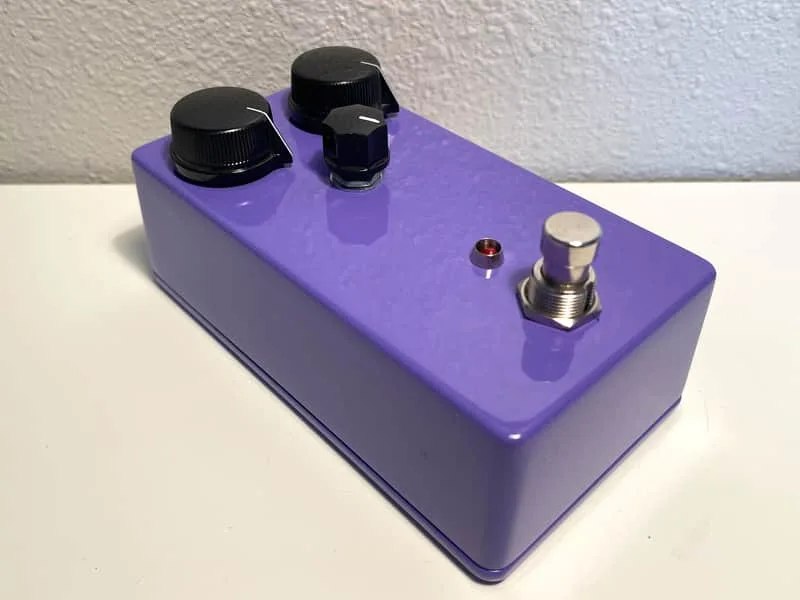


The Wizard is a distortion pedal from Castledine Electronics, described as "a new distortion pedal" when it appeared on Guitar FX Layouts1. Its stated aim is a specific player's sound: the pedal is inspired by Tony Iommi's guitar sound on the early Black Sabbath albums1. For a player chasing that style of overdriven amp tone, the pedal takes a familiar route: a modified Rangemaster principle driving a distortion circuit, in the same spirit as feeding a boost into a distortion or a cranked amp1.
How the circuit works
The design follows a principle Iommi himself was known to use. As Guitar FX Layouts put it, "It is well known that he used a modified Rangemaster to drive his amps, so the same principle was used for The Wizard"1. The Rangemaster, a classic treble booster circuit, is the heart of the pedal's first stage.
- The first gain stage is essentially a Rangemaster, using a germanium transistor, but tweaked for a full range boost1.
- That stage drives a distortion circuit, so the boost acts as the engine pushing the distortion stage, following the principle Iommi used to drive his amps1.
- In the published layout, the germanium transistor in the Rangemaster-style first stage is a CV7351, with builders discussing MP38 or MP21A as replacements1.
Germanium transistors are a defining part of this kind of circuit, and they are also the reason pedals like this sit near fuzz territory in feel: the transistor choice shapes the way the gain stage clips and responds to the guitar's volume control.
"The first gain stage is essentially a Rangemaster, using a germanium transistor, but tweaked for a full range boost."
What builders reported
The Wizard circulated mainly as a DIY stripboard (vero) layout, published by Guitar FX Layouts1. Builders who put the circuit together reported one practical issue worth knowing before you build or buy into this design:
"Output volume is low just barely reaching unity fully cranked"
In other words, even with the output control turned all the way up, the pedal was reported to barely reach unity with the clean signal. A player used to pedals with a substantial volume lift on top of the gain would notice the difference, and it matters if the pedal is meant to push an amp harder1.
A later revision note on the layout (15 June 2020) specifies that a 47 ohm resistor should sit between the 100uF capacitor and the 9 volt pad in the power section1. Anyone building from the original layout should account for this.
Where it sits on a board
As a Rangemaster-derived boost into distortion, The Wizard is closest in role to a gain-staging pedal: it shapes the front end of an amp or drives a following distortion stage, rather than acting as a time or modulation effect. Players comparing it with other gain options would weigh it against a straight overdrive or a preamp pedal, with the germanium first stage and the Iommi-inspired voicing as its distinguishing features1.
Videos
daCod77
pinstripedclips
MMCGuitar
Sources (1)
- Guitar FX Layouts: Castledine Electronics The Wizard, Guitar FX Layouts (tagboardeffects.blogspot.com), 2017-10-22