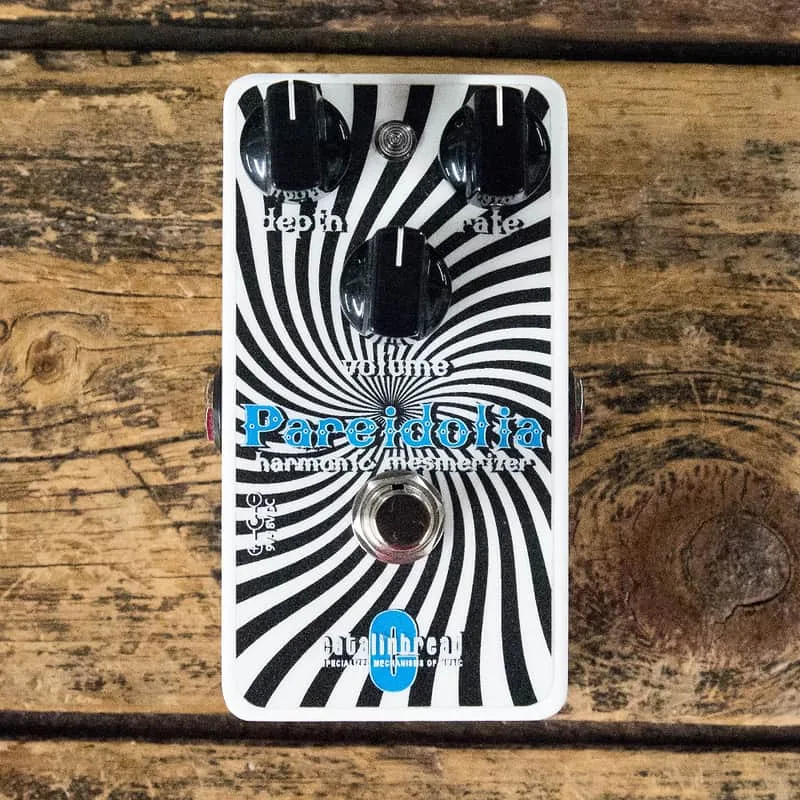


The Catalinbread Pareidolia, sold as the Pareidolia Harmonic Mesmerizer, is an analog pedal that re-creates the harmonic tremolo found in Fender's early-60s "Brownface" amps. Unlike a standard tremolo, which simply turns the volume up and down, harmonic tremolo is built around a dual-band filtering effect, so the high and low parts of your tone move against each other. MusicRadar's reviewer Trevor Curwen called it "the most aurally intriguing" of the amp tremolo types, and describes the Pareidolia's take on it as tremolo-based with elements of both phasing and pitch modulation, "somewhat akin to a Uni-Vibe or rotary speaker, casting a gorgeous otherworldly haze over the tremolo."1
What harmonic tremolo does to your sound
Fender fitted harmonic tremolo to a short run of its early-60s Brownface amps, and it works by splitting the signal into frequency bands and modulating them in opposition, rather than chopping the whole signal as a conventional tremolo does. The result, as Curwen hears it in the Pareidolia, carries hints of phasing and pitch modulation, which is why he compares it to a Uni-Vibe or a rotary speaker.1
Premier Guitar's announcement notes that like most other Catalinbread pedals, the Pareidolia was designed for both 9V and 18V operation, the latter giving "a more pronounced up-front sound to the effect."2
The pedal runs on 9V DC center-negative power and draws 1mA, so it sits comfortably on a daisy chain or a small supply. Running it at 18V changes the character: Premier Guitar describes the 18V sound as more pronounced and up-front.23
The controls: Depth, Rate and Volume
The Pareidolia keeps things simple with three knobs.1
| Control | What it does |
|---|---|
| Depth | Standard tremolo depth; Premier Guitar describes its range as going "from just a slight shimmer in your sound to undulating ocean waves"12 |
| Rate | Standard tremolo rate; Premier Guitar describes it as ranging "from molasses slow phase sweeps to lush tremolo and skittery chops"12 |
| Volume | Hits unity gain at about midway, so pushing it further can give your amp a nice kick1 |
Turn the depth down and the pedal doubles as a pure boost, with the Volume knob supplying the level.1
What reviewers said
MusicRadar's review, by Trevor Curwen, sums the pedal up this way:
"Vintage tremolo with a distinctive voice revisited. And, yes, you'll be mesmerised by it."
His reasons to buy were that the vintage tones are "executed superbly," and under reasons to avoid he found "very few."1
Where it sits among Catalinbread's tremolos
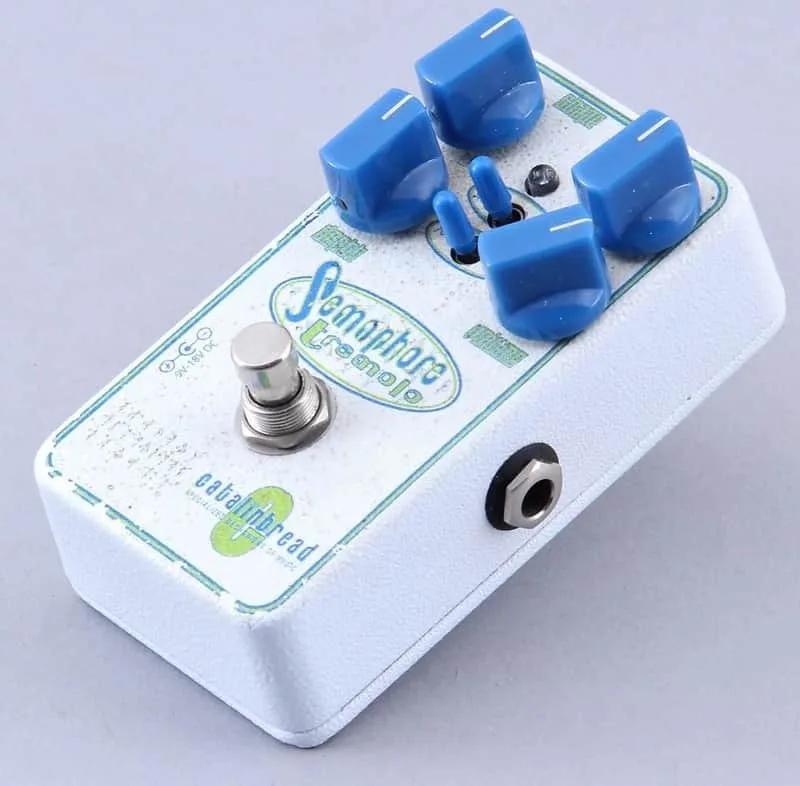
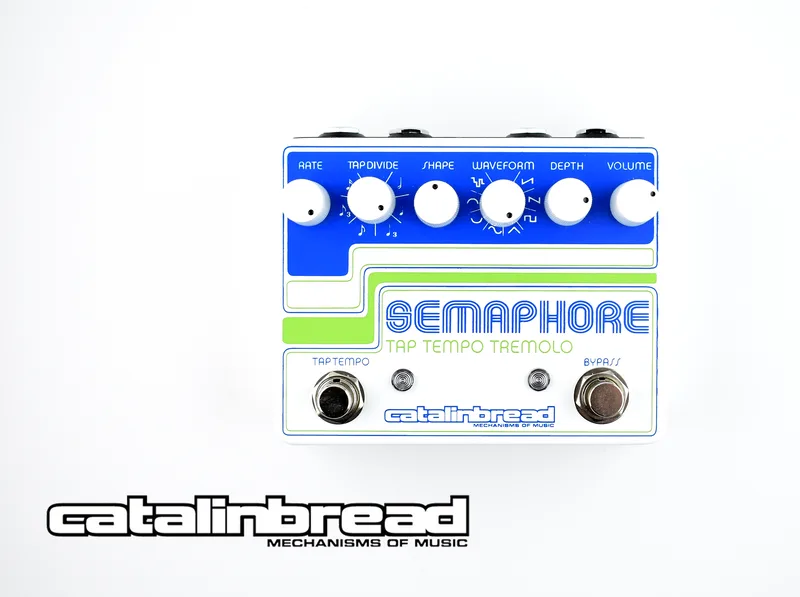
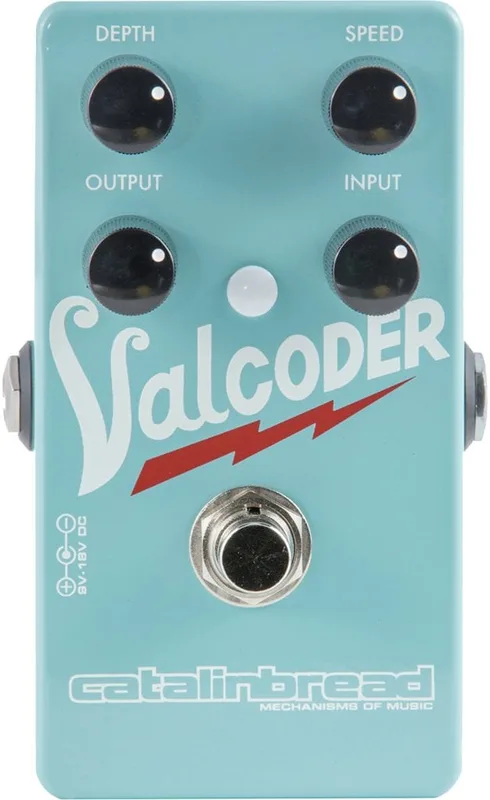
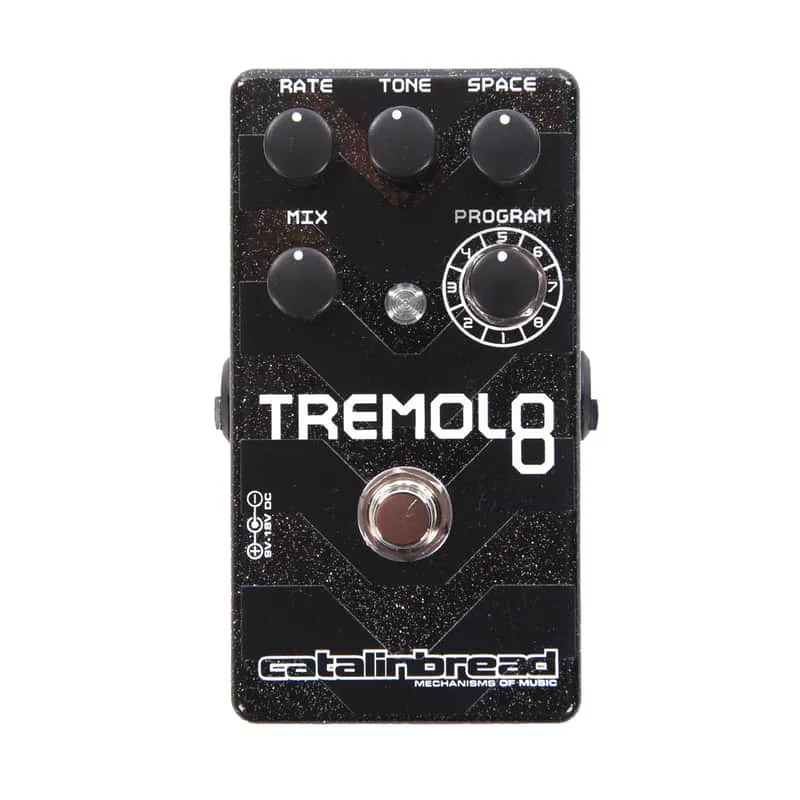
Catalinbread has built several tremolos beyond the Pareidolia, each taking a different approach: the Catalinbread Semaphore and Semaphore Tap Tempo Tremolo are conventional tremolos with waveform and tap tempo features, the Valcoder is a tremolo with a photo-cell based design, and the Tremolo8 offers eight tremolo programs with a reverb dial. The Pareidolia is the one aimed specifically at the Brownface harmonic tremolo sound. For more on the effect type itself, see Tremolo Pedals1.
Videos
Catalinbread Effects
musictoyznetwork rasch
Brett Kingman
Questions
Can the Catalinbread Pareidolia be used as a boost?
Yes. MusicRadar's reviewer Trevor Curwen notes that with the depth turned down, the Pareidolia can be used as a pure boost. The Volume knob reaches unity gain at about midway, so pushing it past that point can also give your amp a nice kick, making the pedal useful as a clean volume boost as well as a tremolo.
Is the Catalinbread Pareidolia analog?
Yes. RockBoard's PedalPedia listing for the Pareidolia gives its circuit type as analog. It is a pedal-format effect rather than a rack unit, and it runs on 9V DC center-negative power, with a current draw listed at 1mA.
How much current does the Catalinbread Pareidolia draw?
RockBoard's PedalPedia lists the Pareidolia's current draw at 1mA, which is very light by pedal standards. The pedal runs on 9V DC center-negative power, and Premier Guitar notes it was also designed for 18V operation, which gives the effect a more pronounced up-front sound.
Does the Pareidolia sound like a Uni-Vibe?
Not exactly, but it sits nearby. MusicRadar's Trevor Curwen describes the Pareidolia's sound as tremolo-based with elements of both phasing and pitch modulation, somewhat akin to a Uni-Vibe or rotary speaker, casting what he calls a gorgeous otherworldly haze over the tremolo. It is a harmonic tremolo rather than a phaser or vibe circuit.
Sources (3)
- Catalinbread Pareidolia review, MusicRadar, 2016-01-18
- Catalinbread Releases Pareidolia Harmonic Mesmerizer, Premier Guitar, 2010-06-16
- Pareidolia by Catalinbread, RockBoard PedalPedia, 2026