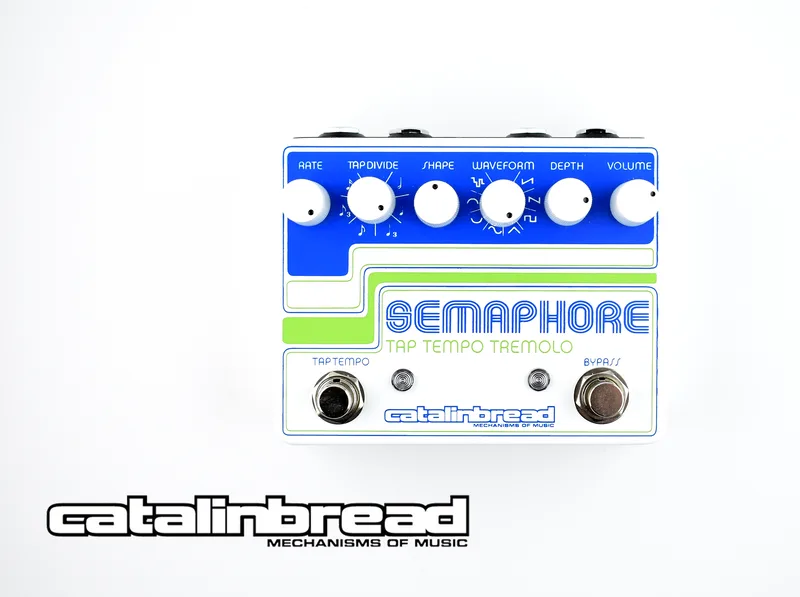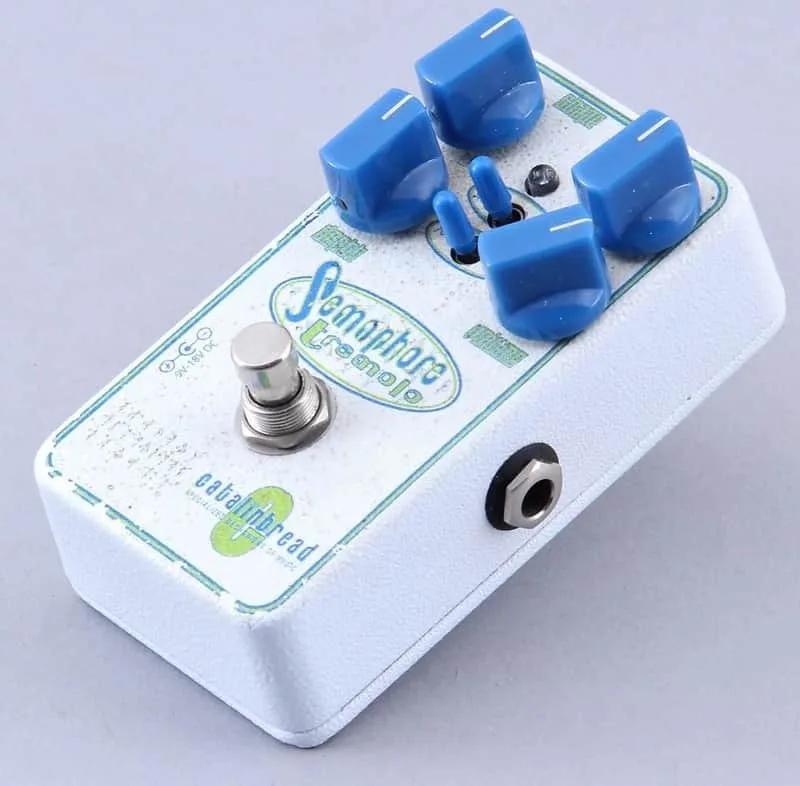


The Catalinbread Semaphore is a tremolo pedal from Catalinbread, handbuilt in Portland, Oregon1. The redesigned version, released November 1, 2011, is an analog tremolo with eight waveshapes, tap tempo and divide, a tap tempo input and expression pedal capabilities, priced at $249.99 at launch1. Its audio path uses optically controlled JFET gain stages, which Catalinbread described as sculpting a clean boost sound that stays present and alive without being peaky or harsh1.
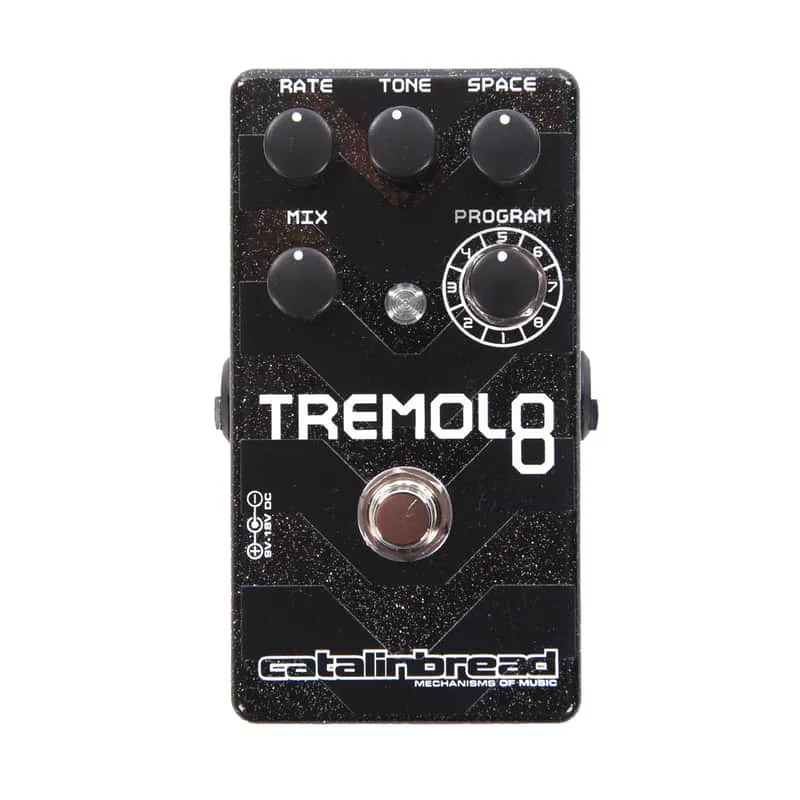
The Semaphore is no longer in production. Pedal of the Day noted in its 2020 review that "These are no longer in production"2. Catalinbread's later tap tempo tremolo is the Semaphore Tap Tempo Tremolo, and the company also makes the Tremolo8.
What the Semaphore does: an analog tremolo with eight waveshapes
A tremolo pedal raises and lowers the volume of your signal in a repeating cycle, and the shape of that cycle is what gives each tremolo its character. The Semaphore's Waveshape control provides eight waveshapes: sine, square, triangle, hyper-triangle, ramp up, ramp down, lumps, and random1. That range runs from the smooth, rounded swell of a sine wave to the hard on-off chop of a square wave.
Pedal of the Day's Mike B. found the range covered a wide spread of tremolo styles:
"Delivers classic tremolo sounds from the smooth and buttery coaxing of vintage "harmonic vibrato" to more modern aggressive hard chop "repeat percussion""3
Because it is analog, Mike B. also noted that "there is none of the sterile, fake digital clang you get from the "competition""3. The pedal packs this into a small enclosure, which he called pedalboard friendly territory: "So many sounds available in such a small enclosure"3. Premier Guitar likewise highlighted its small footprint and a feature set suited to both foot tappers and knob twiddlers1.
The controls
The Semaphore's front panel keeps things simple. Pedal of the Day found Catalinbread "kept it simple and easy to use with a minimum of tweaking required to find what you're looking for"3.
| Control | What it does |
|---|---|
| Waveshape | Selects one of eight waveshapes: sine, square, triangle, hyper-triangle, ramp up, ramp down, lumps, random1 |
| Shape | Morphs the selected waveshape; at noon the waveshape matches the Waveshape control's setting, and to either side it slants. Has no effect on the Random setting1 |
| Rate | Controls the speed of the tremolo; its sweep characteristics are affected by the position of the Tap Divide control1 |
| Depth | Dials in how much tremolo is in your signal; dialed all the way down the pedal works as a boost1 |
| Volume | Sets the overall output2 |
| Tap Divide | Takes your tapped tempo and multiplies it by the corresponding note beats; quarter note equals the tempo you tap out1 |
The Shape control is worth a closer look for players who want more than the stock waveforms. Premier Guitar explained that "The Shape control is used to morph the selected waveshape": at noon you hear the waveshape exactly as selected, and turning it to either side slants it, effectively generating variations on each of the eight shapes1. The one exception is the Random setting, where Shape has no effect1.
The Depth control doubles as the pedal's route into boost territory. With Depth dialed all the way down, the tremolo modulation disappears and the Semaphore can be used as a boost, drawing on those optically controlled JFET gain stages1.
Tap tempo, expression and MIDI sync
The Semaphore's timing features are what set it apart from a simple knob-only tremolo12.
- Tap tempo and divide: You tap in a tempo and the Tap Divide control multiplies it by the corresponding note beats. The quarter note setting represents the same tempo you tap out, so you can lock the tremolo to the tempo of a song and then choose faster subdivisions1.
- In-time rate control: Once a tempo is tapped in, the Rate control can function as an in-time rate control, letting you move between subdivisions without losing sync1.
- External tap input: The pedal has a tap tempo input jack for an external tap switch1.
- Expression pedal: An expression pedal plugged into the pedal nullifies the Rate control when connected, taking over the speed of the effect1.
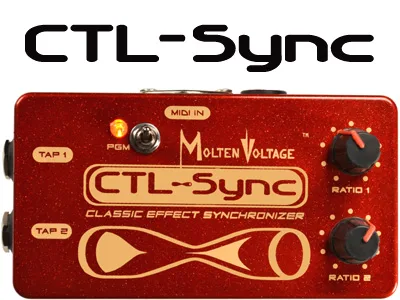
The tap input jack also opens a door to synchronization. The Semaphore can sync to MIDI clock using Molten Voltage's CTL-Sync, connected through its tap input jack4. Molten Voltage's index of guitar effect pedals that sync to MIDI lists the Semaphore Tremolo among the pedals that can sync to MIDI clock using CTL-Sync5. For players running tempo-synced rigs, that puts the Semaphore in the same category as other MIDI-clockable effects.
Old and new versions
There are two versions of the Semaphore. The redesigned version, announced November 1, 2011, quadrupled the number of waveforms over the original, going from two to eight, and added tap tempo and divide, the tap tempo input and expression pedal capabilities1. It launched at $249.991.
The older, more compact version was still in production as of Pedal of the Day's 2014 review, which covered that smaller pedal and its classic tremolo delivery3. By the 2020 review of the Semaphore Tap Tempo Tremolo, Pedal of the Day described the pedal as an upgrade of the smaller original with the quadrupled waveform count, and reported that these are no longer in production2.
What reviewers said
Pedal of the Day's 2020 review summed up the redesigned pedal's combination of eight waveforms, tap divide, external tap input, expression capabilities and the Shape contour that morphs the waveshape, concluding21:
"you've got one of the most well-rounded tremolos in existence"2
The same review praised its build quality, saying "the Semaphore is built like a tank"2. The earlier 2014 review of the compact version emphasized ease of use, with minimal tweaking needed to find the sound you want3.
Videos
ProGuitarShopDemos
Catalinbread Effects
Catalinbread Effects
Questions
Can the Catalinbread Semaphore be used as a clean boost?
Yes. The Depth control sets how much tremolo is in your signal, and with Depth dialed all the way down the Semaphore can be used as a boost. Catalinbread built its audio path around optically controlled JFET gain stages to shape a clean boost sound.
What is the difference between the old and new Catalinbread Semaphore?
The redesigned Semaphore, released November 1, 2011, quadrupled the number of waveforms over the original, giving it eight waveshapes, and added tap tempo and divide, a tap tempo input and expression pedal capabilities. The older compact version was still in production as of a 2014 review.
Is the Catalinbread Semaphore analog?
Yes. Pedal of the Day described it as analog, noting there is none of the sterile digital character found in some competing tremolos. Its audio path uses optically controlled JFET gain stages.
Where is the Catalinbread Semaphore made?
Like all of Catalinbread's pedals, the Semaphore is handbuilt in Portland, Oregon, as Premier Guitar reported at its release. Pedal of the Day's review also lists Portland, OR as its place of manufacture.
Does the Catalinbread Semaphore sync to MIDI clock?
Yes. It can sync to MIDI clock using Molten Voltage's CTL-Sync, connected through its tap input jack. Molten Voltage's index of MIDI-syncable effects lists the Semaphore Tremolo among the pedals that sync this way.
Sources (5)
- Catalinbread Releases Redesigned Semaphore Tap Tremolo, Premier Guitar, 2011-11-01
- Catalinbread Semaphore Tap Tempo Tremolo, Pedal of the Day, 2020-03-24
- Catalinbread Semaphore Tremolo, Pedal of the Day, 2014-02-26
- MIDI PedalBoard Devices: 28 Effects that can sync to MIDI Clock with CTL-Sync, Molten Voltage (blog.moltenvoltage.com), 2014-06-12
- MIDI PedalBoard Devices: Guitar Effect Pedals that Sync to MIDI Clock, Molten Voltage (blog.moltenvoltage.com), 2014-10-07