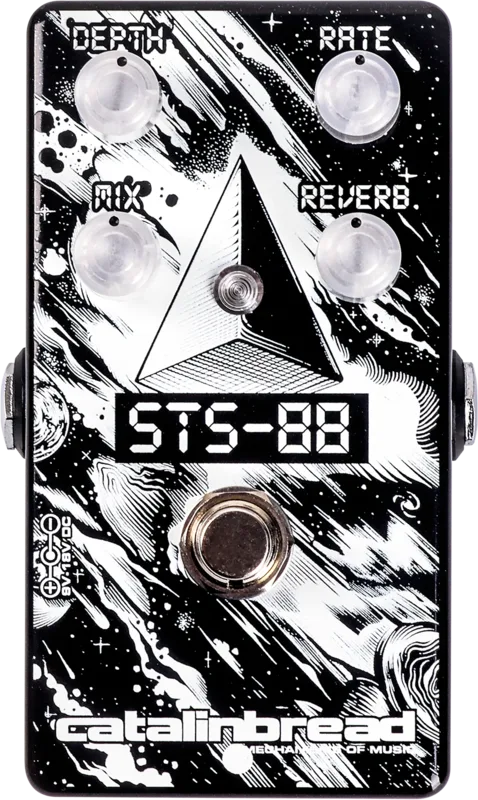



The Catalinbread STS-88 is a flanger pedal with a built-in reverb wrapped around the flange effect, made by the Portland builder Catalinbread. Catalinbread calls it "a love letter to the flanger," and the company says the result is an extremely musical flanger that sounds like an extension of your own instrument1. The sounds it is designed for range from musically unobtrusive and subtle to huge and ambient2.
The idea came out of what Guitar World described as a "late night frenzy of pedal swapping" in the Catalinbread research and development department, which saw the team envelope a flanger in a "cavernous reverb"3. Catalinbread's own account is that "we discovered that enveloping a flanger in a cavernous reverb really did the trick"1. Delicious Audio reports the reverb was added after the flanger as a homage to the shoegaze inclinations of the company and its fans4.
Where the circuit comes from
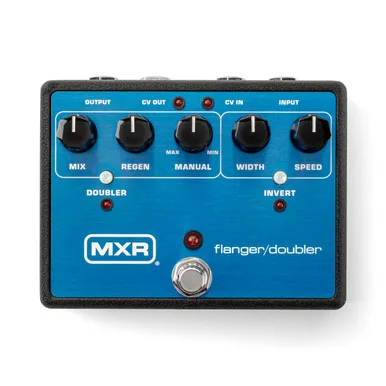
Catalinbread developed the STS-88 after studying a range of classic flangers. The company's development department contains units of all types, "from the ubiquitous Boss HF-2 and EHX Electric Mistress to more exotic" models including the Effectron ADM256 and MXR Flanger/Doubler1. Gearnews notes the pedal name-checks those same classics5.
A practical detail for anyone who has owned a vintage flanger: inside the effect circuit Catalinbread placed what they describe as a gentle noise gate, put there to stifle inherent guitar hiss and LFO clock noise5.
The controls
Gearnews found the controls simple and easy to work out without the manual5. The external knobs and the internal adjustments:
| Control | Location | What it does |
|---|---|---|
| MIX | Top panel | Wet/dry mix; clockwise for more effect, counter-clockwise for less1 |
| REVERB | Top panel | Length of the reverb trails; clockwise for longer, counter-clockwise for shorter1 |
| Depth | Top panel | Amplitude of the LFO6 |
| Gain trimmer | Inside | Adds more overall gain to your signal1 |
| Buffer switch | Inside | Selects true or buffered bypass1 |
To reach the internal controls, unscrew the four screws on the back of the pedal and remove the backplate1. Guitar.com's reviewer Richard Purvis noted that the internal bypass switch also dictates whether the reverb stops abruptly or is allowed to decay after you turn the pedal off7.
The buffer is worth understanding before you change it. Catalinbread says buffered bypass drives long cable lengths, and the STS-88 ships with the buffer switched on1. Players who prefer a true-bypass pedalboard can flip the internal switch, at the cost of the natural reverb decay on switch-off.
Power: 9 to 18V, 100mA
The STS-88 runs from 9 to 18 volts using a standard DC center-negative power supply for pedals, and Catalinbread says to make sure the supply provides at least 100mA1. MusicRadar confirms the same range and draw6.
The STS-88 does not run on batteries, so it needs a spot on a power supply from day one1.
Voltage is a tone tool here. Catalinbread says that if you want a bit more output, a dry signal boost and increased headroom, try any voltage you like up to 18V1.
With dirt in front
The STS-88 is not limited to clean setups. Catalinbread says it "can also fuel up and take off when a little dirt of any kind is applied beforehand"1, so an overdrive, distortion or fuzz placed before it pushes the flange into more aggressive territory.
What reviewers said
Guitar.com's Richard Purvis rated the STS-88 9 out of 10, with the verdict7:
"A fine and flexible flanger finds its perfect partner in cavernous reverb, and the result is instant ambient swirliness."
The same review found it not quite as jet-swooshy as Bob Smith's Boss BF-2, but doing a fine job of the Cure-style atmospheric flanger tone7. MusicRadar included the pedal in its roundup of must-have guitar effects for 2023, describing it as a core flanger effect given a unique spin by way of an expansive reverb6.
Videos
60 Cycle Hum
Dickie's 90-Second Pedal Demos
Let's Play All
News
Questions
Does the Catalinbread STS-88 run on a battery?
No. Catalinbread states plainly that the STS-88 does not run on batteries. It needs a standard DC center-negative pedal power supply providing at least 100mA, and it accepts anywhere from 9 to 18 volts.
Is the STS-88 true bypass or buffered?
Either one, your choice. An internal switch selects true or buffered bypass, and the pedal ships with the buffer switched on. Buffered bypass drives long cable lengths better. The setting also determines whether the reverb cuts off abruptly when you switch the pedal off or is allowed to decay naturally.
What does running the STS-88 at 18V change?
According to Catalinbread, higher voltage gives more output, a dry signal boost and increased headroom. Anything from 9 to 18 volts works, so you can raise the voltage when you want the extra clean level and headroom.
How do you open the STS-88 to reach the internal switches?
Unscrew the four screws on the back of the pedal and remove the backplate. Inside you will find an adjustable gain trimmer that adds more overall gain to your signal, plus the switch that selects true or buffered bypass.
Does the STS-88 work with overdrive in front of it?
Yes. Catalinbread says the pedal can fuel up and take off when a little dirt of any kind is applied beforehand, so overdrives, distortions and fuzzes placed before it in the chain are fair game.
Sources (7)
- STS-88 Manual, Catalinbread Effects
- Catalinbread launches the STS-88, “a love letter to the flanger” that can cloak its modulated swoosh in huge dreamy reverb, MusicRadar, 2023-03-30
- NAMM 2023: Catalinbread writes a “love letter to the flanger” with STS-88 Flanger/Reverb pedal, Guitar World, 2023-03-31
- Catalinbread STS-88 Flanger + Reverb, Delicious Audio, 2023-03-29
- Catalinbread STS-88 Flanger/Reverb: Two classic effects in one, gearnews.com, 2023-03-29
- The must-have new guitar effects pedals of 2023, MusicRadar, 2023-05-04
- The Catalinbread STS-88 is luscious 80s magic in a box, Guitar.com, 2023-07-17