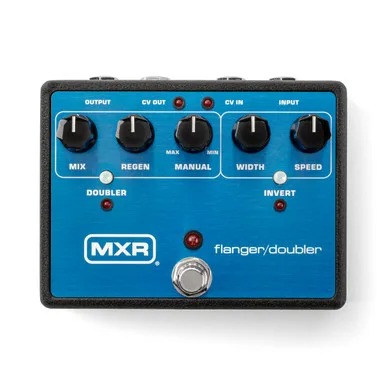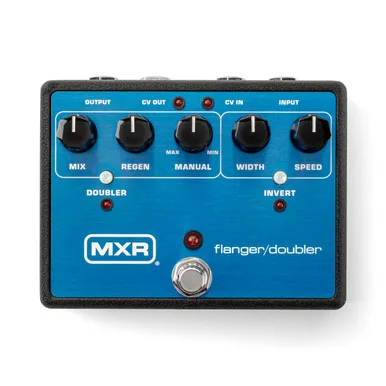


The MXR Flanger/Doubler (model M226R) is a pedal recreation of the company's original Flanger/Doubler rack unit, the 2-space rackmount effect MXR built in the 1970s. It puts both of that unit's voices in a mid-size stompbox enclosure: a flanger for sweeping jet-engine motion and metallic resonance, and a doubler that thickens your signal with a slightly offset second track layer for chorusing effects or a short, tightly dialed slapback delay123. MXR describes it as "authentically capturing classic all-analog flanger and doubler effects featured on hallmark recordings from the '70s and '80s"14.
The pedal is built around authentic bucket-brigade devices (BBDs), the analog delay chips that give vintage flangers and choruses their character, and carries the original control set1. It was announced in August 2026 and is available now. Guitar World reported a price of $3335, while MusicRadar listed it at $339 in the US and £339 in the UK6.
What it does: a flanger and a doubler in one pedal
The pedal is built around two distinct voices, and a Doubler button chooses between them1. Both work the same way at the circuit level: a short delay whose length is modulated. What changes is how long that delay is.
- Flanger mode is the default. MXR's manual says it "is capable of metallic, jet-engine swooshes"4, and the delay range runs from 0.33 ms to 5.5 ms4. This is the classic flanger territory of comb filtering and resonant sweeps.
- Doubler mode switches the delay time to a more expansive range, 14 ms to 66 ms42. Here the effect layers a second, slightly delayed copy of your playing over the original. MusicRadar describes the result as a thickening effect "as though double-tracked, without the differences in pick attack," and notes that in some settings it can sound like a slapback delay6.
The distinction matters in practice. Flanging is an obvious, dramatic effect you hear as motion; doubling is subtler, more like a studio trick that makes one guitar sound like two. Dunlop's own history of the rack unit says heavy players the world over flocked to the Flanger/Doubler for "the massive tone thickening and widening that Dime made famous"3.
Two LEDs on the upper face of the pedal reflect your instantaneous delay time at any given moment, with rate, brightness, and left/right activity determined by the Speed, Width, and Manual settings1.
The controls
The control set is the original rack unit's, moved onto the pedal's face1.
| Control | What it does |
|---|---|
| Manual | Shapes the tone of the effect (delay time)12 |
| Width | Shapes the range of motion of the effect (modulation sweep range)12 |
| Speed | Shapes the sweep rate of the effect (modulation rate)12 |
| Regen | Controls intensity via feedback, from smooth, mellow coloration to aggressive, metallic resonance1 |
| Dry > Wet Mix | Blends the dry and wet signals2 |
| Doubler button | Chooses between the two voices; switches the delay time to the more expansive doubler range12 |
| Footswitch | Toggles effect on/bypass, with a red LED indicating on4 |
| Line Level switch | Ensures optimal performance when working with hot signals1 |
The LFO rate spans 0.025 Hz to 18.5 Hz, from a sweep that takes tens of seconds to complete to one faster than most players would ever need4.
Power and connections
The pedal runs on 9 volts DC and is powered by a 9-volt AC adapter such as the Dunlop ECB003/ECB003EU or an MXR Brick Series power supply4. Plan on a power supply from the start.
Unlike the current MXR Flanger, which Dunlop lists as running on an 18-volt adapter or its DC Brick, Iso-Brick and Mini Iso-Brick supplies7, the Flanger/Doubler takes 9 volts DC4. Check your power supply's voltage before plugging in.
The pedal is designed for use on a pedalboard with a guitar signal, and also with line signals8, which is what the Line Level switch is for. The manual lists a maximum input level of +12 dBu on the Line setting, against 0 dBu on the standard setting4. Noise floor figures are -83 dBu in Flanger at minimum delay and -77 dBu in Doubler at maximum delay (Line setting, Mix at maximum clockwise, all other controls at minimum counterclockwise)4.
The CV jack
The CV IN jack lets you connect an external 0 to 5V control voltage from synths, sequencers, or CV-capable expression pedals4. When a CV source is connected, it bypasses the Manual, Width, and Speed knobs4, so the delay time that shapes the effect can be driven from outside the pedal. MusicRadar highlights this as a way to connect with synths and sequencers, or indeed an expression pedal6.
History: from the MXR rack unit to the M226R pedal
The original MXR Rack Unit Flanger/Doubler, the M-126, a 2-space rackmount flanger/doubler, is believed to date from 1976293. It lasted most of MXR's early period before the company's bankruptcy in 19842. The rack original was used by players including Dimebag Darrell, and gearnews reports it has quite a cult following these days8; Eric Johnson mostly used its Flanger mode9.
The M226R pedal reissues that rack unit in a mid-size pedal enclosure2, carrying the same circuit and control set18. Guitar World called the arrival of a pedalboard-friendly unit channeling the now-discontinued rack mount welcome news, and noted that MXR has recreated "one of Dimebag Darrell's favorite tone shapers in stompbox form"5. Zakk Wylde used the pedal in his Pantera Celebration rig for some shows5.
The rack unit's revival has not been MXR's alone. Guitar Pedal X notes the flanger/doubler is "somewhat in vogue at the moment," with PastFX releasing its own compact take, the doppelflänger, alongside MXR's pedal9.
Videos
Ola Englund
Dagan Wilkin
Sweetwater Soundcheck
News
Questions
What is the difference between flanging and doubling?
Flanging uses a very short modulated delay, 0.33 to 5.5 ms in this pedal, to produce sweeping jet-engine motion and metallic resonance. Doubling uses a longer delay range, 14 to 66 ms, to layer a slightly offset second track over your signal, creating chorusing or a short slapback delay, like a guitar double-tracked without the differences in pick attack.
Is the MXR Flanger/Doubler pedal analog?
Yes. MXR describes it as an all-analog design built around authentic bucket-brigade devices, recreating the circuit of the original 1970s rack unit in pedal form. Guitar World likewise reports an all-analog bucket-brigade design with the full original control set.
What does the CV output on the MXR Flanger/Doubler do?
The CV IN jack accepts an external 0 to 5 volt control voltage from synths, sequencers, or CV-capable expression pedals. When something is connected, the external voltage takes over and bypasses the Manual, Width, and Speed knobs, so the modulation can be driven from outside the pedal.
Can I use the MXR Flanger/Doubler with line-level signals?
Yes. A Line Level switch sets the pedal up for hot signals, and MXR says it ensures optimal performance when working with them. The manual lists a maximum input level of +12 dBu on the Line setting, so it works with guitar signals and line-level gear alike.
Which players use the MXR Flanger/Doubler?
The original rack unit was used by Dimebag Darrell, and Dunlop's own history article says heavy players flocked to it for massive tone thickening and widening. Eric Johnson mostly used its Flanger mode, and Zakk Wylde used the pedal in his Pantera Celebration rig for some shows.
Sources (9)
- MXR® FLANGER/DOUBLER, Jim Dunlop (jimdunlop.com)
- Guitar Pedal X, Guitar Pedal X, 2026-08-13
- MXR: Rackmount Era, Dunlop (lifestyle.jimdunlop.com), 2014-03-28
- M226.pdf, Jim Dunlop, 2026
- MXR revives Dimebag's favorite rack unit in pedal form, Guitar World, 2026-08-11
- MXR reimagines Dimebag Darrell's favourite rack unit as a pedal, MusicRadar, 2026-08-11
- MXR® FLANGER, Dunlop (www.jimdunlop.com)
- MXR Flanger/Doubler: Analog BBD Modulation, gearnews.com, 2026-08-11
- Guitar Pedal X, Guitar Pedal X, 2026-09-25