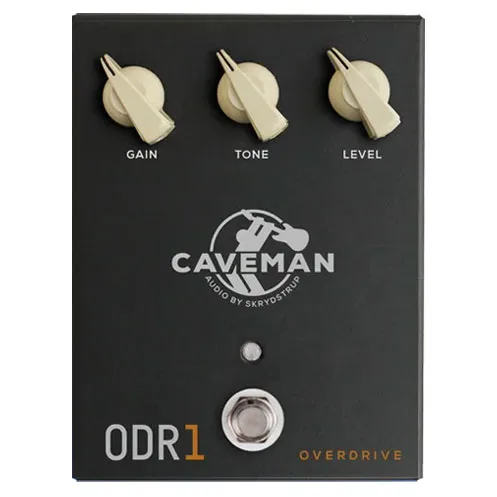



The Caveman ODR1 is a three-knob overdrive pedal from Caveman Audio, a Danish maker that Delicious Audio describes as not as well known as others from the Nordic country. It is designed to emulate the overdrive sound of the company's own X2 Tube Amplifier, and the maker's stated range runs from the crispiness of a semi-cranked VOX AC30 to the grit of Hendrix1. The pedal was designed by Steen Skrydstrup, the brain behind the brand1.
Sound and circuit
Caveman describes the ODR1 as a smooth, dynamic overdrive built to recreate the tone of the company's X2 Tube Amp. The clipping is handled by carefully selected germanium diodes, which the company says gets as close as possible to the natural compressed tone of a tube1. In practice, that means the pedal is aimed at players who want an overdrive that behaves like a pushed tube amp rather than a hard-clipped distortion: the maker's framing puts compression and a natural, tube-like give at the center of the design1. Delicious Audio's summary of the pedal's range puts it this way:
"The ODR1 gives you overdrive tones ranging from the classy crispiness of a semi-cranked VOX AC30 to the addictive grit"
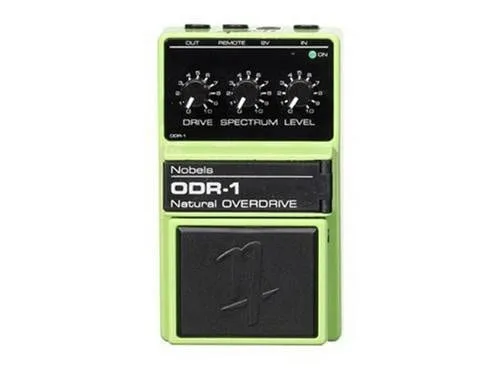
The name invites comparison with the Nobels ODR-1, but the two are different pedals from different makers. The Nobels ODR-1 was designed by Kai Tachibana as an original circuit for Nobels2, and on That Pedal Show, Mick Taylor and Daniel Steinhardt noted that it uses both soft and hard clipping diodes in the design3. The Caveman ODR1 instead leans on germanium diode clipping and its own amp-derived circuit, so a player shopping by name alone should check which pedal they are actually looking at.
Bypass and signal integrity
The ODR1's bypass scheme is one of its more distinctive features. When switched off, the pedal does not simply pass the guitar through untouched: it acts as a unity gain line driver, capable of driving even very long cables without tonal loss or coloration1. For a player with a large board or a long run to the amp, that buffered-style bypass keeps the high end from dulling in the way a plain mechanical bypass can. It also means the pedal keeps working on your signal even when it is off, which is worth knowing when arranging pedal order on a board.
Build
The pedal is housed in a rugged steel chassis built to withstand extensive daily use and continuous touring1. Caveman also pays attention to the signal path details that a player cannot see but can, in the maker's account, hear:
- All internal wiring uses high-quality, shielded audio cable with minimum DC resistance and capacity1
- All 1/4" jack connectors are gold-plated1
Shielded internal wiring and gold-plated jacks are the kind of specification usually reserved for boutique build-to-order pedals, and Caveman presents them as part of the same signal-integrity thinking that shows up in the line-driver bypass1.
Videos
Caveman Audio
Alberto Barrero
shnobel
Questions
Who designed the Caveman Audio ODR1?
The ODR1 was designed by Steen Skrydstrup, the founder behind Caveman Audio. According to Delicious Audio, Skrydstrup has been developing custom solutions for musicians, and the pedal is designed to emulate the overdrive sound of Caveman's own X2 Tube Amplifier. It should not be confused with the Nobels ODR-1, a separate German-designed overdrive from a different maker.
What kind of clipping diodes does the ODR1 use?
Caveman Audio uses carefully selected germanium diodes for clipping in the ODR1. The company says the choice is made to get as close as possible to the natural compressed tone of a tube. That sets it apart from pedals such as the Nobels ODR-1, which uses both soft and hard clipping diodes in its design.
Does the Caveman ODR1 use true bypass?
No. When the ODR1 is switched off, it acts as a unity gain line driver rather than dropping to a simple true bypass connection. That means the pedal actively drives the signal in bypass mode, which Caveman says allows it to drive even very long cables without tonal loss or coloration.
Can the ODR1 drive long cable runs?
Yes. Because the bypassed pedal works as a unity gain line driver, Delicious Audio reports that it is capable of driving even very long cables without tonal loss or coloration. That is useful on large pedalboards or long stage runs, where a plain true bypass pedal can let the signal dull as cable length adds up.
Sources (3)
- Caveman ODR1 Overdrive, Delicious Audio, 2021-08-20
- Andromeda Deluxe Natural Overdrive / Nordland ODR-C, Aion FX, 2021-10-22
- What About The Nobels ODR-1? vs TS9 & BD-2w into AC15 & Deluxe Reverb That Pedal Show, That Pedal Show (YouTube), 2021-10-07