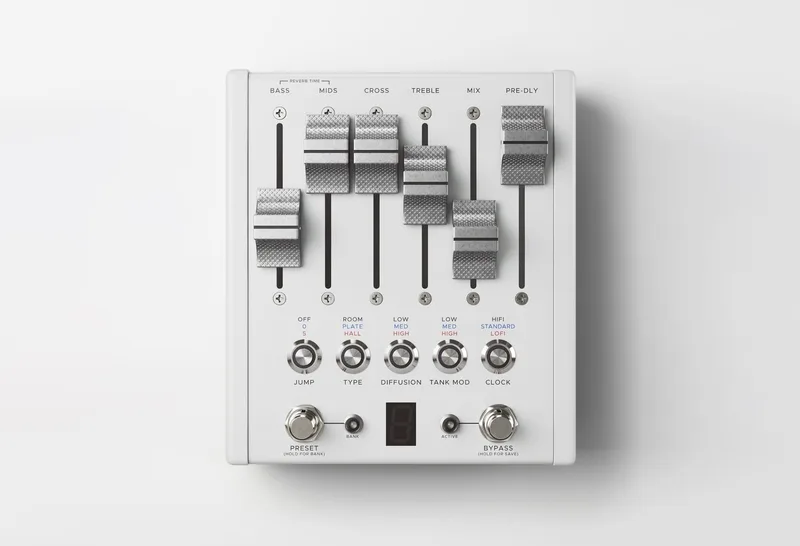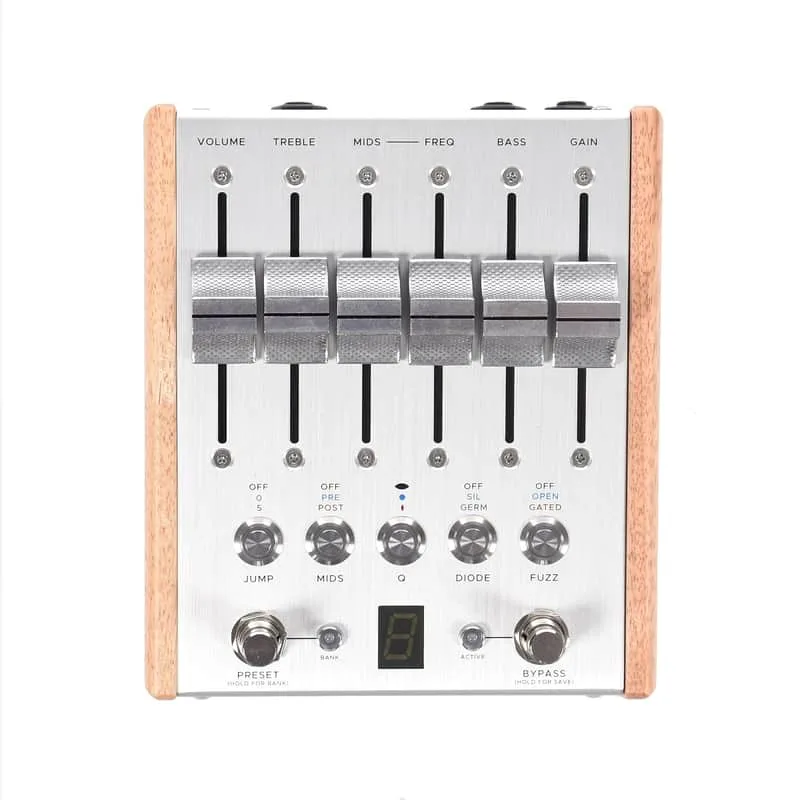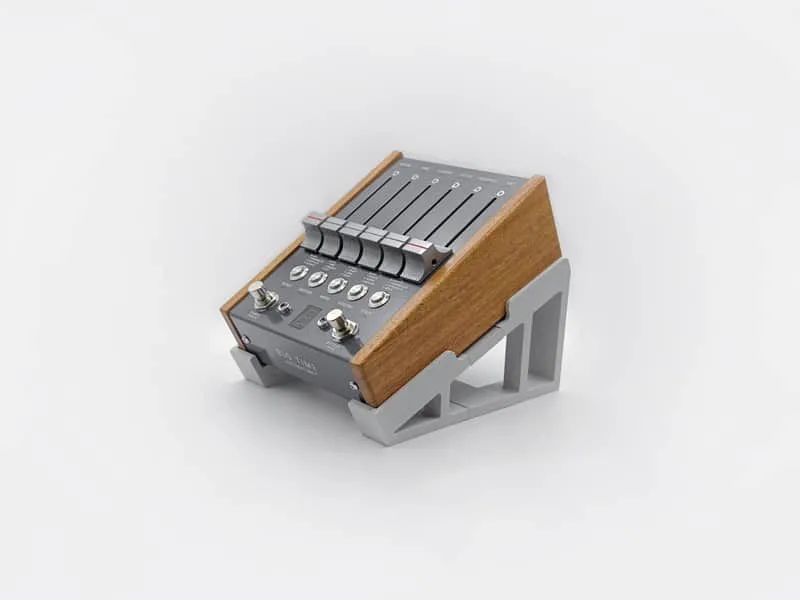


The Automatone CXM 1978 is a digital reverb pedal built as a joint collaboration between Chase Bliss Audio and Meris, released in 2020. It is a reinterpretation of the vintage Lexicon 224 Digital Reverb, the studio rack unit whose sound defined reverb on records through the 1980s, packed into a stompbox with motorized faders123.
Where most reverb pedals give you knobs, the CXM 1978 gives you six motorized sliders that physically move when you recall a preset or send it a MIDI message, an approach Guitar.com called "achingly-cool motorised slider-based operation"4. The makers say the motorized faders make the pedal incredibly intuitive2.
A Lexicon 224-style studio reverb in a pedal
The Lexicon 224 was a large, 34-pound digital reverb unit from the late 1970s, and its sound, along with that of its successor the 480L, became a staple for producers and engineers throughout the 1980s63. GuitarPlayer's Art Thompson notes it was behind great sounds of '80s-era albums including Talking Heads' Remain in Light, Pink Floyd's The Final Cut and U2's The Unforgettable Fire6. The 224 shipped with a remote console-top controller, the LARC, which allowed for ease of manipulation when considering reverb options7.
The CXM 1978 compresses that idea into a pedal. Delicious Audio describes it as a 32-bit AD/DA pedal adaptation of the venerable 1978 Lexicon studio reverb, built in collaboration with Meris5, and Pedal of the Day says it was designed in tribute to the coveted Lexicon 224 Digital Reverb8. Guitar.com's reviewer Ed Oleszko called it a "modern take on vintage studio reverb"1.
The reverb algorithms themselves were created and programmed by Meris, honed from the Meris Mercury 7 and largely matched to the legendary Lexicon 2249. The pedal covers three reverb characters:
| Algorithm | Character |
|---|---|
| Room | Natural ambiance, good for adding life to a flat-sounding amp track2 |
| Plate | A third distinct reverb character alongside Room and Hall8 |
| Hall | A third distinct reverb character alongside Room and Plate8 |
Beyond the three algorithms, the pedal includes a diffusion control whose flexibility depends on the reverb mode selected, something Joel at Chase Bliss said he was proud of working out with Meris2. The pre-delay has a LoFi mode with a special variable clock rate that works the same way a bucket brigade does, adding a warm and grainy texture2. Joel also pointed to EQ shaping of the reverb tail and the different clock settings as favorite features, saying the pedal "covers so much ground"2.
Controls, connections and MIDI
The pedal's front panel is built around its six motorized faders, with a Type button selecting Room, Plate or Hall8 and two multi-function footswitches1. Its full connection set:
The faders respond to MIDI1, and the makers describe MIDI as one of the external elements the CXM will grow with as you master it, alongside the expression pedal and aux switch, for dynamic control over animating your sound1. Guitar Pedal X also lists expression pedal control among its features9.
Guitar.com's reviewer strongly recommends experiencing the unit in stereo with a pair of amps1, and Pedal of the Day confirms stereo inputs and outputs8.
The CXM 1978 is a studio-style reverb workstation rather than a simple stompbox: it carries stereo 1/4-inch input and output jacks, MIDI in and thru, expression pedal and aux inputs, and its faders respond to MIDI1. External control through an expression pedal, an aux switch and MIDI was part of the design from the start2.
History: the Lexicon 224 and the Chase Bliss and Meris collaboration
The CXM 1978 is the second Automatone pedal, following the Preamp MKII collaboration with Benson Amps1. Chase Bliss said "since we put out CXM 1978 with Meris in 2020," placing the release in that year94. The pedal is a 32 Bit AD/DA pedal adaptation of the venerable 1978 Lexicon studio reverb, built in collaboration with Meris5, and its reverb algorithms were honed from the Meris Mercury 7 and largely matched to the legendary Lexicon 224 Digital Reverb59.
The collaboration itself has a neat origin: the Lexicon 224's LARC remote and the Automatone both had 6 faders, which inspired the two companies to work together2. The division of labor, as Joel described it in the Delicious Audio interview:
- Angelo (Meris): all the DSP work2
- Terry (Meris): PCB layout and design on the DSP part of the circuit, plus the analog circuits for the balanced I/O2
- Joel (Chase Bliss): the balanced I/O PCB layout and the other basic layout2
- Charlie (Chase Bliss engineer): the code for the motorized faders and interfacing with Meris' tech2
- Jinna and Joel: marketing strategy and logistics2
What reviewers made of it
Guitar.com's Ed Oleszko reviewed it in January 2021 and concluded that it is far from a mere clone of the Lexicon 2241:
"it's far from a mere clone, and Chase Bliss and Meris are to be applauded for elevating the humble reverb pedal concept"
Guitar.com also named it among the best premium effects pedals of 2021, describing it as taking that recipe and, with the help of Meris, aiming to offer a "modern take on vintage studio reverb"10. Guitar Pedal X placed it in a 2021 roundup of top stereo reverb workstation pedals, noting the Meris-honed algorithms9, and Guitar.com later called it "an incredibly premium reverb pedal"4.
Videos
Knobs
Pete Thorn
Vintage King
Questions
Does the CXM 1978 have balanced inputs and outputs?
Yes. The analog circuits for the balanced I/O were designed by Terry at Meris, and Joel at Chase Bliss laid that part out on the PCB. The pedal's connections are stereo 1/4-inch input and output jacks, so it runs in full stereo with a pair of amps, which reviewers strongly recommend.
Can the CXM 1978 faders be controlled over MIDI?
Yes. The pedal has MIDI in and thru, and the faders respond to MIDI. The makers describe MIDI as one of the external elements the CXM will grow with as you master it, alongside an expression pedal and aux switch, giving dynamic control over animating your sound.
What reverb modes does the CXM 1978 have?
Three algorithms: Hall, Room and Plate, selected with the Type button for three distinct reverb characters. The Room algorithm is aimed at adding natural ambiance to a flat-sounding amp track, and the pre-delay has a LoFi mode with a variable clock rate that adds a warm, grainy texture.
Is the CXM 1978 analog or digital?
It is a digital reverb pedal with 32-bit AD/DA conversion, made in the USA. Its sound is modeled on early digital reverb rack units from the 1970s, specifically the Lexicon 224 Digital Reverb, with reverb algorithms honed from the Meris Mercury 7.
Where is the Automatone CXM 1978 made?
It is made in the USA. The pedal is a joint collaboration between Chase Bliss Audio and Meris: Angelo at Meris did the DSP work, Terry did the PCB layout and analog circuits, and Joel's engineer Charlie wrote the code for the motorized faders.
Sources (10)
- Review: Chase Bliss Audio Automatone CXM 1978, Guitar.com, 2021-01-27
- A Q&A With Chase Bliss Audio And Meris About The CMX 1978 Automatone, Delicious Audio, 2020-11-03
- The Best Budget Reverb Pedals for your Home Studio, www.gearnews.com, 2026-01-19
- Chase Bliss Audio teases new pedal that’s “taken two years to get right”, Guitar.com, 2022-03-28
- Best Stereo Reverb Pedals For Synths For Texture, Ambiance, And Automation, Delicious Audio, 2024-02-23
- ''Creating dreamy sounds that were once only possible in world-class recording studios…'' The new award-winning range of stompboxes from Universal Audio will blow your mind, GuitarPlayer (www.guitarplayer.com), 2023-11-17
- 1978 Lexicon 224 Digital Reverb, Performer Mag, 2014-08-13
- Chase Bliss Audio CXM 1978 Automatone Reverb, Pedal of the Day, 2020-12-06
- Guitar Pedal X, Guitar Pedal X, 2021-08-16
- Gear Of The Year: Best Premium Effects Pedal of 2021, Guitar.com, 2021-12-09