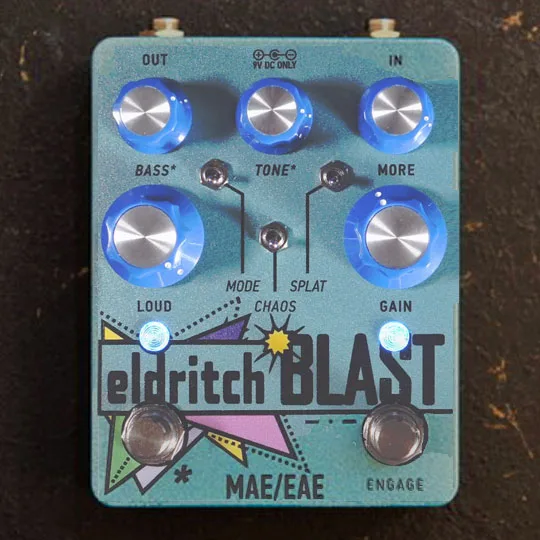


The EAE Eldritch Blast is a fuzz pedal built around what Electronic Audio Experiments calls "a high-gain octave/intermodulation generator." It is an unusual transistor circuit that the maker describes as capable of "heavy, complex riffs or touch-sensitive textures with a ripping, splatty octave up," with a switchable active EQ that "invokes sinister high-gain tones worthy of the outer gods." The pedal was a collaboration with Mask Audio Electronics, produced in small batches approximately once per year from 2018 to 2025, and it now sits on EAE's legacy pages as a discontinued design1.
The Eldritch Blast is discontinued. Electronic Audio Experiments produced it from 2018 to 2025, with the final V3 running from April 2023 to August 20251.
An octave fuzz with switchable active EQ
The circuit is not a conventional fuzz. EAE describes it as a greatly expanded take on the Magic Missile Fuzz, an old EAE design that was itself an homage to the modern classic fuzzes of Devi Ever, Tim Escobedo, and the circuit-benders of ilovefuzz.com. Where a typical octave fuzz stacks an octave-up generator on a fuzz stage, the Eldritch Blast's generator produces intermodulation as well, so chords and complex intervals break up into harmonically tangled textures rather than a clean doubling. The maker says the circuit handles both heavy, complex riffs and touch-sensitive playing, with the ripping, splatty octave up sitting on top of the fuzz1.
The active EQ is the other half of the character. It is a peaking filter that only comes into play when the star footswitch is on, letting you push or cut low end around 100 Hz rather than simply rolling off bass. EAE credits the EQ with the pedal's "sinister high-gain tones," and because it is switchable, the fuzz can run bare or with the low end boosted into heavier territory1.
The controls and footswitches
The Eldritch Blast keeps its control set compact, with three knobs, two toggle switches, and two footswitches. Here is what each one does, per the maker's own description1:
| Control | What it does |
|---|---|
| Gain | Controls the amount of gain and low frequencies at the input. Turn clockwise to add gain and thickness. |
| Volume | Loudness amount. |
| Bass | Active peaking filter centered around 100 Hz. Active only when the star footswitch is on. |
| Mode | Changes transistors in the octave generator to change the texture and amount of saturation. |
| Splat | Shifts the dynamics and gating of the transistor stages, switching between a smoother character or a harsh note decay with splatty artifacts. |
| Chaos | Engages a self-oscillating mode with highly interactive squeals, squealches, and sub-bass drones. (V3) |
The two footswitches divide the labor. The Engage footswitch is the master bypass, turning the whole pedal on and off, while the star footswitch toggles the active EQ independently. That means you can leave the fuzz running and kick the EQ in and out mid-part, or run the EQ as part of the sound from the start1.
The Chaos control deserves its own note. On V3 it was redesigned as a toggle that produces an oscillating effect, and the maker describes the result as a self-oscillating mode with "highly interactive squeals, squealches, and sub-bass drones." In practice this turns the pedal into a sound generator in its own right, one that responds to the Gain and Splat settings and to what you play into it1.
Power and connections
The Eldritch Blast runs on a 9V DC supply with a 2.1 mm center negative barrel connector, the standard arrangement on most modern pedalboards. The current draw is 80 mA with both channels engaged, and EAE recommends a regulated, isolated power supply rated for 100 mA minimum. The PSU input is protected against reverse polarity, so a center-positive plug will not damage the pedal, though it will not power it either1.
The Eldritch Blast does not accept batteries, and EAE recommends an isolated supply rather than a daisy chain. Plan for 100 mA minimum on your power brick1.
Input impedance is 220 kΩ at 1 kHz and output impedance is 1 kΩ at 1 kHz, figures consistent with a pedal that sits comfortably first in a chain or after other true-bypass boxes. Bypass is relay switching with true bypass, so the pedal is out of the signal path entirely when disengaged1.
History: from the Magic Missile to V3
The Eldritch Blast's lineage runs through three versions over its production life1:
| Version | Years | Notes |
|---|---|---|
| V1 | 2018 (initial release) | Thru-hole PCB |
| V2 | 2021 | SMT PCB layout |
| V3 | April 2023 to August 2025 | Redesigned Chaos toggle, now produces an oscillating effect |
The design began as the Magic Missile Fuzz, an old EAE circuit that paid homage to the modern classic fuzzes of Devi Ever, Tim Escobedo, and the circuit-benders on ilovefuzz.com. The turning point came when EAE teamed up with Alec from Mask Audio Electronics to flesh out and fine-tune the design. The maker says the circuit diverged significantly from the original Magic Missile circuit after that collaboration, and the result became the Eldritch Blast, produced in small batches approximately once per year from 2018 to 20251.
The art design on the pedal came from Dan at Audio Disruption Devices, whom EAE thanked for what it called "the stellar art design"1.
"We teamed up with Alec from Mask Audio Electronics (MAE) to flesh out and fine-tune the design, and together came up with..."
Videos
Noise Generator
collector//emitter
Sound Isles
Questions
Is the EAE Eldritch Blast discontinued?
Yes. Electronic Audio Experiments lists the Eldritch Blast on its legacy pages. It was produced from 2018 to 2025 in small batches roughly once per year, with V3 running from April 2023 to August 2025. The maker has not announced a direct replacement for the circuit.
What does the Splat switch do on the Eldritch Blast?
Splat shifts the dynamics and gating of the transistor stages. In one position the fuzz has a smoother character; in the other the note decay turns harsh with splatty artifacts, which is where the switch gets its name. It works alongside the Mode control, which swaps transistors in the octave generator to change texture and saturation.
Does the Eldritch Blast take a battery?
No. Electronic Audio Experiments states plainly that its pedals do not accept batteries. The Eldritch Blast runs on a 9V DC, 2.1 mm center negative barrel supply, and the maker recommends a regulated, isolated supply rated for at least 100 mA.
Who is Mask Audio Electronics?
Mask Audio Electronics is the workshop of Alec, a builder who teamed up with Electronic Audio Experiments to flesh out and fine-tune the Eldritch Blast design. The collaboration produced the circuit that diverged significantly from EAE's original Magic Missile design, and the pedal was built in small batches from 2018 to 2025.
Sources (1)
- MAE/EAE Eldritch Blast, Electronic Audio Experiments