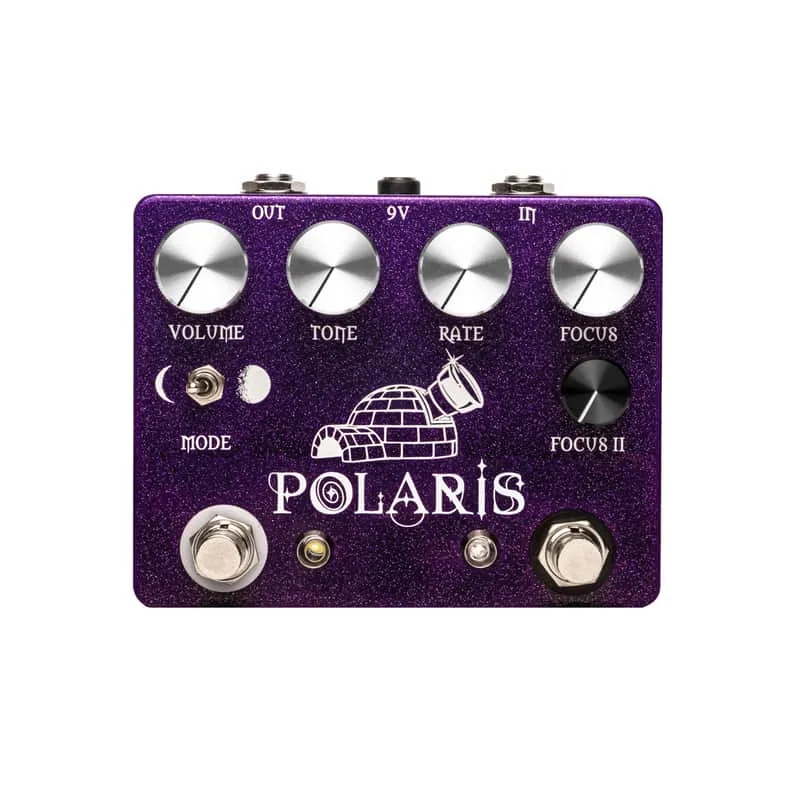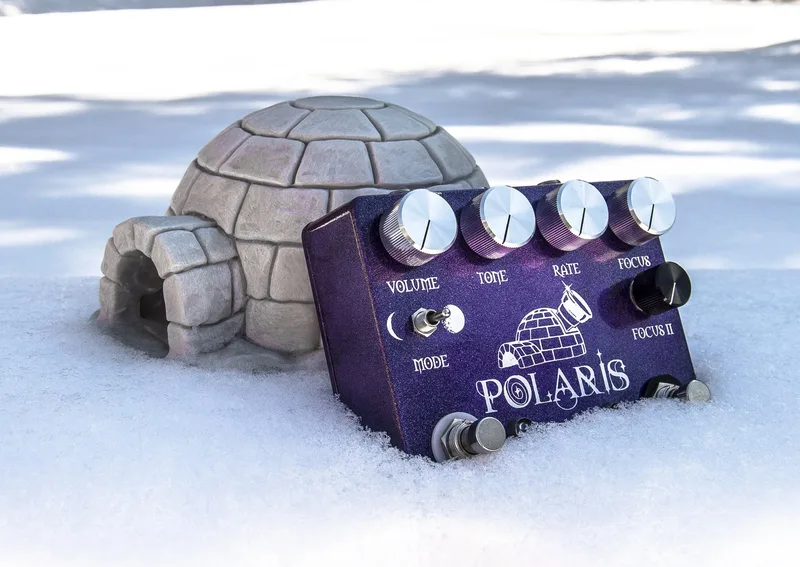


The CopperSound Polaris is a premium all-analog chorus and vibrato pedal. CopperSound describes it as delivering "lush, velvety pitch modulation for a rich, immersive sound experience," and the circuit is inspired by the classic Electro-Harmonix Small Clone12. At its heart sits an MN3007 bucket-brigade (BBD) chip, the same chip used in the original Small Clone, which is what makes the modulation genuinely analog rather than digitally modeled3.
The pedal gives you two independent depth levels, one for the chorus setting and one for the vibrato setting, and a secondary footswitch to move between them while playing43. Pedal of the Day reviewed it in May 2021 and found it "covers all the aspects of chorus and vibrato effects a player could want," in a pedalboard-friendly enclosure4.
CopperSound's product page currently lists the Polaris as sold out, at a list price of $229.00, with an email notification offered for when it returns to stock2. The page also shows "Only 1 available" alongside the sold-out notice2.
An all-analog chorus and vibrato built on the Small Clone
Chorus works by splitting your signal, delaying one copy slightly, and varying that delay over time; vibrato is the same varying delay without the clean blend, so the pitch wobbles on its own. The Polaris does both jobs in one box, and because it uses bucket-brigade technology rather than a digital processor, the modulation is true analog4.
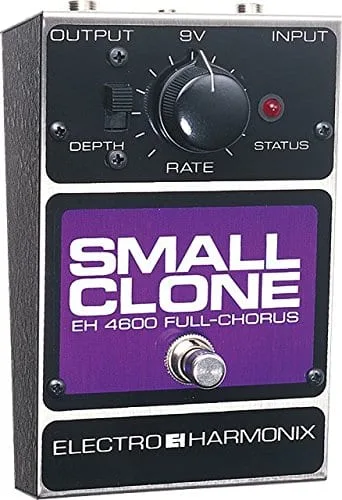
The family tree is explicit. CopperSound says the Polaris is "inspired by the classic Small Clone," and Pedal of the Day describes it as "based loosely on the classic Electro-Harmonix Small Clone"14. The Electro-Harmonix Small Clone is itself an analog chorus, still in production, and Pedal of the Day called it "an extremely well built unique sounding" chorus in a 2014 review5. Delicious Audio confirms the shared DNA at the component level: "At the heart of Polaris resides an MN3007 BBD chip. The same chip found in the original Small Clone."3
For a player comparing the two, the practical difference is flexibility. The Small Clone keeps its control set minimal, while the Polaris adds a second depth knob, a tone control, a volume control, and a footswitch to toggle between chorus and vibrato depth settings143.
The controls
The Polaris carries a small control set, and the two depth knobs are the heart of it3.
| Control | What it does |
|---|---|
| Depth (x2) | Two independent depth levels, one for chorus and one for vibrato; the secondary footswitch selects which is active43 |
| Tone | Sets the balance of bass and treble: counter-clockwise for rich low-end warmth, clockwise for sparkling highs paired with smooth modulation1 |
| Volume | Works with Tone to sculpt the initial sound, and gives an extra bit of boost if required4 |
The Tone control is worth a note for anyone who has fought thin-sounding chorus pedals. CopperSound says it lets you dial in the balance of bass and treble, and Pedal of the Day describes it as a way to "cut or boost the lower bass presence to taste"14. Volume then works alongside it, offering a boost when the effect is engaged4.
The two footswitches divide the work: one engages the effect, and the other flips between the two depth settings. Delicious Audio quotes the design intent directly: "we incorporated a second depth knob that is selectable via the secondary footswitch."3 That means you can set a subtle chorus depth and a deeper vibrato depth, then jump between them mid-song without touching a knob.
Power and connections
The Polaris runs on a standard 9V DC supply with a 2.1 x 5.5mm center-negative barrel plug, drawing 40mA1. That is the same arrangement as most modern pedals, so any typical pedalboard power brick with 9V center-negative outputs will run it, and the low draw means it can share a daisy chain if you are not using isolated outputs. There is no battery option in the maker's specifications1.
Input impedance is 1M and output impedance is 30K, figures that place it comfortably in a pedal chain with typical guitar-level gear1. Bypass is mechanical true bypass, so with the pedal off your signal passes through untouched1.
What reviewers said
Published coverage of the Polaris has been limited, and the maker's own description is the fullest account of its character: CopperSound describes the pedal as delivering "lush, velvety pitch modulation for a rich, immersive sound experience"2.
"Based loosely on the classic Electro-Harmonix Small Clone, the Polaris uses BBD (Bucket Brigade) technology to produce true analog modulation effects."
A note on the name
There is a second pedal called Polaris, a resonant overdrive by Spaceman Effects with controls for Level, Bass, Drive, Initial and Filter67. It is an entirely different effect from a different maker, so if you are searching for the CopperSound chorus and vibrato, make sure a listing names CopperSound before assuming it is the same pedal.
Videos
Pete Thorn
Premier Guitar
CopperSound Pedals
Questions
Is the CopperSound Polaris true bypass?
Yes. CopperSound lists the Polaris as mechanical true bypass, and Pedal of the Day's review confirms it. When the pedal is off, your signal passes through without buffering or coloration, which suits players who keep long cable runs or want the pedal out of the chain entirely when disengaged.
What chip does the CopperSound Polaris use?
The Polaris is built around an MN3007 bucket-brigade (BBD) chip, the same chip found in the original Electro-Harmonix Small Clone. Bucket-brigade chips are what give analog chorus and vibrato pedals their character, passing your signal along a chain of capacitors slightly delayed, which produces the modulation.
Does the CopperSound Polaris run on a battery?
No battery option appears in CopperSound's specifications. The pedal runs on 9V DC through a 2.1 x 5.5mm center-negative barrel jack, drawing 40mA, so it needs an external power supply or an isolated pedalboard power brick with a matching output.
What does the second footswitch on the Polaris do?
The secondary footswitch selects the second depth knob. The pedal has two independent depth settings, one for chorus and one for vibrato, and the extra switch lets you move between them while playing rather than bending down to turn a knob mid-phrase.
What power supply does the CopperSound Polaris need?
A 9V DC supply with a 2.1 x 5.5mm center-negative plug, the standard arrangement used by most modern pedals. Current draw is 40mA, low enough that it can share a daisy-chain supply with other 9V center-negative pedals if you are not using isolated outputs.
Sources (7)
- Polaris Analog Chorus & Vibrato, CopperSound Pedals
- Polaris Analog Chorus & Vibrato, CopperSound Pedals
- Coppersound Polaris Vibrato / Chorus, Delicious Audio, 2022-03-30
- CopperSound Pedals Polaris Analog Chorus Vibrato, Pedal of the Day, 2021-05-22
- Electro-Harmonix Small Clone Analog Chorus, Pedal of the Day, 2014-07-07
- Polaris: Resonant Overdrive, Spaceman Effects
- Guitar Pedal X, GuitarPedalX, 2025-10-30