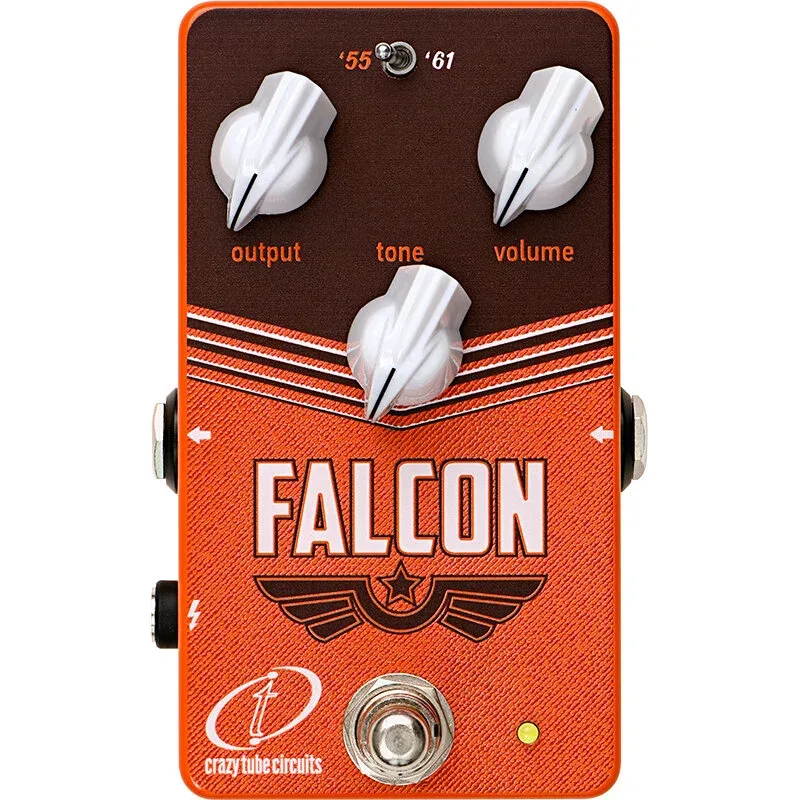


The Crazy Tube Circuits Falcon is an analog overdrive pedal that puts two classic Fender amp circuits in one box: the 5E3 Tweed Deluxe and the 6G2 Brownface Princeton. A single toggle switch moves between the two voices, labeled '55 for the tweed side and '61 for the brownface side12.
The pedal began as a custom amp. Back in 2016, Crazy Tube Circuits built an amp designed to morph between the sounds of a 5E3 Tweed Deluxe and a 6G2 Brownface Princeton, then decided to capture it in a pedal format13. Rather than copying only the preamp, the company says it copied the behavior, sound and feel of the preamp, phase inverter and power amp of both designs, using JFET technology to recreate not just the overdriven sounds but the lower gain and clean sounds as well13.
What the Falcon does to your sound
The Falcon is voiced to imitate two classic Fender amps, and the two modes give it two distinct characters6. The part Crazy Tube Circuits says it worked hardest on is the feel: emulating the compression and sag that come from the power amp and tube rectifier, which is what makes a tweed-style amp respond to picking attack. Depending on the amp mode setting and your guitar or pickup's output, this effect can be more or less pronounced1.
The two sides of the pedal sound noticeably different, as Guitar Player's reviewers found28:
| Mode | Amp emulated | Character |
|---|---|---|
| '55 | 5E3 Tweed Deluxe | More gain, greater low-end response, higher sag and compression; loose low end, raw and ragged high end21 |
| '61 | 6G2 Brownface Princeton | Lower gain, slightly overdriven sounds; less breakup, more focused low end, sits between tweed roughness and blackface smoothness21 |
Pete Thorn described the difference in his demo: the '55 setting captures the Tweed Deluxe's cathode bias, a little softer, with more sag, more compression and definitely more gain on tap, while the '61 setting emulates the class AB power amp sound, a little tighter with more headroom and sparkle9.
The controls
The Falcon keeps the control set of the amps it copies, which makes it simple to dial in but interactive in use210:
| Control | What it does |
|---|---|
| Volume | Controls the amount of gain; turning it up gives more gain, just as the Volume control on the original 5E3 and 6G2 amps did65 |
| Tone | Interactive: above halfway it boosts the high frequencies; dialed down it helps smooth out the overall sound6 |
| Output | Sets the overall output level; "Output does the rest"65 |
| Amp Mode switch | Selects between the '55 and '61 amp modes5 |
Because Volume is the gain control, the pedal works the way the original amps do: low Volume settings with higher Output give cleaner, boosted sounds, while higher Volume settings push into overdrive. Pete Thorn noted that with an anemic clean sound from your amp, you can set the '61 mode with the volume control below half and use the output to get more viby cleans than the amp alone9.
The Falcon requires an external 9V DC regulated and filtered power supply to run6. There is no battery option, and the maker's call for a regulated and filtered supply points toward a quality isolated supply rather than a basic daisy chain.
How it responds to your playing and other pedals
Guitar Player's reviewers found that the Falcon cleans up beautifully when you play lighter or back off your guitar's volume, and that the pedal retains the touch and guitar volume response of the tweed character2. That is the practical payoff of the power amp and rectifier emulation: it behaves like an amp, not a fixed-gain overdrive.
The same reviewers also found that the Falcon responds beautifully when driven by boost, overdrive and fuzz pedals, just like a real amp, and that it works at any volume2. If you stack gain pedals, the Falcon can sit at the end of the chain as the "amp" they push.
Where it came from
Crazy Tube Circuits announced the Falcon in December 2018, with coverage from Gearnews, Guitar World, Guitar.com and MusicRadar65108. At launch it carried an RRP of EUR 1696. The pedal is a recreation of the custom amp the company built in 2016, and the maker's product page describes it as a painstakingly close emulation of the circuits found in those amps13. Delicious Audio's buying guide on tweed-style overdrives notes that the pedal combines the 5E3 Deluxe and a '61 brown panel circuit in one stompbox, hailing from Greece11.
The Falcon remains in production, listed on the maker's webstore at €179.00 with availability of 5 to 6 days for shipping7. A B-Stock unit has been offered at a sale price of €142.004.
Demos: Pete Thorn and That Pedal Show
Pete Thorn demoed the Falcon in January 2019 using a Gibson Memphis 1958 ES-335, with the '61 setting for the cleaner rhythm parts and the '55 setting for the lead parts912. In his demo he explains the two modes and shows the '61 setting working as a clean-ish platform with the volume below half9.
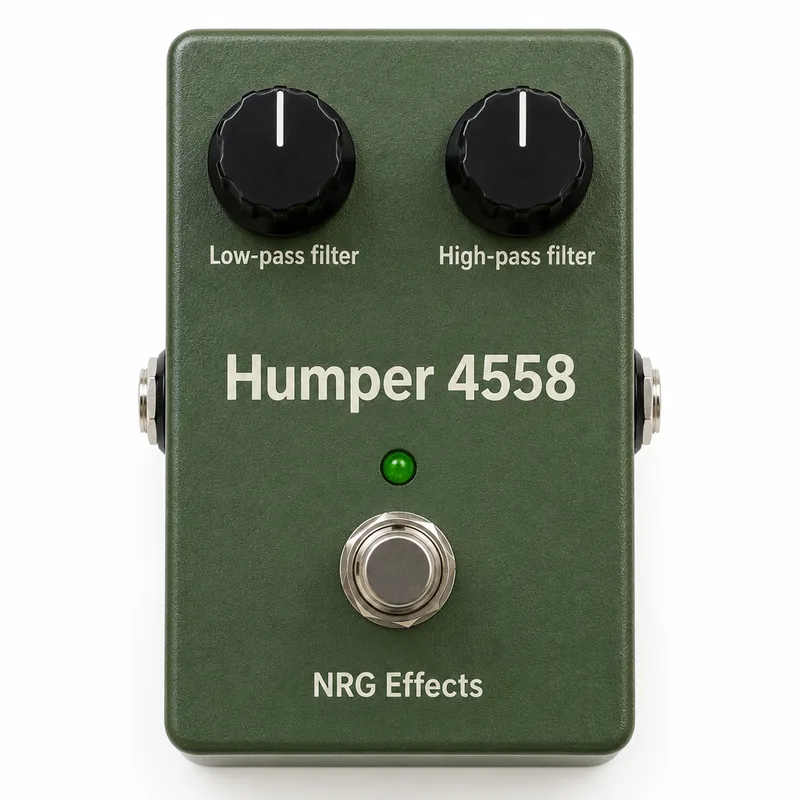
That Pedal Show also covered the Falcon in a March 2019 episode (34:20 long) alongside the NRG Humper 4558, Thorpy Deep Oggin and Anasounds Utopia, using a Gibson Memphis 1958 ES-335 and playing through both humbucker and P90 pickups. The show's stated agenda was simply to plug the pedals in, see what sounds and features they find, and combine them in whatever way inspires them12.
Videos
CrazyTubeCircuits
JayLeonardJ
Questions
Is the Crazy Tube Circuits Falcon analog or digital?
It is analog. Crazy Tube Circuits built the Falcon with JFET technology to recreate the behavior, sound and feel of the preamp, phase inverter and power amp of a 5E3 Tweed Deluxe and a 6G2 Brownface Princeton, including the lower gain and clean sounds as well as the overdriven ones.
Does the Crazy Tube Circuits Falcon take a battery?
No. The Falcon requires an external 9V DC regulated and filtered power supply to run, so there is no battery option. Plan on a quality isolated or filtered supply rather than a basic daisy chain.
Can the Falcon be used as a clean boost?
Yes, in effect. Pete Thorn noted that if your amp's clean sound is anemic, you can set the Falcon to the '61 mode with the volume control below half and use the output control to add more viby cleans than the amp alone provides.
How does the Falcon respond to a boost or fuzz in front of it?
Guitar Player's reviewers found that the Falcon responds beautifully when driven by boost, overdrive and fuzz pedals, just like a real amp, and that it works at any volume. The pedal emulates the compression and sag of a power amp and tube rectifier, so it stays responsive to picking attack.
Where is the Crazy Tube Circuits Falcon made?
The Falcon is made in Greece. Crazy Tube Circuits is a Greek effects maker, and Guitar Player's review of the Falcon lists its country of build as Greece.
Does the Falcon clean up with the guitar volume?
Yes. Guitar Player's reviewers found that the Falcon cleans up beautifully when you play lighter or back off your guitar's volume, while keeping the tweed character, touch response and guitar volume response of the amps it emulates.
Sources (12)
- Falcon - Crazy Tube Circuits, Crazy Tube Circuits
- Crazy Tube Circuits Falcon and Killer V Reviews, GuitarPlayer, 2022-01-12
- Crazy Tube Circuits Falcon Overdrive, Delicious Audio, 2020-11-02
- Falcon (B-Stock), Crazy Tube Circuits
- Crazy Tube Circuits introduces the Falcon, Guitar.com, 2018-12-13
- Crazy Tube Circuits Falcon Overdrive: Tweed inspired vintage tones in a pedal, gearnews.com, 2018-12-10
- Falcon - pedals, Crazy Tube Circuits
- Crazy Tube Circuits takes flight with tweed-inspired Falcon overdrive, MusicRadar, 2018-12-10
- CRAZY TUBE CIRCUITS FALCON emulates 55 TWEED/61BROWNFACE TONES!, youtube.com, 2019-01-24
- Crazy Tubes Circuits Announces Falcon Overdrive, Guitar World, 2018-12-10
- Best Tweed-Style Overdrives & Fender-in-a-Box Pedals In 2024, Delicious Audio, 2024-11-13
- Crazy Tube Circuits Falcon, NRG Humper 4558, Thorpy Deep Oggin, Anasounds Utopia, That Pedal Show, 2019-03-12