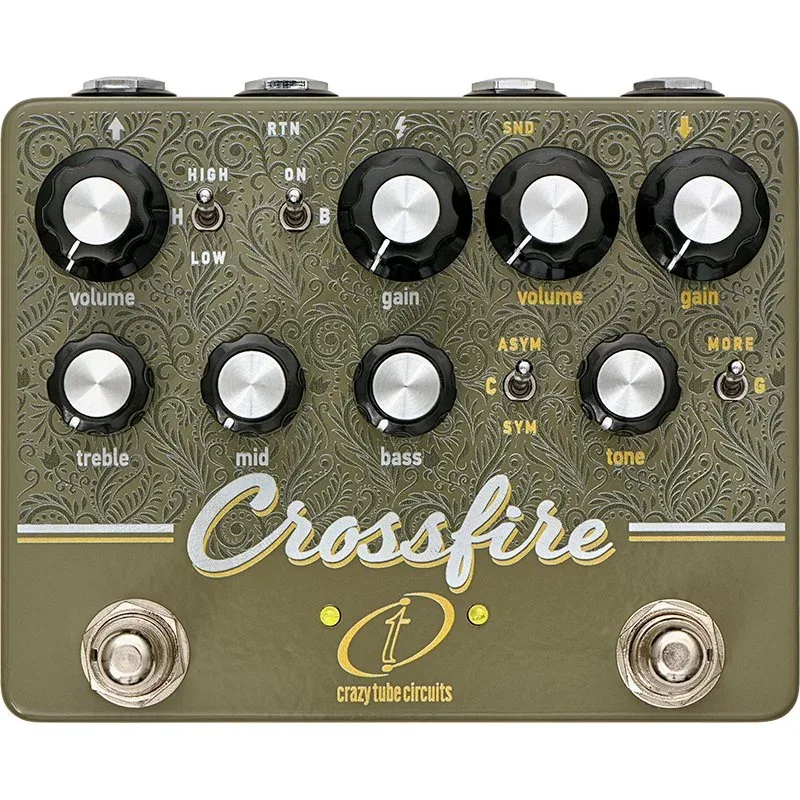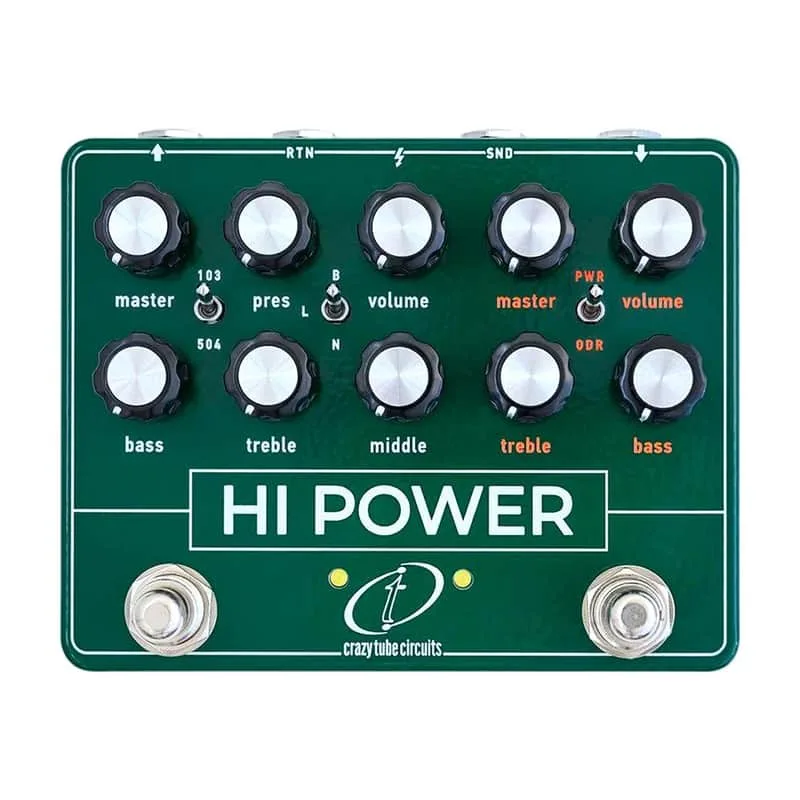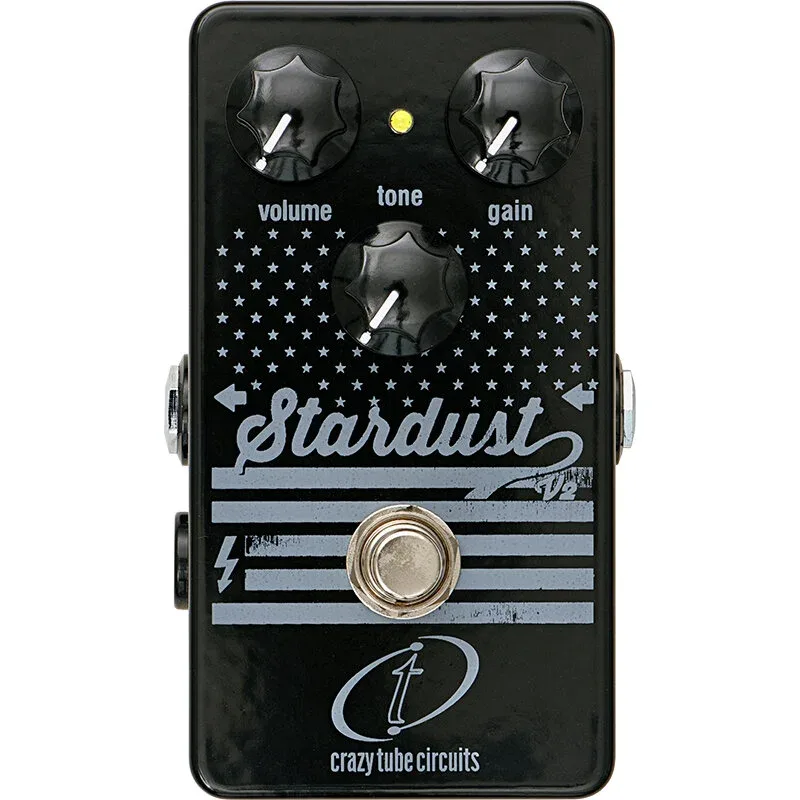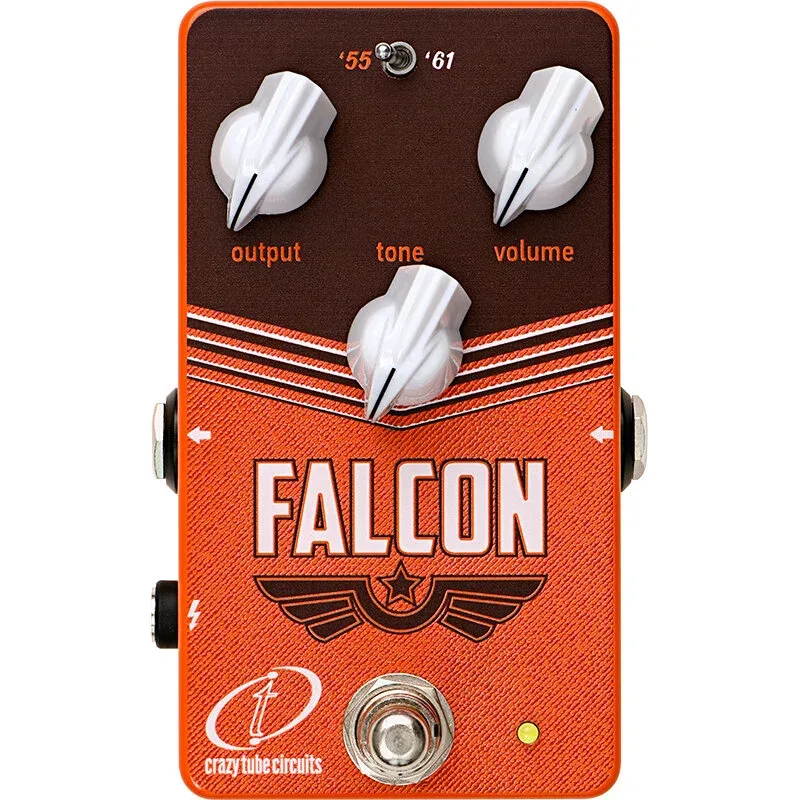


The Crazy Tube Circuits Heatseeker is a dual overdrive pedal that puts three classic British tube amps and a vintage wireless-system preamp in one box. The drive side models three Marshall amplifiers, selectable on a three-way switch, while the boost side recreates the preamp and dynamic expansion circuit of the Schaffer-Vega Diversity System, a mid-'70s wireless system that Crazy Tube Circuits calls "the secret recipe to major rock star guitar rigs"1. It is the fourth pedal in the maker's twin-footswitch series, following the Crossfire, Unobtanium and Hi Power2.
MusicRadar framed what it goes after this way:
The Heatseeker is the fourth in Crazy Tube Circuits' twin-footswitch series, following the Crossfire, Unobtanium and Hi-Power2. Its three-way mode switch moves between three different Marshall models: a JTM45, a 1959 Super Lead, and a late-'70s JMP 2203 Master Volume model, the same as a JCM800, in increasing order of gain2. The 45 mode covers sweet cleans and dynamic, crunch rhythms; SL delivers what Andertons calls "super iconic lead" sounds; and MV moves into the '70s era of master volume controls with more saturation3.
The whole circuit is analog, built on JFETs rather than tubes or digital modeling, and it runs internally at 27 volts for extra headroom14.
The three amp modes
The drive side is an amp-in-a-box with a three-way mode switch. In increasing order of gain, the modes are2:
| Mode | Amp modeled | What reviewers found it for |
|---|---|---|
| 45 | Marshall JTM45 | "For all your sweet cleans and dynamic, crunch rhythms"32 |
| SL | Marshall 1959 Super Lead | "Those 'super iconic lead' sounds"3 |
| MV | Late-'70s JMP 2203 Master Volume (same as a JCM800) | "The '70s and the era of master volume controls... more saturation"3 |
Guitar.com's Richard Purvis found the three settings genuinely distinct: "The three amp types sound markedly different in terms of top-end friskiness and saturation, but are all equally good"4. He described the mid-gain JTM45 tone with all knobs at halfway as "rich, smooth and tight, and a strong starting point for any journey into Plexi-land"4.
The controls
The Heatseeker carries a full amp-style control set. MusicRadar describes the core of it: "Dial in your drive sound via the Master and Volume knobs," alongside "controls for bass, middle and treble"3. Guitar World's Trevor Curwen found the interplay of those two gain controls does the heavy lifting: the juxtaposition of Volume and Master "runs the gamut from glassy cleans through the various levels of break-up and crunch, to the distorted roar associated with a Marshall stack at full pelt"2.
The boost side has its own control, the Enhance knob, which governs the Dynamic Expansion circuit. Crazy Tube Circuits says it works on the guitar tone's dynamic response, that around 10 o'clock is a good starting point, and that maxed out it can revive dull sounds1. Curwen found its effect is subtle: it "works on dynamic and harmonic components to offer a certain enrichment to the sound, which you can dial in to taste"2.
The last control is a toggle switch activating the Wall of Sound circuit, which boosts the output, in MusicRadar's words, "adding thundering lows and dense high mids"3. Guitar.com's reviewer went further: "a flick of the switch to engage the wall of sound adds depth and 'bigness' in a way that makes it hard to turn off again"4.
Boost and drive: two circuits, two footswitches
The pedal has two dedicated on/off footswitches, one per circuit, so the boost and drive sections can be used independently or stacked on top of each other5. The Schaffer-Vega-style circuit sits first in the routing order5, and the boost side delivers up to 15dB of clean boost, which Curwen called "plenty for an extra-switchable element to the amp sounds for lead breaks"2.
Guitar.com's Purvis characterized the boost's voice as its own thing rather than a treble booster clone: "It's bright and peppy, but somehow more integrated into the tone than an all-out treble booster. There's also some extra" compression4.
As with all of Crazy Tube Circuits' dual drive pedals, a passive effects loop between the two sections lets you connect other pedals in between them1.
Power: 9V in, 27V inside
The Heatseeker runs on a 9V DC adaptor, drawing 115mA, and boosts that internally to 27 volts to feed the JFET circuit12.
Do not plug in a power supply higher than 9V DC. The pedal generates its own 27 volts internally; a higher input voltage is not supported by the maker1.
Where it came from and where it is made
Crazy Tube Circuits is a Greek effects maker, and Guitar World lists the Heatseeker's origin as Greece2. The pedal continues a line of work the company began with its Unobtanium pedals and carried on with the Hi Power, recreating vintage circuits in pedal form5. Guitar World notes it is the fourth in the twin-footswitch series after the Crossfire, Unobtanium and Hi-Power2.
What reviewers said
Reviewers found plenty of range in the three modes. Guitar World's reviewer noted that the Juxtaposition of the Volume and Master knobs "runs the gamut from glassy cleans through the various levels of break-up and crunch, to the distorted roar associated with a Marshall stack at full pelt"2. Guitar.com's reviewer found the mid-gain JTM45 tone with all the knobs at halfway "rich, smooth and tight, and a strong starting point for any journey into Plexi-land"4, and recommended the 45 mode "for all your sweet cleans and dynamic, crunch rhythms," the SL mode for "super iconic lead" sounds, and the MV mode for its move into the '70s master-volume era with more saturation3.
Price and availability
Guitar World lists the Heatseeker at $279 / £235 / €2792. The maker's own store has shown it at €279.00 originally and €232.00 as a sale price6, and lists availability as shipping in 5 to 6 days1.
Videos
Pete Thorn
The Studio Rats
Leon Todd
Questions
Can the Heatseeker get Angus Young's tone?
Guitar World's reviewer listed accurate emulation of Angus Young's sound among the pedal's pluses. The three amp modes cover a JTM45, a 1959 Super Lead and a late-'70s JMP 2203 Master Volume, and the boost section recreates the Schaffer-Vega Diversity System preamp associated with classic AC/DC rigs. How close you get still depends on your guitar and amp.
What is the Schaffer-Vega Diversity System?
A mid-'70s wireless guitar system whose analog preamp and tone enhancer circuit found its way into major rock star rigs. Crazy Tube Circuits based the Heatseeker's boost section on its preamp and dynamic expansion circuit, re-imagined with an Enhance knob for more control over the guitar's dynamic response.
Is the Crazy Tube Circuits Heatseeker true bypass?
Yes. Guitar World's review lists true bypass among the pedal's features. It runs on a 9V DC adaptor, drawing 115mA, and boosts that internally to 27 volts for extra headroom.
Can I use the Heatseeker's boost and drive separately?
Yes. The two circuits each have their own on/off footswitch, so you can run them independently or stack them. A passive effects loop between the sections lets you insert other pedals in between, with the Schaffer-Vega-style boost first in the routing order.
Where is the Crazy Tube Circuits Heatseeker made?
In Greece, according to Guitar World's review. Crazy Tube Circuits is a Greek effects maker whose twin-footswitch series includes the Crossfire, Unobtanium, Hi Power and now the Heatseeker.
What does the wall of sound switch do on the Heatseeker?
It activates the Wall of Sound circuit, which boosts the output with what MusicRadar called thundering lows and dense high mids. Guitar.com's reviewer found it adds depth and bigness in a way that makes it hard to turn off again.
Sources (6)
- Heatseeker, Crazy Tube Circuits
- Crazy Tube Circuits Heatseeker review, Guitar World, 2025-03-15
- “Imagine standing in front of a wall loaded with tube amp heads and 4x12 speaker cabinets, grabbing your guitar and hitting a chord”: Crazy Tube Circuit's Heatseeker is an amp-in-box to help you nail Angus Young's high-voltage AC/DC tones, MusicRadar, 2024-12-10
- Crazy Tube Circuits Heatseeker review: hard-rocking tones, Guitar.com, 2025-08-06
- Crazy Tube Circuits Heatseeker, Delicious Audio, 2025-01-08
- Heatseeker (B-Stock), Crazy Tube Circuits