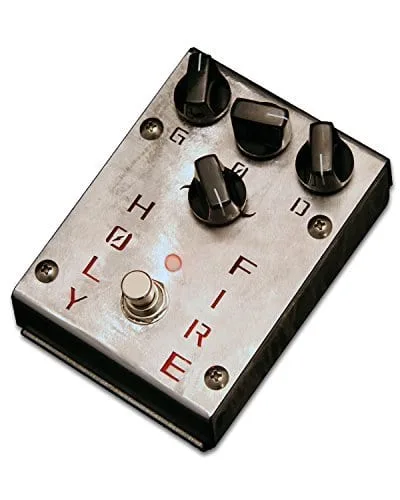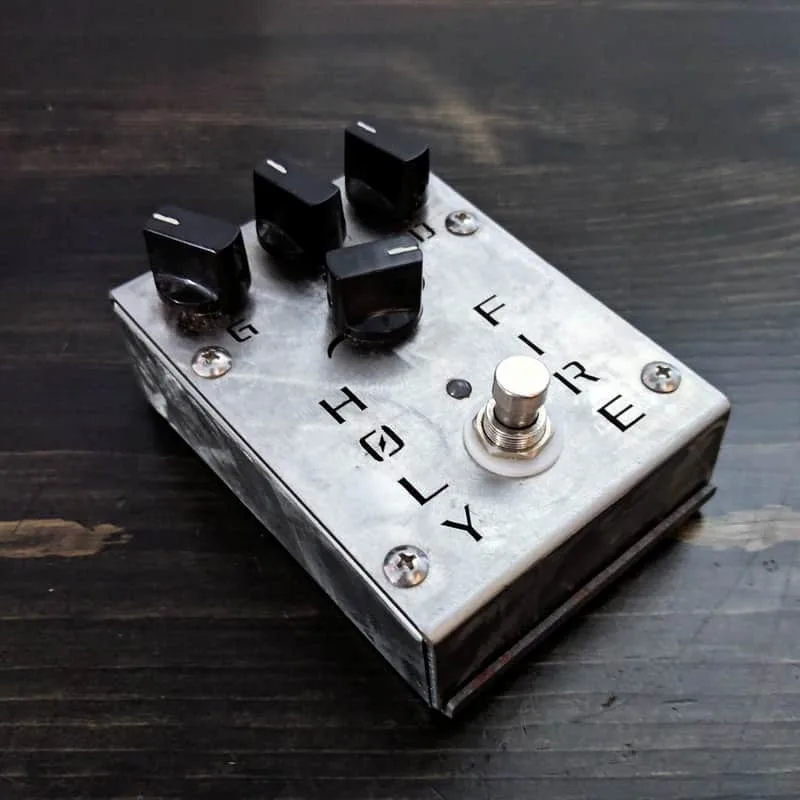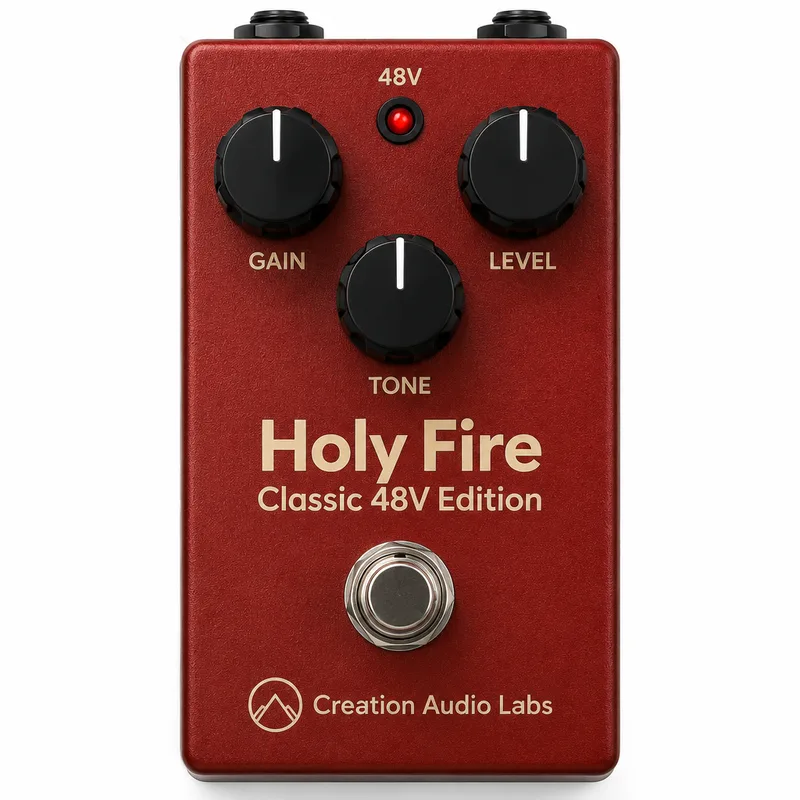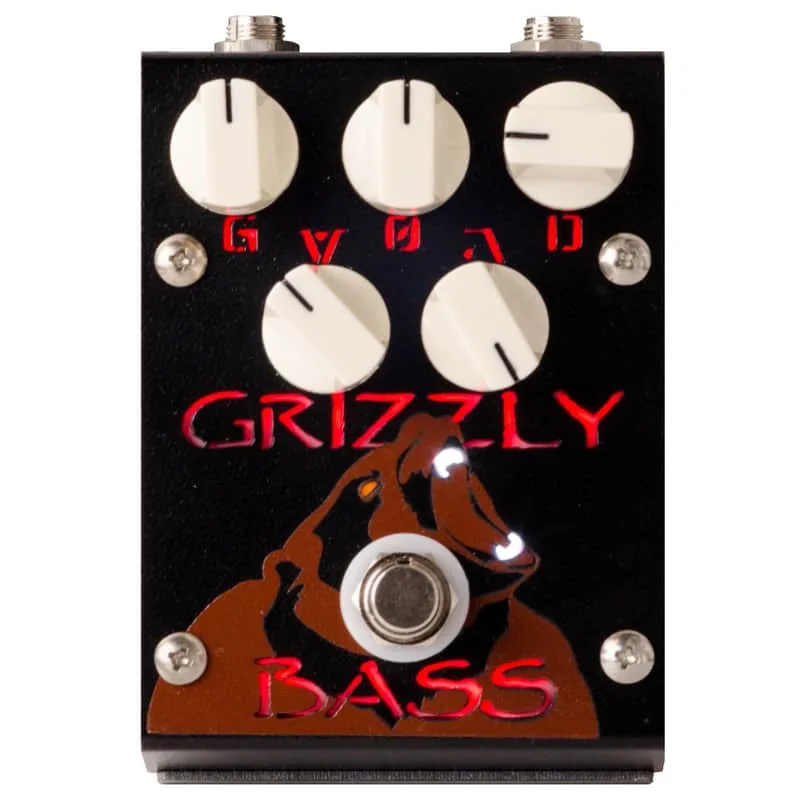


The Grizzly Bass is an overdrive, distortion and tone-shaping pedal from Creation Audio Labs, built for bass but also usable on guitar. The maker pitches it simply: "make your bass (or guitar) growl like a grizzly!"1 Its circuit borrows proprietary wave-shaping technology from the company's Holy Fire pedals to produce what Creation Audio Labs describes as tube-like saturation without adding noise or heavy filters, preserving bass tone all the way down to 20Hz1.
The pedal is a completely analog signal processor. Creation Audio Labs describes its core as an analog computer, the same approach used in the Holy Fire 48 and Holy Fire 9, where the overdrive and distortion knobs act as variables in a mathematical equation that reshapes the input waveform. As the maker puts it, an analog computer "has no sampling or latency errors"2.
The controls: G, O, D and V
The Grizzly Bass puts its shaping on four knobs, and Creation Audio Labs has explained each one in detail2.
| Control | What it does |
|---|---|
| G (Gain) | Adds up to 12 dB of pure clean boost for solos, or can be turned completely off; acts as a master volume on the pedal's output2 |
| O (Overdrive) | Saturates the signal like a vacuum tube as it is turned up2 |
| D (Distortion) | Works with O as a variable in the analog computer's wave-shaping equation; the distortion side uses hard edge clipping circuitry21 |
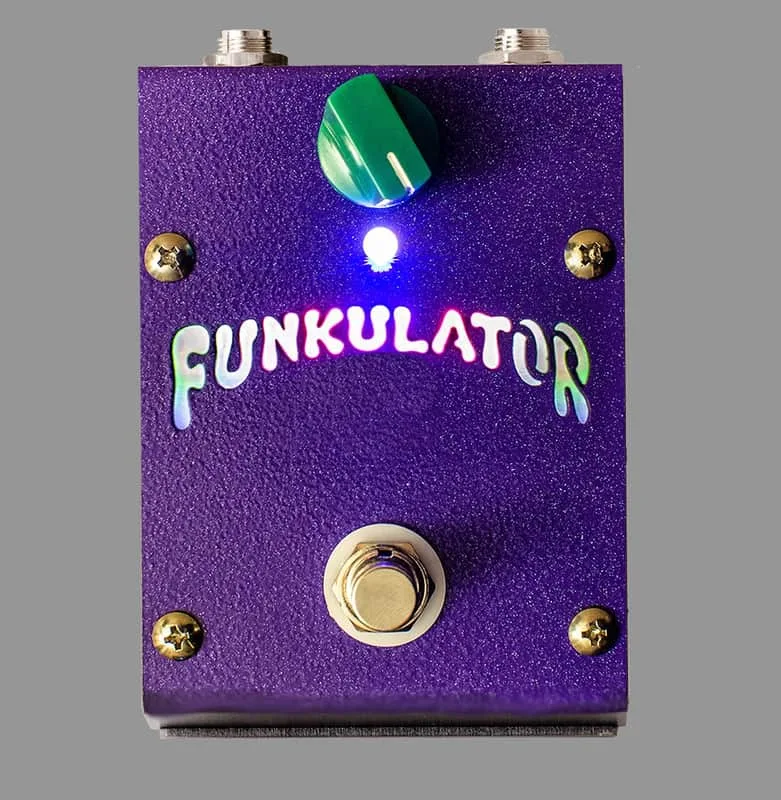
| V (Mid Scoop) | A mid scoop borrowed from the Funkulator bass tone shaper; all the way up is flat, turning it down scoops mids while adding the same energy to highs and lows, and the Q of the scoop tightens as the scoop gets deeper2 |
The V control is the tone-shaping heart of the pedal for players who want a scooped, funk-ready bass sound, and it comes straight from another Creation Audio Labs design, the Funkulator2. Alongside the knobs, the pedal offers three modes:
- Overdrive: analog wave-shaping tube simulator technology1
- Distortion: hard edge clipping circuitry1
- Clean Boost: from 0 dB to +12 dB1
The maker also fits a hi-cut filter to shape the edges of the sound for vintage speaker simulation. All the way up it is flat; turning it down sweeps in a gentle 6 dB per octave high cut from 20 kHz to 400Hz, which by itself can simulate a vintage speaker12.
Power and practicalities
The Grizzly Bass runs on 9V DC at 250mA, using a standard center-negative 5.5 x 2.1mm barrel connector1.
At 250mA the Grizzly Bass is too hungry to survive on a regular 9V battery, and Creation Audio Labs recommends the High-Current output of your pedal power brick for best results23. The maker notes that Pedaltrain's rechargeable VOLTO battery fits under the pedal's footprint if you need battery power2.
The enclosure is built for the road, with a thick 16 gauge steel chassis, a heavy brushed stainless steel bottom, and a black textured powder coated backdrop2. The pedal keeps a small footprint at 3.1" x 4.25", so it fits on a crowded pedalboard without taking up much room1.
Bypass, buffer and DI use
Buffered bypass is stock, using Creation Audio Labs' Redeemer buffered output, with true bypass available as an option1. For players running long cable runs or big boards, the stock buffer keeps the signal intact when the effect is off; players who prefer a fully passive signal path when bypassed can order the true bypass version.
The pedal can also serve as your direct connection to the house system. Creation Audio Labs says it "can be used as a DI to plug directly into the line-in of any sound system"1, so a bassist can go from the Grizzly Bass straight into a mixer without a separate DI box.
Where the circuit came from
The Grizzly Bass draws on the experience and technological advancements of several earlier Creation Audio Labs designs: the Holy Fire, the MW1 and the Funkulator1. Its wave-shaping core comes from the Holy Fire line, including the Holy Fire 9, while its mid scoop comes from the Funkulator bass tone shaper12. Compared with a straightforward distortion pedal, the Grizzly Bass stacks overdrive, hard-clipping distortion, a parametric-style scoop and a clean boost in one analog box aimed squarely at bass players who want grit without losing the bottom of their tone.
Videos
Creation Audio Labs
Creation Audio Labs
Creation Audio Labs
Questions
Can I use the Grizzly Bass as a DI?
Yes. Creation Audio Labs says the Grizzly Bass can be used as a DI to plug directly into the line-in of any sound system, so you can run it straight into a mixer or powered speaker without a separate DI box.
Is the Grizzly Bass true bypass?
Buffered bypass is stock, using Creation Audio Labs' Redeemer buffered output, and true bypass is available as an option. If you run long cables or a large pedalboard, the stock buffer keeps the signal strong when the pedal is off.
Does the Grizzly Bass keep low end on bass?
Creation Audio Labs says the Grizzly Bass produces tube-like saturation without adding noise or heavy filters, preserving bass tone all the way down to 20Hz. The maker designed it specifically so distortion does not thin out the low end.
Is the Grizzly Bass analog?
Yes. Creation Audio Labs describes it as a completely analog signal processor, an analog computer that reshapes the waveform with no sampling and no latency errors, using wave-shaping technology from the Holy Fire pedals.
Sources (3)
- Grizzly Bass, Creation Audio Labs
- Grizzly Bass Overdrive Distortion Pedal, Creation Audio Labs, 2014-09-12
- GRIZZLY BASS, Creation Audio Labs