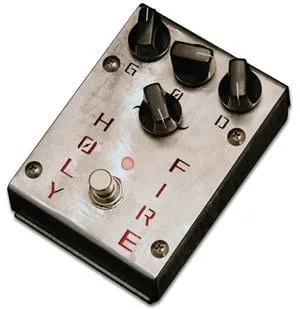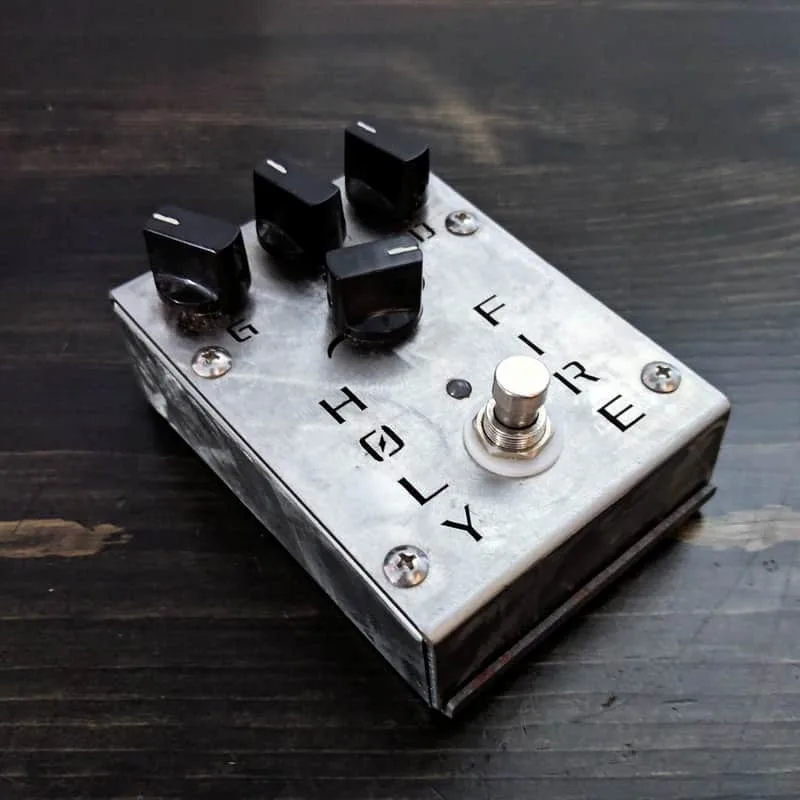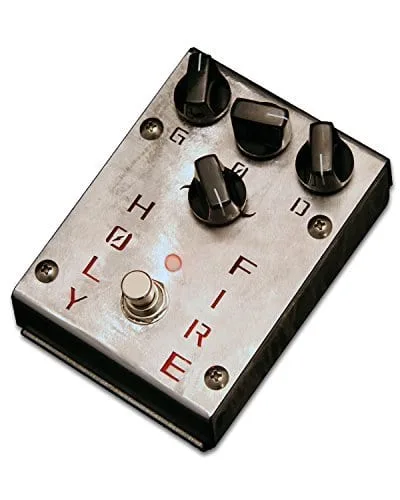


The Creation Audio Labs Holy Fire is an overdrive/distortion pedal first released in 2008 by Creation Audio Labs1. What sets it apart from most gain pedals is how it makes its distortion: instead of pushing high gain into a clipping circuit, it uses proprietary analog wave-shaping circuitry to model the saturation and distortion waveforms produced by vacuum tubes, transformers or analog tape12. The maker describes it as "like a tube preamp in a pedal, but without the bulky, fragile and expensive tubes and transformers"3.
The circuit runs at 48 volts, which is far above the 9V supply most pedals use, and Premier Guitar's reviewer found that those volts are put to real use, writing that "Those 48 volts are put to great use in creating a sound unlike most gain/overdrive/distortion pedals on the market"4. The pedal sits in the distortion family, but its tube-modeling approach puts it closer in spirit to a preamp pedal than to a conventional clipping overdrive.
What it does: tube-style saturation from a 48-volt circuit
Creation Audio Labs says the Holy Fire "introduces the world to analog wave-shaping technology to re-shape the waveform and achieve tube-like FX" without adding noise or heavy filters3. In the maker's words, the design "combines old school analog computing with state of the art analog circuitry" to model the way tubes, transformers and tape saturate1. The Holy Fire 9 applies the same idea: "the Holy Fire 9 uses our proprietary analog wave-shaping circuitry to model all the vacuum tube crunch you could ever want" rather than relying on hard high-gain clipping alone2.
The pedal responds to playing dynamics and instrument volume. Creation Audio Labs says you can "play with a softer attack and velocity for a cleaner sound, or dig in to get as much grit as you want"3. The maker also credits the design with an ultra-wide bandwidth, tube-like response without changing your core tone, and an extremely low noise floor7.
Both versions share a set of voicing features:
- Distortion mode uses hard edge clipping circuitry78
- Hi-cut filter to shape the edges of the waveform for vintage speaker simulation38
- Clean boost, on the Holy Fire 9, alongside overdrive and distortion2
On the Holy Fire 9, the "D" control is the distortion knob, and turning it up "begins to introduce hard clipping and compression"6.
Holy Fire Classic vs Holy Fire 9
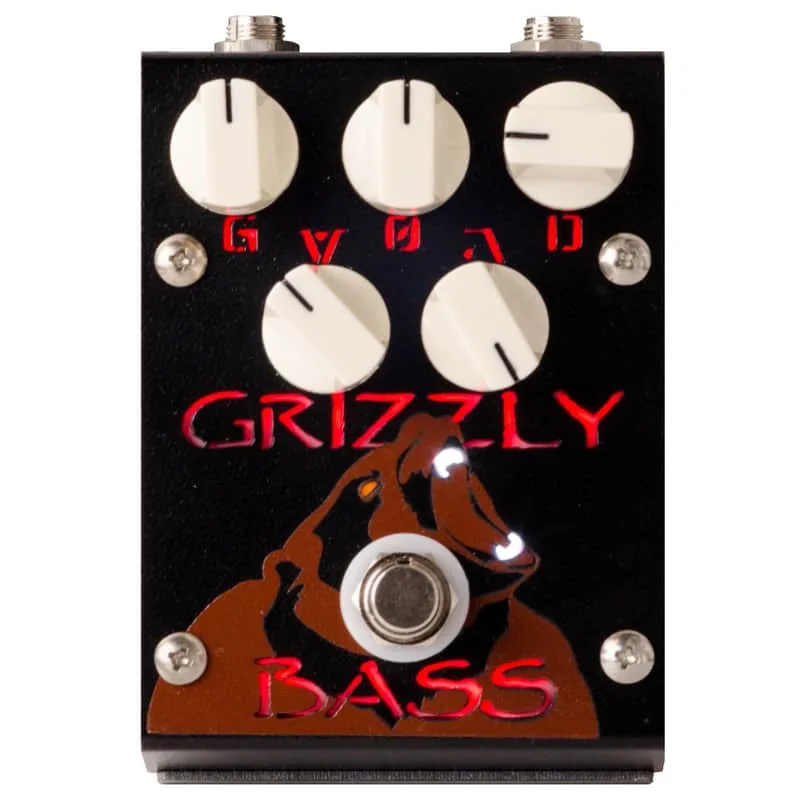
The original Holy Fire Classic needs its 48 volts, so Creation Audio Labs includes a 48VDC universal power supply that accepts 90 to 260VAC mains input37. That rules out running it from a standard 9V pedalboard supply. The Holy Fire 9 solves that: it carries a power circuit that steps up a standard 9VDC pedal power supply to the voltage the wave-shaping circuitry requires, a design Creation Audio Labs announced in 2014 alongside the Grizzly Bass9. The company's history page says this "power boosting circuit opened the door for a 9V version of the HOLY FIRE"1.
| Holy Fire Classic | Holy Fire 9 | |
|---|---|---|
| Circuit | Holy Fire Classic wave-shaping design69 | Holy Fire Classic circuit with a new power circuit69 |
| Power | 48VDC universal supply included37 | 9VDC, 250mA, center negative, 5.5 x 2.1mm barrel28 |
| Modes | Overdrive/distortion with hard edge clipping and hi-cut filter28 | Transparent gain, touch-sensitive overdrive, thick distortion, clean boost2 |
| Analog or digital | Analog7 | Analog, no sampling or latency6 |
The Holy Fire 9 draws up to 250mA at 9V86, well above what a typical analog overdrive needs, so plan pedalboard power accordingly. The Classic cannot run from a 9V supply at all and uses its own included 48VDC supply3.
Creation Audio Labs describes the Holy Fire 9's sound as "Transparent GAIN, dynamic smooth touch sensitive OVERDRIVE, thick rich DISTORTION"2, and sums up the design as having "the heart of the Holy Fire Classic and the power of a Grizzly"6.
Build and what reviewers said
The Holy Fire comes in a heavy, brushed stainless steel box with lettering punched through the metal rather than painted or stenciled on, as Premier Guitar's reviewer noted4. The reviewer's verdict on the sound was positive on the point that matters most to many players: the pedal "always makes the sound bigger," and "there was never a loss of bass response with an increase of gain, overdrive or distortion"4. That low-end retention at high gain is a common weakness in conventional overdrive pedals, which often thin out as clipping increases.
Players
Lee Roy Parnell is quoted on Creation Audio Labs' artist page on his use of the pedal in the studio5:
"while I have used it on my guitar on countless sessions, recently we needed a little more "hair" (or harmonic distortion) on the bass guitar. WOW! Exactly what the Doctor ordered!!!"5
Videos
Premier Guitar
Creation Audio Labs
Texas Blues Alley
Questions
Does the Creation Audio Labs Holy Fire run on 9V?
The original Holy Fire Classic does not. It runs on a 48VDC supply, and Creation Audio Labs includes a universal 48VDC power supply with the pedal. The Holy Fire 9 is the version that runs on a standard 9VDC pedal power supply, using an internal power circuit that steps the 9V up to the voltage the wave-shaping circuitry needs.
What is the difference between the Holy Fire and the Holy Fire 9?
The Holy Fire 9 is built around the Holy Fire Classic circuit but replaces the external 48V supply with a power circuit that steps up a standard 9VDC pedal power supply. Creation Audio Labs describes it as combining the heart of the Holy Fire Classic with the power circuit of their Grizzly, offering transparent gain, touch-sensitive overdrive and thick distortion.
Is the Holy Fire analog or digital?
It is analog. Creation Audio Labs describes the Holy Fire Classic as an all-analog wave-shaping design with no sampling or latency, and says the analog process preserves your original tone. The circuit models the saturation and distortion waveforms of vacuum tubes, transformers or analog tape rather than processing the signal digitally.
Who has used the Holy Fire in the studio?
Lee Roy Parnell is quoted on Creation Audio Labs' artist page saying he has used the Holy Fire on his guitar on countless sessions, and that it delivered exactly the harmonic distortion the session needed when a bass track needed more hair.
Sources (9)
- Creation Audio Labs, Creation Audio Labs
- HOLY FIRE 9, Creation Audio Labs
- HOLY FIRE CLASSIC, Creation Audio Labs
- Creation Audio Labs Holy Fire Pedal Review, Premier Guitar, 2010-03-11
- Guitar Audio News, Tips & Tricks from Creation Audio Labs, Creation Audio Labs
- Holy Fire 9 Revisited, Creation Audio Labs, 2026-03-06
- Holy Fire Classic, Creation Audio Labs
- Holy Fire 9, Creation Audio Labs
- New Grizzly Bass & Holy Fire 9 by Creation Audio Labs, Premier Guitar, 2014-11-13