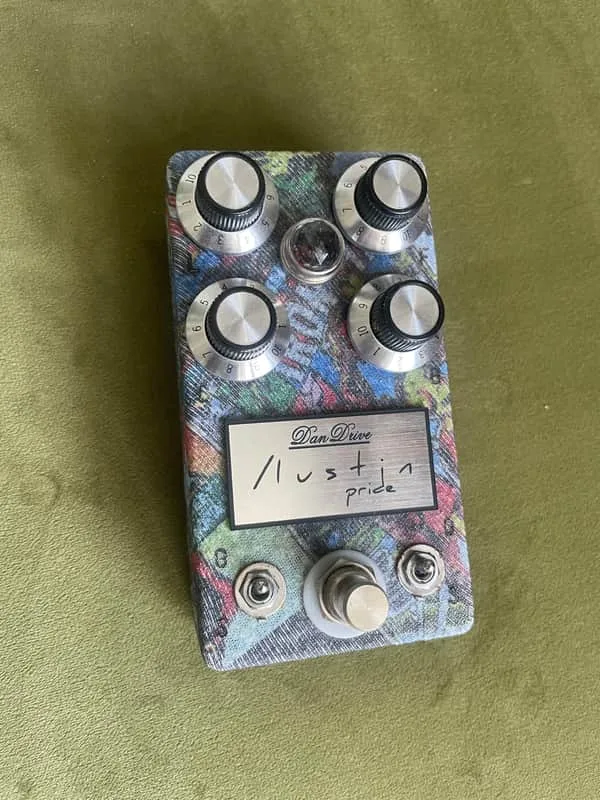



The DanDrive Austin Pride is a fuzz pedal made in Germany that recreates the classic Fuzz Face circuit with a twist: separate switches let you select germanium or silicon transistors in both gain stages, so one enclosure covers germanium, silicon and hybrid voicings12. It is built by DanDrive around the 1991 César Díaz Square Face Fuzz take on the Fuzz Face circuit, a design associated with Stevie Ray Vaughan's guitar tech2.
Germanium, silicon and hybrid voicings
The Austin Pride's central idea is that both transistor stages, Q1 and Q2, carry a germanium and a silicon device, and a switch on each stage selects between them23. That gives three basic voicings: both stages germanium, both stages silicon, or a hybrid of one of each2.
Guitar.com's Ed Oleszko described the germanium side in his 2020 review: "Thick and warm germanium fuzz, rich and enveloping sustain, and blurry-edged single notes and chords are coupled with the beautiful sparkly clean-up we associate with the best of these circuits."1
Of the silicon setting, he wrote: "Switching both transistors to silicon gives the fuzz voice more midrange authority, note articulation and definition, and a tighter low end."1
The transistor complements themselves are the subject of some variation between units and reports. Guitar.com describes the germanium units as military-spec OC75-equivalent CV2N1308 parts and the silicon units as gain-matched NTE123AP1. Guitar Pedal X's Stefan Karlsson, writing about his own unit, cites the pairing as Germanium NTE103 and Silicon NTE123 transistors on both Q1 and Q223. Guitar Pedal X notes that all four varieties of the design are still available, while the look and finish may vary, as may some of the overall specs2.
Controls
The pedal carries four knobs and three switches, a step up from the two knobs of the Square Face it is based on2.
| Control | Function |
|---|---|
| Level | Output level |
| Fuzz | Fuzz amount |
| Clean-up | Clean-up response |
| Bias | Transistor bias |
| Bass Boost | On/Off bass boost switch |
| Q1 Ge/Si Switch | Selects NTE103 germanium or NTE123 silicon in the first stage |
| Q2 Ge/Si Switch | Selects NTE103 germanium or NTE123 silicon in the second stage |
How it differs from the Square Face Fuzz
The Austin Pride's lineage runs through César Díaz, Stevie Ray Vaughan's guitar tech, whose 1991 Square Face Fuzz was itself a take on the Fuzz Face circuit2. As Stefan Karlsson put it in Guitar Pedal X: "And where Dan Querner further evolved that circuit to the Austin Pride variant here - which goes from 2 knobs to 4, adds a further bass boost switch, and switches for selecting Silicon or Germanium Transistors on both Q1 and Q2 Slots."2
In other words, the Austin Pride keeps the Square Face foundation and adds the transistor-switching flexibility, the extra controls and the bass boost on top of it2.
What reviewers said
Guitar.com reviewed the Austin Pride in March 2020, with Ed Oleszko calling it "a faithful recreation of the classic Fuzz Face circuit with some intriguing alterations"1.
Guitar Pedal X's verdict, from August 2026, was stronger still. Karlsson called it "the best version of the Square Face Fuzz, and an S-Tier example of this type of 2-Stage Transistor Switching Fuzzes overall"2.
Guitar World's 2023 history of the fuzz placed the Austin Pride among the pedals that "offer both in a single enclosure", naming it alongside the Spaceman Effects Gemini IV Dual Fuzz Generator as an example of germanium and silicon combined in one box4.
Power, size and availability
The pedal runs on either a battery or a 9V power supply with a DC 2.1mm center negative adaptor, so it works with standard pedalboard power1. Its enclosure measures 121 x 64 x 55mm and carries a custom cloth covering1. As of August 2026, Guitar Pedal X reports all four varieties still available, with a listed price of €589 ($543), while noting that the look, finish and some specifications may vary between editions2.
Guitar Pedal X notes that transistor selections, specifications and appearance may vary between editions of the Austin Pride, and that the look and finish may change2. Karlsson described snagging "one of the very last Austin Pride editions with the classic pairing" of NTE103 germanium and NTE123 silicon transistors2.
Videos
DanDrive pedal
Franco Fuzz
JamesOnGuitar
Questions
Is the DanDrive Austin Pride true bypass?
Yes. Guitar.com's review lists true-bypass switching among the pedal's features, alongside its custom cloth covering and its battery or 9V power options. True bypass means the pedal's circuit is removed from the signal path entirely when it is switched off, so your guitar's signal reaches the amp unaltered until you engage the fuzz.
Who designs the DanDrive Austin Pride?
The Austin Pride is designed by Dan Querner of DanDrive. According to Guitar Pedal X's Stefan Karlsson, Querner took the 1991 César Díaz Square Face Fuzz, itself a take on the Fuzz Face circuit, and evolved it: the Austin Pride goes from two knobs to four, adds a bass boost switch, and adds switches for selecting silicon or germanium transistors in both the Q1 and Q2 slots.
What transistors does the Austin Pride use?
The pedal carries pairs of germanium and silicon transistors, one of each in the Q1 and Q2 positions, and lets you switch between them. Guitar.com's review describes the germanium units as military-spec OC75-equivalent CV2N1308 parts and the silicon units as gain-matched NTE123AP. Guitar Pedal X also cites the pairing as NTE103 germanium and NTE123 silicon transistors.
Can the Austin Pride run on a battery?
Yes. Guitar.com's review states the pedal is powered by either a battery or a 9V power supply using a DC 2.1mm centre negative adaptor, so it can sit on a board with a standard supply or run standalone on a battery.
How is the Austin Pride different from the Square Face Fuzz?
The Austin Pride is based on the 1991 César Díaz Square Face Fuzz take on the Fuzz Face circuit, but Dan Querner evolved it further. Where the Square Face has two knobs, the Austin Pride has four, and it adds a bass boost switch plus separate germanium/silicon selection switches for both transistor stages, giving germanium, silicon and hybrid voicings.
Where is the DanDrive Austin Pride made?
Guitar.com's review describes the Austin Pride as a fuzz pedal made in Germany, where DanDrive builds it.
Sources (4)
- Review: DanDrive Austin Pride, Guitar.com, 2020-03-12
- Guitar Pedal X, Guitar Pedal X, 2026-08-14
- Guitar Pedal X, Guitar Pedal X, 2026-07-03
- Fuzz pedals: how the wildest drive of all conquered the radio, Guitar World, 2023-06-14