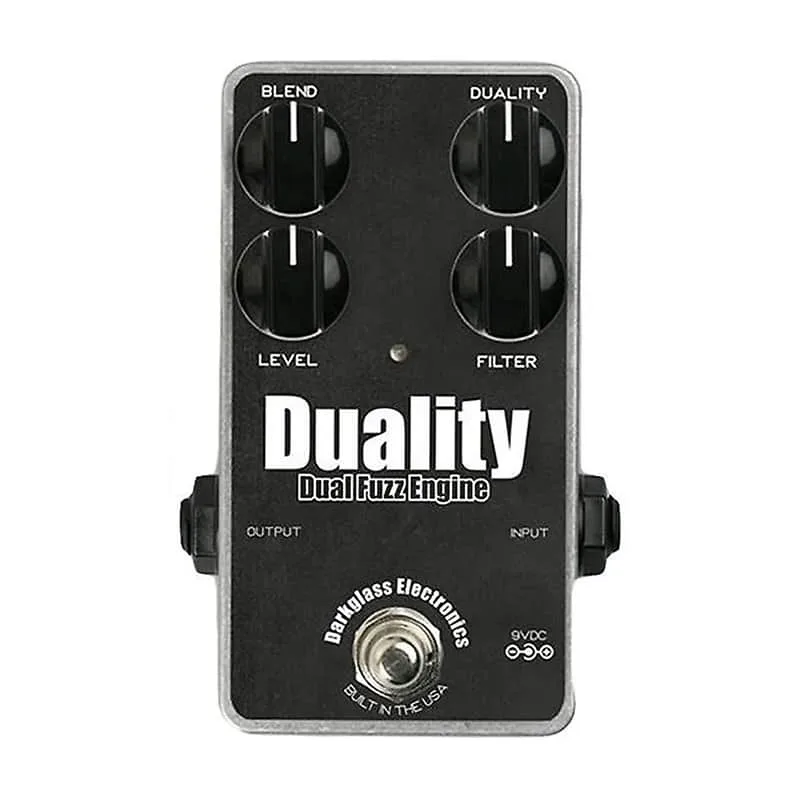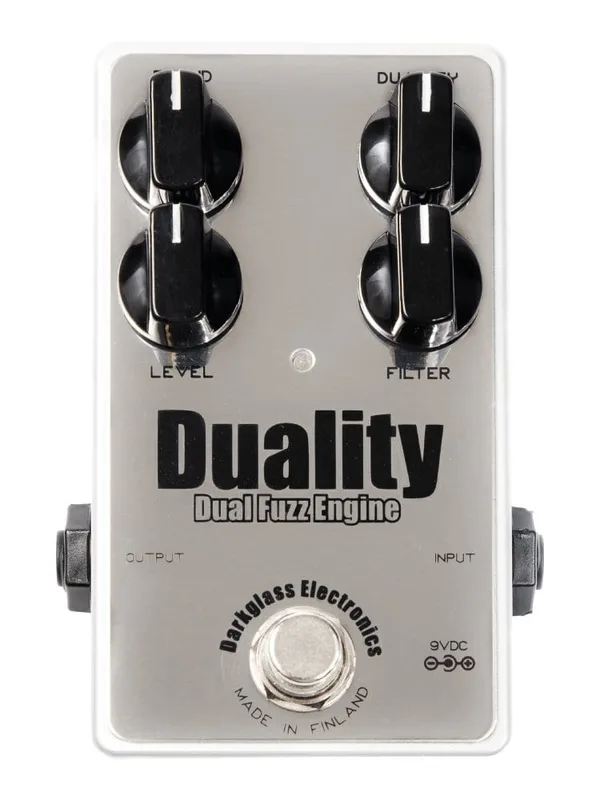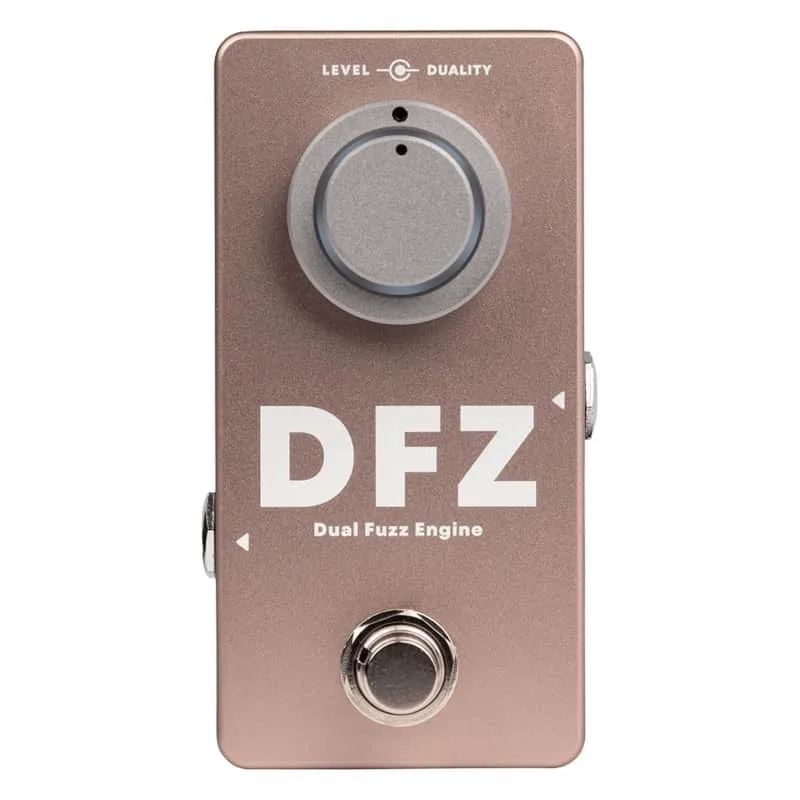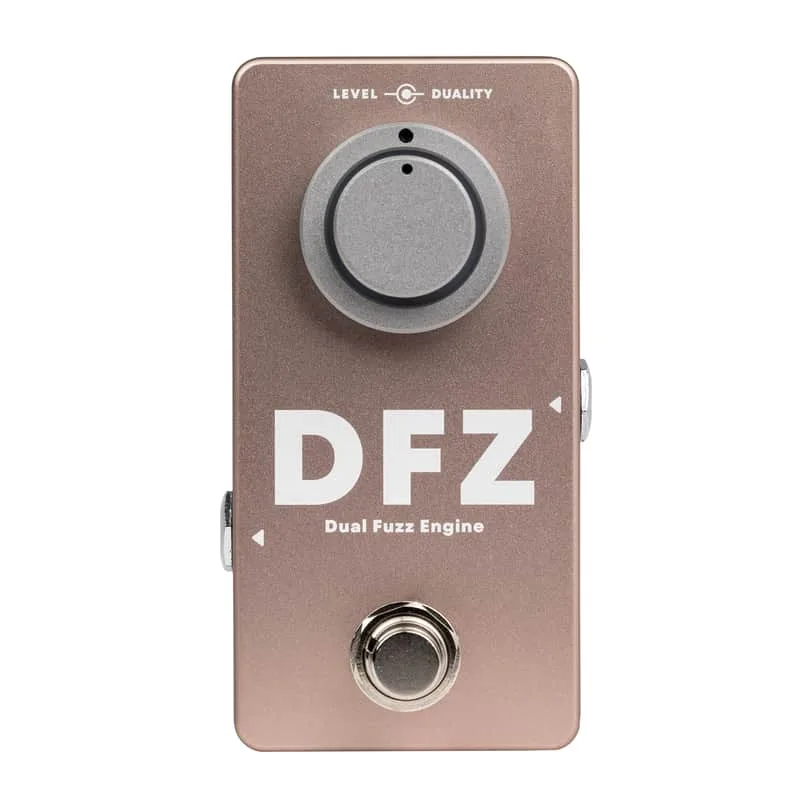


The Darkglass Electronics Duality Dual Fuzz Engine is a fuzz pedal for bass, first released in 2013, that puts two distinct fuzz circuits in one box and lets you blend them with each other and with your clean signal12. Where most fuzzes give you one flavor of breakup, the Duality runs two fuzz paths in parallel and gives you a knob to pan between them in any ratio, which is where the "Dual" in its name comes from32.
The Darkglass Duality Dual Fuzz Engine is a fuzz pedal built for bass, housed in an enclosure measuring 11.3×7.5 cm (4.45×2.95 in)4. The core idea is simple: keep your low end intact by blending clean signal back in, and shape the fuzz itself with a filter, so the effect sits tight instead of washing the bass out5.
Two fuzz circuits blended in parallel
The Duality's signal path splits into two fuzz circuits that run side by side. Pedal of the Day described them as "a gated saw-tooth wave and a raunchy high-gain sound," and the Duality knob pans between them so you can use one, the other, or a mix of both3. MusicRadar summed up the concept: the pedal "offers not one but two distinct fuzz circuits, which can be blended any way you choose with your clean signal"5.
On top of that, the whole fuzz output is mixed against your clean bass signal, so the pedal works like a parallel-blend fuzz rather than a straight serial one. Aion FX's technical analysis notes that the combination of the effect volume and the clean blend "provides extra fine-tuned mixing" beyond what the Blend knob alone gives you1.
The controls
The pedal has four knobs plus a footswitch. MusicRadar found the four black controls "all turn reassuringly smoothly while the stomp button is solid and firmly operated"5.
| Control | What it does |
|---|---|
| Duality | Mixes the two discrete fuzz circuits. At minimum, a pure gated saw-tooth wave; turned up, tighter high-gain fuzz4. Can also select one circuit entirely3. |
| Blend | Mixes the clean input signal with the effected signal, from fully clean turned left to full fuzz turned right, both audible at once54. |
| Level | Sets the volume of the fuzz signal only; the clean side stays at unity gain14. MusicRadar found it "adds grit and distortion" as it comes up5. |
| Filter | Controls the high-frequency content of the fuzz signal4; MusicRadar found it "increases the resonance, top end clarity and definition"5. |
The clean signal remaining at unity while Level sets the fuzz volume is what makes the blend ratio precise: you are balancing two fixed references rather than guessing4. Pedal of the Day called the Filter's range "broad and sweeping, allowing the player to cover a lot of ground musically"3.
The circuits inside
Aion FX traced the circuit in 2021 and published a full analysis1. The two fuzz paths work very differently:
- First path: a cascade of overloaded CD4049UBE hex inverter stages, three CMOS stages total, providing the distortion. Aion FX describes the result as an aggressive but articulate and versatile drive tone1.
- Second path: a single op-amp stage configured as a comparator, with the signal into the inverting input, the non-inverting input tied to a reference voltage, and no feedback path. The comparator is followed by a primitive two-diode noise gate, and those diodes also add crossover distortion. Aion FX calls this path "all-out square wave mayhem, complete with heavily gated 'velcro' tones characteristic of misbiased transistors"1.
The comparator concept is similar to Craig Anderton's "Ultra Fuzz," first published in Electronics Project for Musicians in 1978, though the Duality's comparator threshold is fixed rather than variable1.
Aion FX also flagged one quirk: a capacitor (C22 in the original Duality) sits between two resistors where it forms a 16kHz lowpass filter that "does basically nothing" and is likely a design mistake, one that has stayed the same across at least seven revisions of the circuit1.
One circuit quirk has survived every revision: a capacitor (C16, C22 in the original Duality) sits between R19 and R20 instead of between R20 and the noninverting input of IC6A, forming a 16kHz lowpass filter that does basically nothing in this application and is likely a design mistake. It has stayed the same across at least seven revisions1.
What reviewers said
Reviews were consistently positive. MusicRadar's verdict listed "Easy to use, quality tones, very impressive sounding" among its reasons to buy5. Bass Musician Magazine's Kilian Duarte rated construction 5 out of 5, calling it "incredibly durable and well put together with a solid chassis," and closed with "The Duality Fuzz Engine pedal is a fun pedal that was a joy to play"4.
Across the years since its release, the published verdicts have held up. MusicRadar summed up its case for the pedal as "Easy to use, quality tones, very impressive sounding"5, and Bass Musician Magazine's Kilian Duarte gave construction 5 out of 5, describing it as "incredibly durable and well put together with a solid chassis"4.
Videos
Darkglass Electronics
Darkglass Electronics
Darkglass Electronics
Sources (5)
- Tracing Journal: Darkglass® Duality Dual Fuzz Engine, Aion FX, 2021-11-12
- Binary Dual Fuzz / Darkglass Duality, Aion FX, 2021-11-12
- Darkglass Electronics Duality Dual Fuzz Engine, Pedal of the Day (www.pedal-of-the-day.com), 2015-05-14
- Review - Darkglass Electronics Duality Fuzz Engine - Bass Musician Magazine, The Face of Bass, Bass Musician Magazine, 2015-10-01
- Darkglass Duality Dual Fuzz Engine review, MusicRadar, 2017-01-11