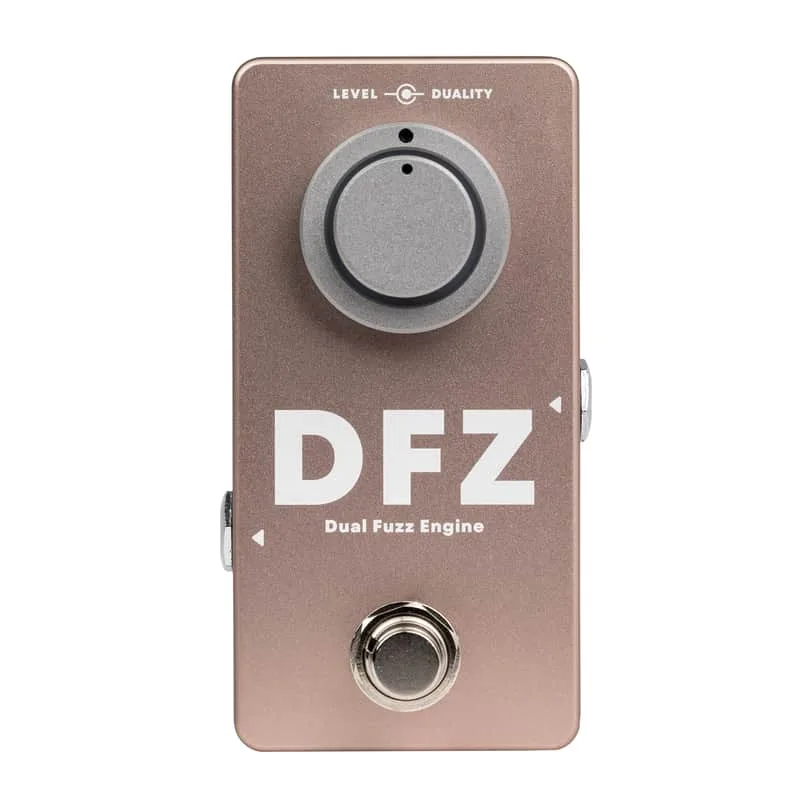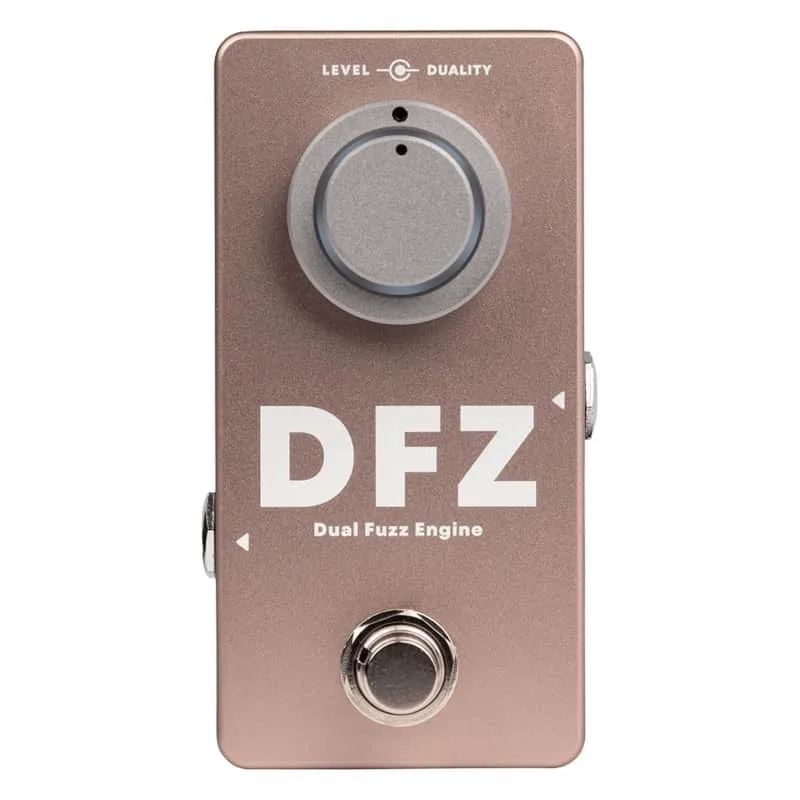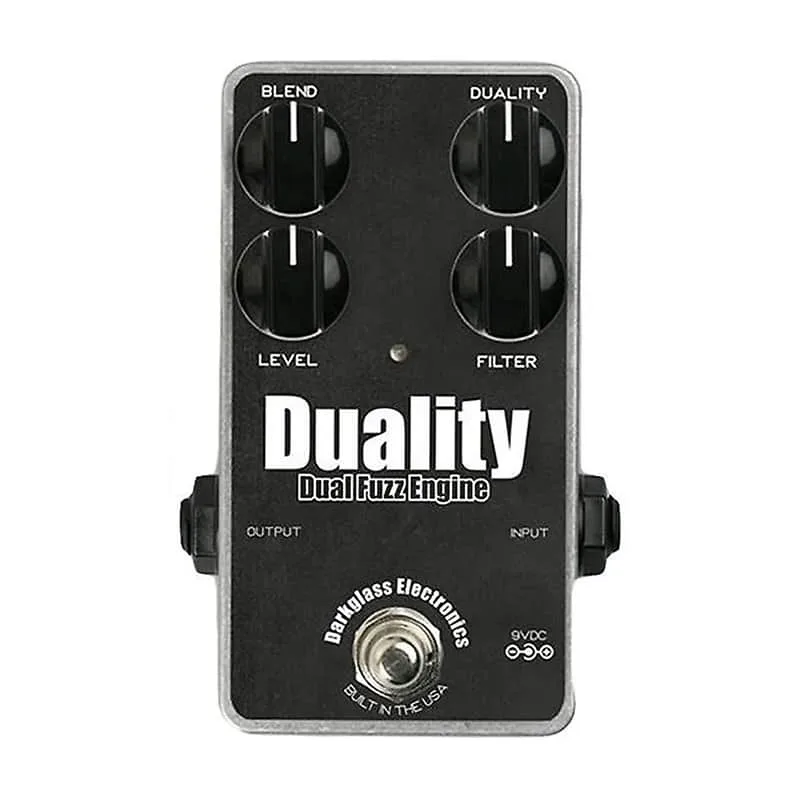


The Darkglass Duality Dual Fuzz Engine is a fuzz pedal for bass, first released in 2013 by Darkglass Electronics1. What sets it apart from most fuzzes is that it contains two distinct fuzz circuits running in parallel, and you can blend them together in any ratio, then mix the result with your clean signal21. One side is a gated, sawtooth-style fuzz with a thick, classic character; the other is a tighter, more modern high-gain fuzz2. The Duality knob pans between them, so you can sit on one circuit, the other, or any mix of the two3.
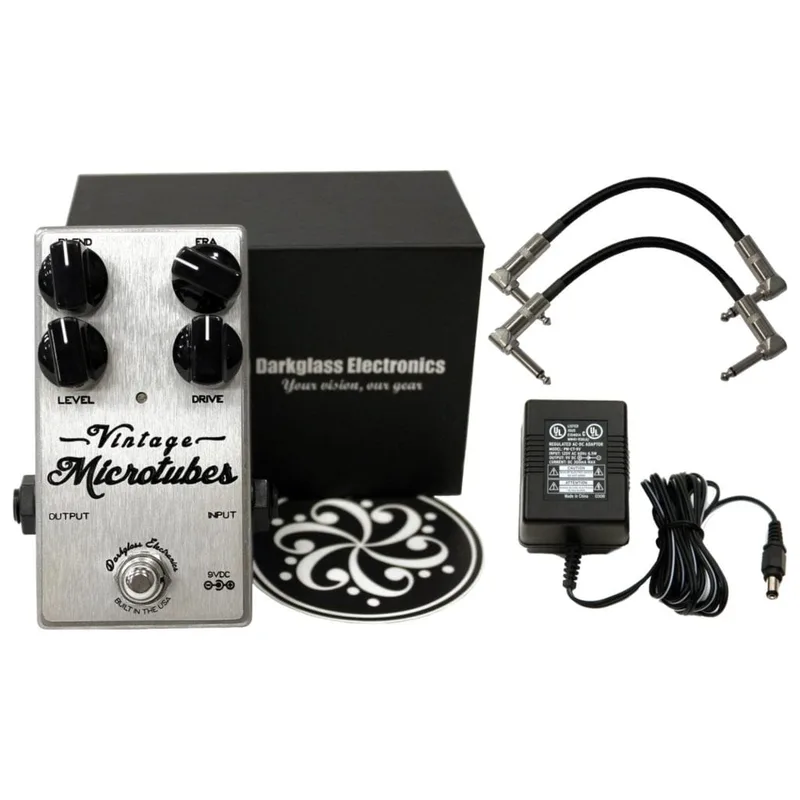
The pedal is classily presented in a brushed silver matte finish with a mirror chromed top facing, and its styling mirrors the company's Microtubes Vintage, but with a darker hue24. It is now the predecessor of the Duality DFZ, which Darkglass launched in November 2022 as its successor5.
Two fuzz circuits blended with your clean bass
The core idea of the Duality is that fuzz for bass works best when you keep some of your clean low end in the mix. The pedal offers two distinct fuzz circuits, which can be blended any way you choose with your clean signal2. Premier Guitar's reviewer found that its low-pass filter and blend control enable precise low-end sculpting and exceptionally tight and punchy fuzz, and that the pedal was very clearly built to address the shortcomings bass players encounter when adapting guitar fuzz to their instrument4.
The two circuits have distinct characters:
- Left extreme (Duality knob): a gated sawtooth circuit, a thick, classic sounding fuzz2. Premier Guitar described it as a gated, sawtooth sound4.
- Right extreme: a more modern, tighter high-gain sounding fuzz, which Darkglass itself describes as tighter high-gain fuzz24.
- In between: mixes of the two fuzz circuits across the pan2.
Aion FX, which traced the circuit in 2021, characterizes the first path as an aggressive but articulate and versatile drive tone, and the second as all-out square wave mayhem, complete with heavily gated "velcro" tones characteristic of misbiased transistors6. Pedal of the Day's 2015 review summed up the two circuits as a gated sawtooth wave and a raunchy high-gain sound3.
The controls: Duality, Blend, Level and Filter
The pedal has four black control knobs plus a stomp button, and the controls are logically arranged with a smooth feel24. Each knob does one clear job:
| Control | What it does |
|---|---|
| Duality | Pans between the two fuzz circuits: fully left is the gated sawtooth fuzz, fully right is the tighter high-gain fuzz, and anywhere between mixes the two24 |
| Blend | Mixes the fuzz with your clean signal, from fully clean (left) to fully fuzzed (right), with both clean and effected signals audible simultaneously23 |
| Level | Sets the volume of the effect; MusicRadar notes that pushing it adds grit and distortion23 |
| Filter | A tone control that increases the resonance, top end clarity and definition, with a broad and sweeping range23 |
Aion FX's trace adds detail on how the controls sit in the circuit: the volume control only applies to the fuzz signal, and the combination of the effect volume and the clean blend provides extra fine-tuned mixing capability6. In bypass mode, the blend knob is hard-wired to 100 percent, so the pedal passes your clean signal6.
The soft switches Darkglass uses are quiet to operate; Pedal of the Day's reviewer wrote that "you can stomp all over them barefoot and not even notice"3.
"The Blend control ranges from a clean signal when turned fully left to a positively dripping fuzztone when panned fully right."
Inside the circuit: CMOS stages and a comparator fuzz
Aion FX traced the Duality's circuit in 2021, and the trace explains why the two fuzz paths sound so different16.
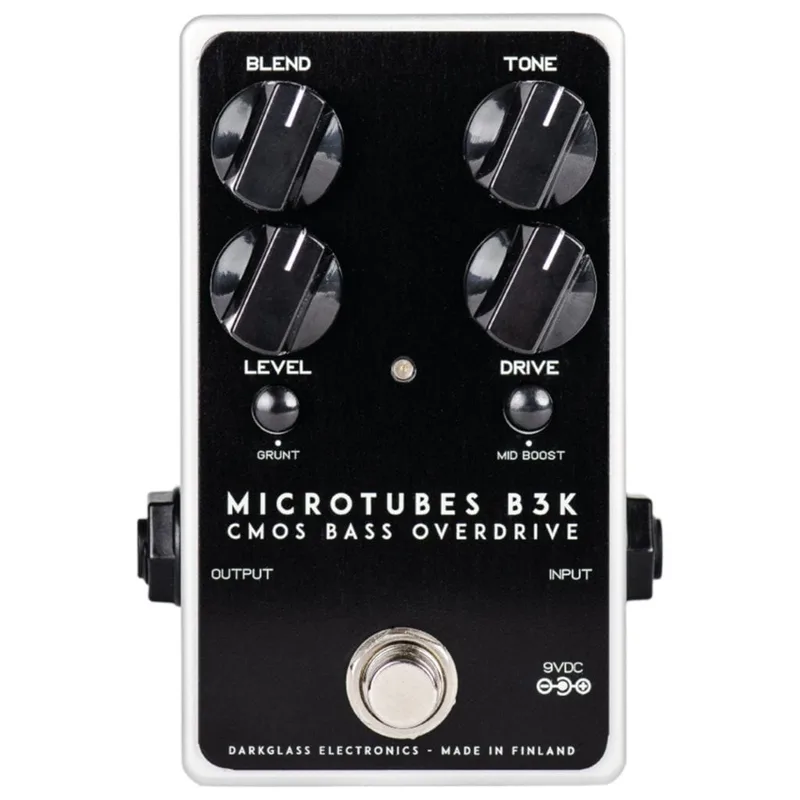
The first fuzz path is a cascade of overloaded CD4049UBE hex inverter stages providing the distortion, with three CMOS stages6. This is the aggressive but articulate path, and Aion FX notes it sounds pretty similar to Darkglass's flagship Microtubes B3K6.
The second fuzz path is built differently: a single op-amp stage configured as a comparator, with the signal going to the inverting input, the non-inverting input tied to a reference voltage, and no feedback path6. The comparator is followed by a primitive two-diode noise gate to keep it quiet when no signal is coming through, and those diodes also add crossover distortion6. This is the source of the heavily gated "velcro" tones6. Aion FX notes the comparator concept is similar to Craig Anderton's "Ultra Fuzz," first published in Electronics Project for Musicians in 1978, though the Duality's comparator threshold is fixed rather than variable6.
The bypass is a fairly standard JFET flip-flop design, only using the CD4049 instead of transistors like Boss or Ibanez use6. Aion FX also found one quirk that has stayed the same across at least seven PCB revisions: a capacitor that forms a 16kHz lowpass filter, which does basically nothing in this application and is likely a design mistake6. Revision 7 added R11, a 1M bias resistor at the input of the opamp buffer stage after the CMOS inverters, which Aion FX calls an editorial change rather than a tonal tweak, suggesting the revisions were primarily layout optimizations6.
The Duality has no battery compartment. The only way to power it is with a 9V adaptor, so plan on a pedalboard power supply with a 9V output4.
What reviewers said
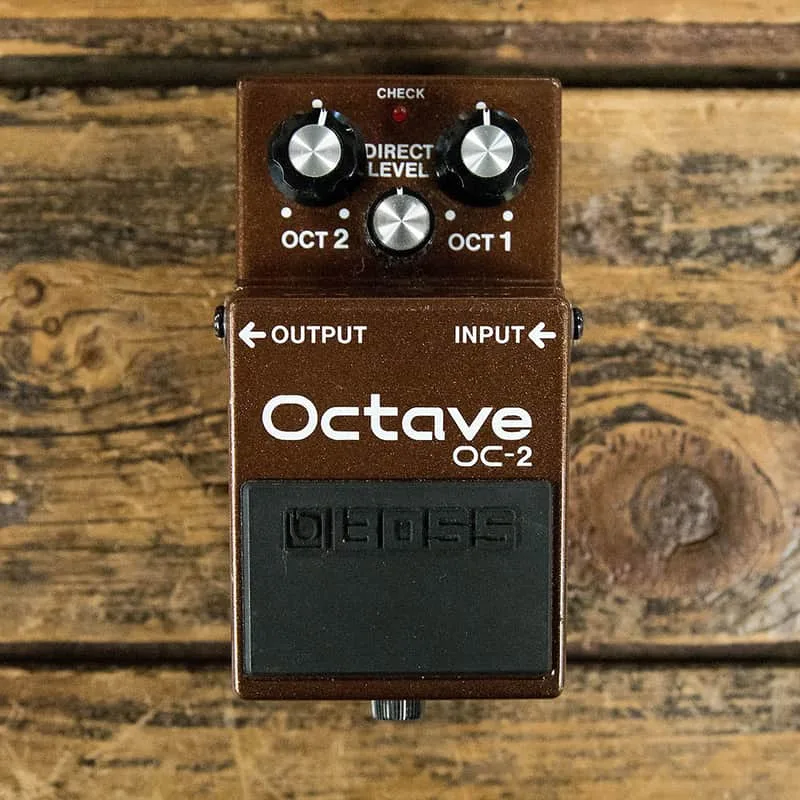
Published reviewers were positive about the Duality. MusicRadar called it "a real winner from Darkglass, impressively simple to use but very effective"2. Premier Guitar's verdict was "big and versatile fuzz tones in a small box"4. The Premier Guitar review tested the pedal with a Nash P-Style bass through an Epifani AL 112 combo, and later with a 1964 Fender J bass paired with a Boss OC-24.
The Duality and the Duality DFZ
The Duality Dual Fuzz Engine was first released in 20131. Its single duality dial is the heart of the pedal: panned fully left it initiates the gated saw-tooth circuit, a thick classic sounding fuzz, and panned fully right it gives what Darkglass describes as tighter high-gain fuzz, with mixes of the two across the pan2. Reviewers found it impressively simple to use but very effective, calling it "a real winner"2.
Videos
Darkglass Electronics
Darkglass Electronics
Darkglass Electronics
Questions
Does the Darkglass Duality run on a battery?
No. The Duality has no battery compartment and can only be powered by a 9V adaptor, so you need a power supply or a pedalboard power brick with a 9V output to run it.
Is the Darkglass Duality true bypass?
No. It uses a JFET flip-flop buffered bypass built around the CD4049 chip rather than the transistors Boss and Ibanez use. In bypass mode the fuzz path is disabled and the blend knob is hard-wired to 100 percent, so your clean signal keeps flowing.
Can you use the Darkglass Duality on guitar?
It is a bass pedal by design. Premier Guitar's reviewer found it was built to address the shortcomings bass players encounter when adapting guitar fuzz to their instrument, with a low-pass filter and blend control for precise low-end sculpting, but nothing stops a guitarist from trying it.
What is the difference between the Duality and the Duality DFZ?
The Duality DFZ, launched in November 2022, is the successor to the original Duality Dual Fuzz Engine. MusicRadar described it as a stripped-back iteration that keeps the two mixable fuzz circuits, at a lower price point than the original.
Where are Darkglass pedals made?
The Duality was described at launch as a little pedal from Finland, made by Darkglass Electronics, a company based in Helsinki. The original Duality Fuzz was designed in Helsinki and built in Seattle.
Sources (6)
- Binary Dual Fuzz / Darkglass Duality, Aion FX, 2021-11-12
- Darkglass Duality Dual Fuzz Engine review, MusicRadar, 2017-01-11
- Darkglass Electronics Duality Dual Fuzz Engine, Pedal of the Day (www.pedal-of-the-day.com), 2015-05-14
- Darkglass Electronics Duality Dual Fuzz Engine Review, Premier Guitar, 2014-10-10
- The new Darkglass Duality DFZ pedal has two fuzz circuits, MusicRadar, 2022-11-29
- Tracing Journal: Darkglass® Duality Dual Fuzz Engine, Aion FX, 2021-11-12