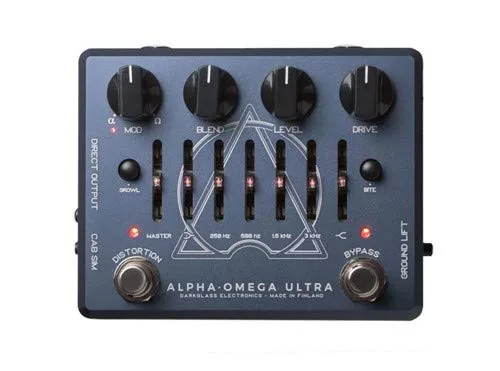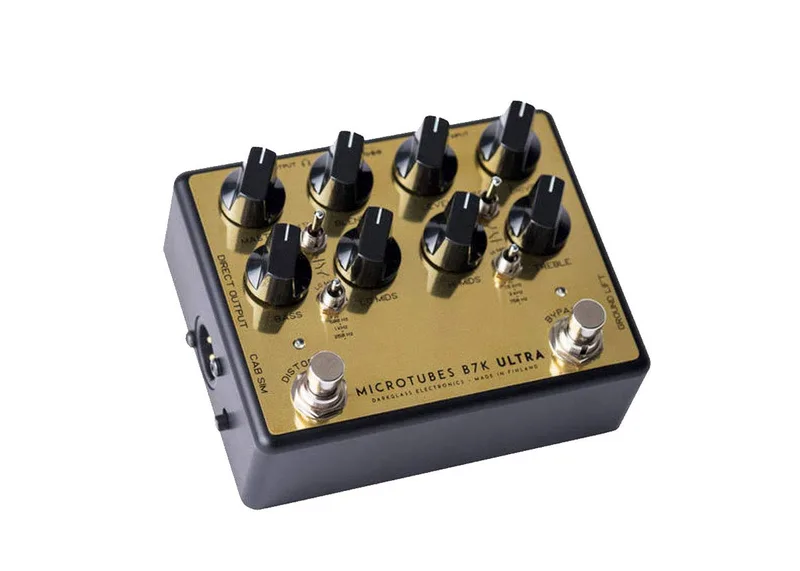


The Darkglass Microtubes B7K Ultra is a bass preamp and overdrive pedal in one box, made by Darkglass of Finland1. It takes the Microtubes saturation circuit from the original B7K and adds more tone shaping and control: a four-band EQ with switchable mid frequencies, a master volume, a separate footswitch for the overdrive section, and a balanced DI output with switchable cabinet simulation12. Darkglass describes it as covering everything "from crisp, punchy clean preamp to obliterating high gain distortion, and everything in between"2.
The pedal grew out of the original B7K, which Bass Musician Magazine called the company's "crown jewel" and said was revised into the Ultra model with more user-friendly options based on customer input3. The overdrive circuit itself stayed the same; what changed is the tone sculpting and the control options around it3.
The controls: drive, blend and a four-band EQ
The signal path is built around a blend. The Blend knob mixes the clean input signal with the overdriven signal; the clean side stays at unity gain while the Level knob sets the volume of the driven side, so you control the ratio precisely4. Drive sets the amount of saturation in the overdriven signal4. Master adjusts the overall volume of the whole unit, which Darkglass notes is ideal for fine tuning the output in clean mode and also serves as the DI level control42.
The EQ is four bands, with the two mid bands switchable between three center frequencies each2:
| Control | Frequencies | Range |
|---|---|---|
| Bass | 100 Hz | +/-12 dB1 |
| Lo Mids | 250 Hz, 500 Hz or 1 kHz | +/-12 dB4 |
| Hi Mids | 750 Hz, 1.5 kHz or 3 kHz | +/-12 dB4 |
| Treble | 5 kHz | +/-12 dB1 |
Premier Guitar's reviewer confirmed the switchable values: low mids boost or cut at 250 Hz, 500 Hz or 1 kHz, and high mids at 750 Hz, 1.5 kHz or 3 kHz1. Later versions add Attack and Grunt toggle switches that control high and low frequency saturation2.
Two footswitches do different jobs. One engages the pedal, the other engages the distortion section on its own, which means the onboard EQ can run as a clean preamp with the drive off13.
Power and connections
The B7K Ultra runs on a regulated 9V DC adapter with a center-negative plug and draws about 120mA4. Darkglass's warning is direct: unregulated power supplies or higher voltages "may result in suboptimal noise performance and even damage your unit, voiding the warranty"4.
At ~120mA, the B7K Ultra draws more current than many compact overdrives; the original B7K drew only 20mA45. Check that your power supply's outputs can cover it before daisy chaining.
Connections on the Ultra with Aux In version include a 1/4" mono instrument input, a 1/4" output for an amp or the next pedal, a balanced XLR Direct Output for a mic preamp or PA, a 3.5mm aux input for backing tracks, a 3.5mm headphone output, and a Micro USB B port for loading cabinet simulation impulse responses from a computer2. The aux input works only together with the headphone output, with the level set from the audio source2. The internal headphone amplifier drives a minimum load of 16 ohms2.
The Cab Sim switch on the Direct Output toggles the cabinet simulation on and off; Darkglass says switching it off completely bypasses the digital circuits for a zero latency signal when needed2.
How it differs from the original B7K
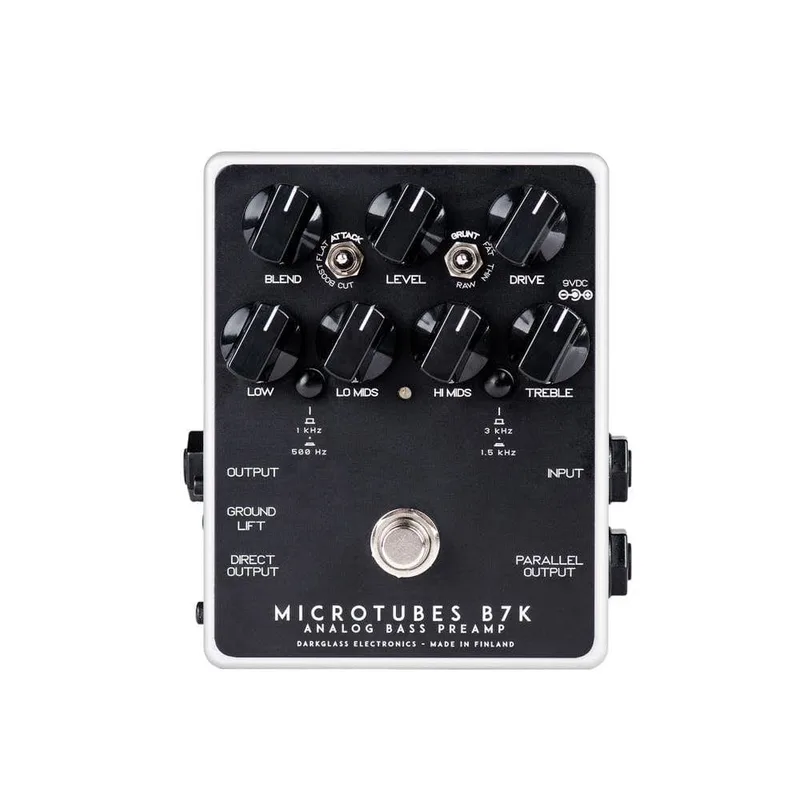
The original Microtubes B7K had a four-band EQ too, but its mid switches each offered only two positions: Low Mids switched between 1 kHz and 500 Hz, and Hi Mids between 3 kHz and 1.5 kHz5. The Ultra gives each mid band three choices instead of two4. Premier Guitar summed up the Ultra's additions over its predecessor as "expanded EQ flexibility, a separate distortion footswitch, and a master volume control"1.
The Ultra also grew. The original B7K measured 94 mm by 120 mm and weighed 320 g5; the Ultra is 125 mm by 96 mm and weighs 430 g4, the extra bulk housing the additional controls and connections.
Versions: Aux In and The Squid limited edition
The B7K Ultra line went through several versions. The Ultra with Aux In added the 3.5mm aux input for practicing with backing tracks, the headphone output with cab sim, and the USB port for loading impulse responses2. Darkglass's own store lists it at £380.00 GBP and shows it sold out2.
In August 2020, Darkglass announced "The Squid", a limited edition of the Microtubes B7K Ultra V2 with Aux In in a special enclosure with custom art from artist Ignacio Bazan Lazcano678. It was limited to 1,000 pieces worldwide89, listed at £399, and carried the same feature set: four-band EQ with six selectable mid frequencies, aux in, headphone output, balanced XLR with ground lift and switchable IR cab sim, and a USB B connector for loading cabinet simulations1067. No Treble noted that the pedal it was based on was the company's all-time best-seller7.
What reviewers said
Premier Guitar reviewed the B7K Ultra in August 2021 and called it "an excellent upgrade to its predecessor"1. The review's pros listed "Clean to crass tones. Excellent EQ section. Rugged design."1, and its cons were "Switch layout a bit unintuitive. Adjusting drive and levels take some time. Does not come cheap."1. On the EQ specifically, the reviewer wrote:
"The EQ was impressively clean. I dialed in thick lows that weren't muddy and highs that didn't bite but still presented crisp clarity in the top end."
The same reviewer found the frequency switch layout frustrating for on-the-fly adjustments, instinctively switching up for higher frequencies when the layout did not match that expectation1. The review also noted the build: a silver-and-black enclosure with prominent blue LEDs and a "stout, road-worthy chassis"1.
Bass Musician Magazine's Kilian Duarte reviewed the earlier B7K Ultra in March 2016, testing it with a Brubaker JXB, a Fender Japanese PJ, an Ibanez Soundgear SR1806 and an NS CR5 Radius3. His verdict on the drive:
"The biggest plus being the clarity that was present regardless of the bass in question and regardless of the saturation of the drive."
The same magazine's Ty Campbell, reviewing the original B7K, called it "a great addition to any pedalboard for live use and very well rounded for studio use"11.
Videos
Darkglass Electronics
The Bass Channel
SpectreSoundStudios
Questions
Can the B7K Ultra be used as a DI?
Yes. It has a balanced XLR Direct Output for connecting to a microphone preamp or PA system, and Bass Musician Magazine described it as perfect for use as a straight DI. The Master volume also serves as a DI level control, so you can set the level going to the desk independently of your stage sound.
Does the B7K Ultra work as a clean preamp with the drive off?
Yes. Darkglass says it allows tone tailoring from a crisp, punchy clean preamp to high gain distortion and everything in between. A dedicated footswitch engages the overdrive section independently, so the EQ and preamp can run on their own with the drive disengaged.
What power supply does the Darkglass B7K Ultra need?
It needs a regulated 9V DC adapter with a center-negative plug, and draws about 120mA. Darkglass warns that unregulated supplies or higher voltages can cause noise problems and even damage the unit, which would void the warranty. That draw is high enough that a typical 100mA daisy chain output may not be enough.
Does the B7K Ultra have a cab sim?
Yes, on the Direct Output. A Cab Sim switch toggles the cabinet simulation on and off at the XLR out, and Darkglass says switching it off completely bypasses the digital circuits for a zero latency signal. Impulse responses can be loaded over USB from a computer.
What frequencies do the B7K Ultra mid switches select?
The Lo Mids control is switchable between 250 Hz, 500 Hz and 1 kHz, and the Hi Mids control between 750 Hz, 1.5 kHz and 3 kHz, each offering up to 12 dB of boost or cut. Bass is set at 100 Hz and treble at 5 kHz, also with 12 dB of range.
What is the difference between the B7K and the B7K Ultra?
The Ultra keeps the B7K's overdrive circuit but adds expanded EQ flexibility, a separate distortion footswitch and a master volume control. The original B7K's mid switches offered two center frequencies per band; the Ultra offers three per band, plus a headphone output, aux input and USB port on later versions.
Sources (11)
- Darkglass Microtubes B7K Ultra Review, Premier Guitar, 2016-05-19
- Microtubes B7K Ultra with Aux In, Darkglass
- Darkglass B7K Ultra Review by Kilian Duarte, Bass Musician Magazine, 2016-03-01
- Microtubes B7K Ultra Manual, Darkglass
- Microtubes B7K Manual, Darkglass
- Darkglass Electronics unveils limited-edition The Squid drive pedal with custom artwork, Guitar World, 2020-08-14
- Darkglass Electronics Unveils Limited Edition Microtubes B7K Ultra V2 Pedal, “The Squid”, No Treble, 2020-08-15
- Darkglass Electronics launch custom art edition of the Microtubes B7K Ultra V2 bass distortion, Guitar.com, 2020-08-12
- Darkglass Introduce ‘The ‘Squid’ Microtubes Bass Distortion Pedal, Music Instrument News, 2020-08-12
- Darkglass's SQUID is rising from the depths to get you, MusicRadar, 2020-08-12
- Darkglass Electronics Microtubes B7K Analog Bass Preamp Review, Bass Musician Magazine, 2016-07-01