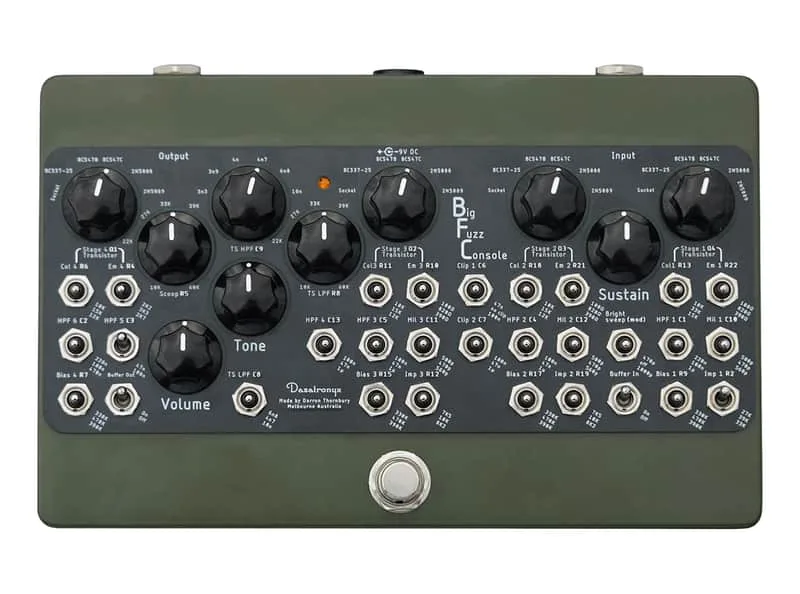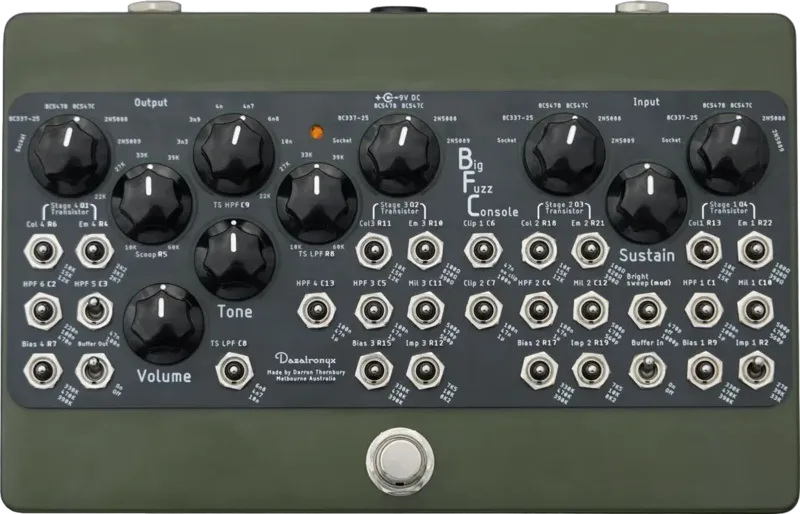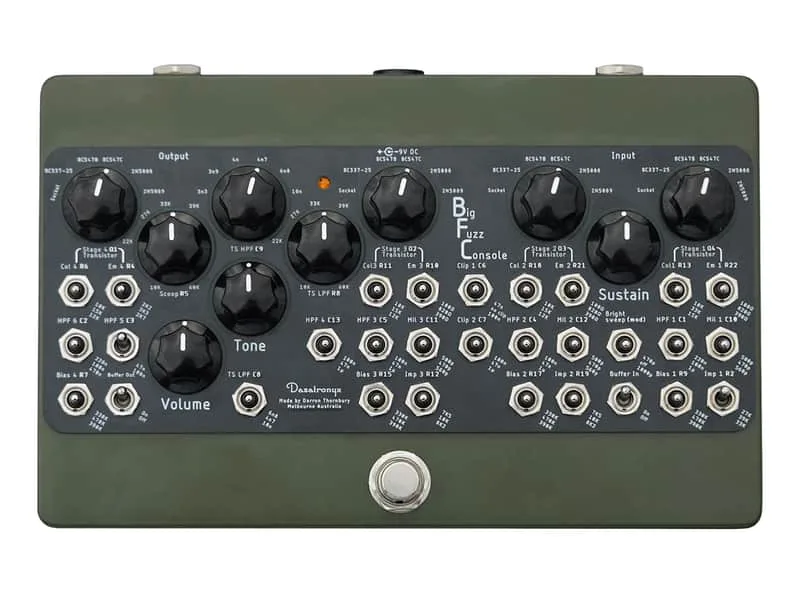


The Dazatronyx Big Fuzz Console is a fuzz pedal that takes the classic four-stage Big Muff circuit and unrolls it onto the front panel. Where a normal Big Muff clone fixes its component values inside the box, the Console puts external switches and sockets on nearly every value, so a player can change capacitors, resistors and transistors on the fly1. RockBoard's PedalPedia describes it as an advanced, breadboard-style development tool and multi-fuzz pedal designed for ultimate Big Muff tone-shaping1.
It is fully analog, hand-built in Melbourne by Darron Thornbury of Dazatronyx, and listed at $499 direct from the Dazatronyx webstore as of February 202623. Delicious Audio calls it "a deeply thoughtful, fully analog development tool that invites you to look under the hood of why classic fuzz circuits behave the way they do"2.
A Big Muff circuit with nearly every value switchable
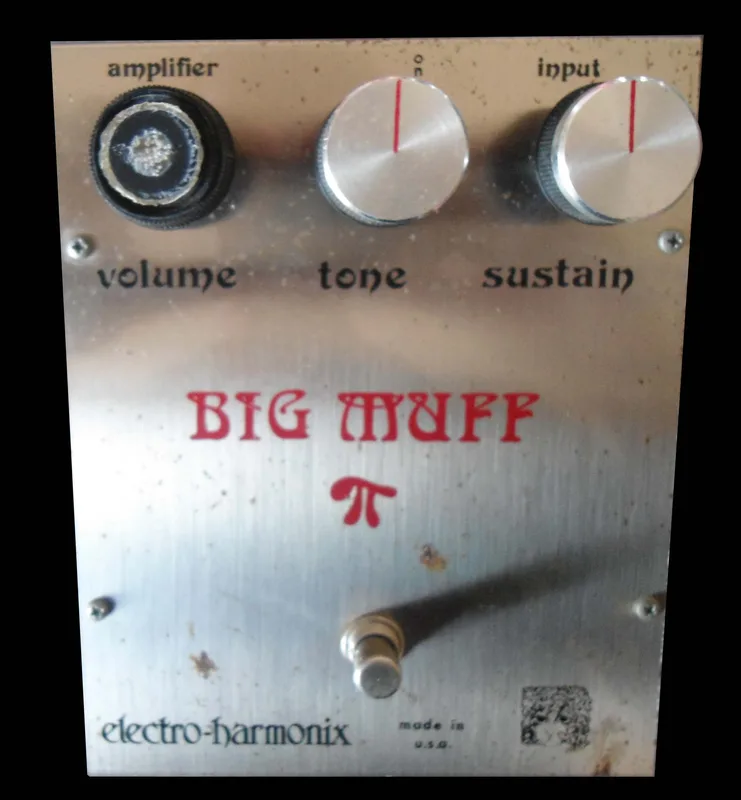
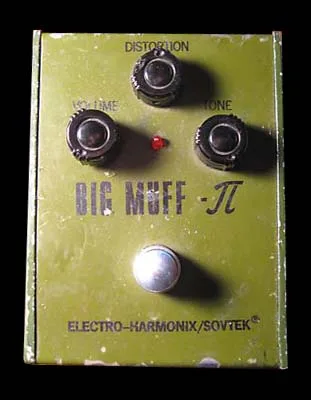
A Big Muff's character comes from the specific capacitor and resistor values in its four gain stages, which is why Triangle, Ram's Head and Russian versions of the same circuit sound different. The Console's approach is to make those values player-selectable: each gain stage has a 3-way toggle for choosing different capacitor and resistor values, and sockets allow transistors to be swapped1. Delicious Audio notes that with this you can "map out vintage specs like Triangle, Ram's Head, or Russian units, or venture entirely off-map into custom territory"2.
The controls, stage by stage
The Console follows the four-stage Muff architecture, with each stage given its own set of controls1:
| Stage | What it does | Controls |
|---|---|---|
| Stage 1: Gain Boost | Shapes the initial input gain stage | Rotary transistor selector, independent biasing, component-level toggles2 |
| Stage 2: Gain Boost with Diode Clipping | First clipping stage | Rotary transistor selector, selectable clipping capacitors including a no-clip option, dedicated clipping-stage controls2 |
| Stage 3: Gain Boost with Diode Clipping | Mirrors stage 2 | Own transistor switching, clipping capacitor selection, circuit-tweaking toggles2 |
| Stage 4: Final Gain Boost and Output | Final boost before the volume control | Component toggles, including output filtering2 |
| Passive Tone Control Stage | Carves the final voicing | Dedicated rotary controls for Scoop, Sustain, Tone, and Tone Stack high-pass and low-pass filtering2 |
Guitar Pedal X's Stefan Karlsson documented how this works in practice. In his Violet Ram's Head session he set values like the tone stage high-pass filter capacitor (3n3, against a reference of 560 or 470p), a stage 3 high-pass filter at 47n, and a stage 4 low-pass filter at 470n, each chosen against reference values he aggregated from resources including Kit Rae's Big Muff Pi page4. His reference settings for that voicing also put the volume control at maximum4.
Transistors and clipping diodes
Each of the four gain stages carries a 6-way rotary transistor selector with these options3:
- 2N2222A (socketed)
- BC337-25
- BC547B
- BC547C
- 2N5088
- 2N5089
The 2N2222A position uses a socket, so a player can insert other transistors directly3. On the fixed-transistor positions, the Ultimate Multi-Muff's selectors offer BC337-25, BC547B, BC547C, 2N5088 and 2N50894.
For clipping, the circuit uses 1N914/1N4148 small signal silicon diodes, with no other diode options. Guitar Pedal X reports that most circuit versions can be recommended to be built with these, and that the line had to be drawn somewhere on options3. The clipping stages do include a no-clip option on their selectable capacitors, which lets a stage run without diode clipping2.
Reproducing vintage Big Muffs
The Console's main draw for many players will be its ability to chase specific Big Muff voicings. Because nearly every component value can be manipulated on the fly through external switches and sockets1, a player can dial a circuit toward a particular vintage character rather than being locked to one fixed build. The reference values behind those settings were aggregated from a variety of resources, including Kit Rae's Big Muff Pi page4, and the transistor options selectable on the rotary controllers include BC337-25, BC547B, BC547C, 2N5088, and 2N50894.
Of the Violet Ram's Head mapping, he wrote:
"The Violet Ram's Head core output has a wonderful zing to it, and I feel my preferred settings sound pretty spot on"4
He settled on BC337-25 or BC547C transistors for the Green Russian voicing, with a detailed resistor and capacitor profile across the stages4. Concluding the series, he wrote that the Console "consistently delivers my favourite Big Muff tones, this is for sure the Ultimate Big Muff Pedal, and one of the very best multi-fuzzes overall"5.
Videos
TheSuperFunAwesomeHappyTimePedalShow
Brett Kingman
Bipolar Recorder
Questions
What is the Dazatronyx Big Fuzz Console?
It is a multi-fuzz pedal and breadboard-style development tool built around the classic four-stage Big Muff circuit. Instead of fixed component values, it exposes nearly every value on the panel through switches and sockets, so a player can reproduce vintage Muff variants or design their own voicing. It is hand-built in Melbourne by Darron Thornbury of Dazatronyx.
Can the Big Fuzz Console reproduce a Ram's Head or Russian Big Muff?
Yes. Guitar Pedal X's Stefan Karlsson published sound-shaping sessions mapping the Console to a 1973 V2 Violet Ram's Head and a 1994 V7C Green Russian Big Muff, plus an EarthQuaker Devices Hoof hybrid voicing, using the switches and transistor selectors to match reference component values.
What power does the Big Fuzz Console need?
It runs on 9V DC, center negative, drawing about 50mA. That is standard pedalboard power supply territory, though the current draw is higher than a simple vintage-style fuzz, so a dedicated output is the safe approach.
Does the Big Fuzz Console have a buffer?
Yes. It has a built-in buffer that is switchable in and out, with the input and output buffers independently switchable, and the pedal uses true bypass switching when the buffers are off.
Is the Big Fuzz Console analog?
Yes. Delicious Audio describes it as a fully analog development tool, and the maker lists its circuit type as analog. All the switching happens in the analog signal path, selecting component values rather than modeling them.
Where is the Dazatronyx Big Fuzz Console made?
It is hand-built in Melbourne, Australia, by Darron Thornbury of Dazatronyx. The maker also produces the simpler Dazatronyx Big Fuzz, a Big Muff evolution pedal with a Mids knob and a Supa Fuzz mode.
Sources (5)
- Big Fuzz Console by Dazatronyx, RockBoard PedalPedia, 2026
- Dazatronyx Big Fuzz Console, Delicious Audio, 2026-09-15
- Guitar Pedal X, Guitar Pedal X, 2026-02-24
- Guitar Pedal X, Guitar Pedal X, 2026-04-06
- Guitar Pedal X, Guitar Pedal X, 2026-04-21