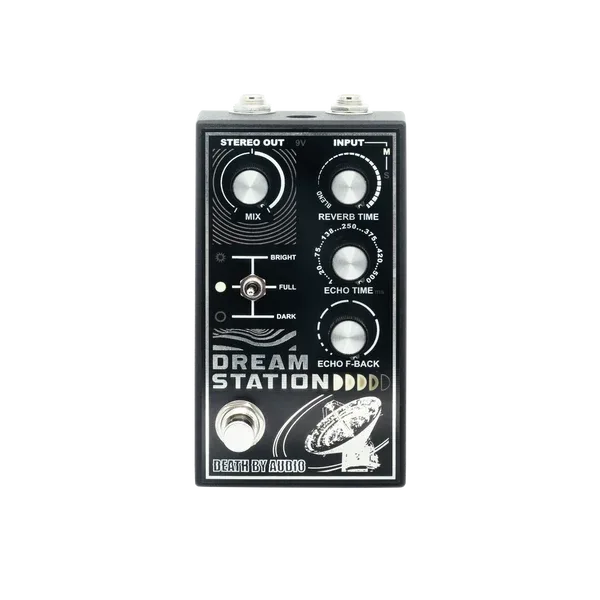


The Death By Audio Dream Station is a reverb and delay pedal, part of the Destroyer Series that Death By Audio launched alongside the Moonbeam Phaser and Thee Treble Overload. It combines the two ambient effects in one package, with a MIX control that balances between 100% dry and 100% wet signals and an internal bypass switch that determines whether delay and reverb trails continue when the pedal is bypassed1.
Death By Audio describes it as an instant mood creator, blending DBA-style reverb and delay, and lists its range as running from shimmering, lush pads to wild slapback insanity, ping-pong comb filtering, and swirling atmospherics1. It carries a list price of $2501.
A stereo reverb and delay with three filter voices
The Dream Station puts reverb and delay in one pedal, and a single mode switch selects between three filter settings, BRIGHT, FULL, and DARK, that apply to both effects1. Each voice gives the pedal a noticeably different character:
| Filter setting | What it does |
|---|---|
| BRIGHT | Low frequencies are filtered out for a splashy, airy "tape" sound1 |
| FULL | A complete, natural tone for a clean "digital" sound1 |
| DARK | High frequencies are filtered out, creating a warm, analog-style sound1 |
Death By Audio announced the series with the same three voices described as spaces ranging from airy and bright, dark and moody, and full-range digital2. Premier Guitar's reviewer heard the differences clearly in practice: the dark-voiced reverb is hazy and, at times, just a bit trashy and gritty at the corners, while the full tone setting is softer around the edges, if still a bit metallic, and gives a sense of greater mass and body3.
Controls
The control set is minimal, in keeping with the Destroyer Series look of a compact footprint, glowing vintage-style LED display, and minimal controls1.
| Control | What it does |
|---|---|
| ECHO TIME knob | Sets the delay time from 2ms to 500ms; in stereo mode the delay ping-pongs between outputs at half the set time1 |
| ECHO F-BACK knob | Controls the feedback of the delay; pushing past roughly 3 o'clock may trigger oscillation1 |
| MIX knob | Balances between 100% dry and 100% wet signals; when TRAILS is activated and the pedal is bypassed, MIX still sets the volume of the wet signal1 |
| Mode switch | Selects between BRIGHT, FULL, and DARK filter settings for the delay and reverb1 |
| INPUT CONFIGURATION switch (internal) | Switches between TS and stereo TRS input; mono input lights the "M" indicator on the faceplate, stereo input lights "S"1 |
| BYPASS TRAILS switch (internal) | TRAILS continues delay and reverb trails when bypassed; NO TRAILS mutes the effects when bypassed1 |
The feedback control is where the pedal crosses from utility into noise-making territory. With ECHO F-BACK kept below about 3 o'clock it behaves as a conventional echo; pushed past that point it may start oscillating on its own, which is the kind of behavior experimental players look for in a delay1.
Running it in stereo
The Dream Station features TRS stereo input and output for mono or stereo operation1. To run it in stereo:
- Feed the input with a TRS cable carrying a stereo signal.
- Set the internal INPUT CONFIGURATION switch to stereo TRS; the "S" indicator lights on the faceplate.
- Connect the stereo TRS output to two amps or a stereo interface.
In stereo mode the delay ping-pongs between the two outputs at half the set time, which widens the repeats across the stereo field1. With a TS cable and the switch set to mono, the "M" indicator lights instead1. The pedal also has a wet/dry mix that Death By Audio says fits it into any scenario, recording or live, in mono or stereo chains1.
The trails behavior is set by an internal switch, so decide whether you want echoes and reverb to continue after bypass before you mount the pedal on a board. In NO TRAILS mode the effects cut off the moment you bypass the pedal1.
What reviewers said
Premier Guitar reviewed the Dream Station alongside the Moonbeam Phaser in February 2026. The reviewer found the Dream Station the most expansive of the two pedals, and in that sense the most traditionally DBA-like, with an enormous range of available tones3. The three voice modes and stereo capability were credited with making it much more than a simple mashup of essential time-based effects3.
"The Dream Station and Moonbeam can work in service of utility or in pursuit of the demented."3
On value, the reviewer was direct:
"In terms of pure value, I have to give the nod to the Dream Station for its range."3
The review also noted a practical point for studio and quiet-stage players: the pedals have a low noise floor that makes them suitable for mixing or artists working in quieter settings3. Paired with longer delay times and the reverb, the full voice was described as sounding big enough to be measured in astrophysical terms3. The pedals also come with a lifetime warranty3.
Where it sits in the Death By Audio line
Death By Audio describes the build as a rugged enclosure with quality components, hand-assembled and built to last1.
Videos
Death By Audio
Project louder
Musiker TV
Questions
Does the Dream Station have trails?
Yes. An internal BYPASS TRAILS switch sets whether delay and reverb trails continue when the pedal is bypassed. In TRAILS mode the wet signal keeps ringing out after you switch off; in NO TRAILS mode the effects are muted when bypassed. When trails are active, the MIX knob still sets the volume of the wet signal while bypassed.
How do you run the Dream Station in stereo?
The pedal has TRS stereo input and output jacks. Use a TS cable for mono input or a TRS cable for stereo input, and set the internal INPUT CONFIGURATION switch to match: mono lights the M indicator on the faceplate and stereo lights S. In stereo mode the delay ping-pongs between the two outputs at half the set delay time.
What is the maximum delay time on the Dream Station?
The ECHO TIME knob sets delay from 2ms to 500ms. In stereo operation the delay ping-pongs between the left and right outputs at half the set time, so a 500ms setting gives repeats alternating every 250ms per side.
Will the Dream Station self-oscillate?
It can. The ECHO F-BACK knob controls the delay feedback, and Death By Audio says pushing it past roughly 3 o'clock may trigger oscillation. That makes it usable both as a straightforward echo and as a sound-making tool for experimental players.
Does the Death By Audio Dream Station have a warranty?
Yes. Premier Guitar's review notes that the Destroyer Series pedals come with a lifetime warranty. Death By Audio describes the build as a rugged enclosure with quality components, hand-assembled and built to last.
Sources (3)
- DREAM STATION, Death By Audio
- Can These Replace Your Spring Reverb & Single-Knob Phaser?, Premier Guitar, 2026-02-24
- Death By Audio Moonbeam and Dream Station Review, Premier Guitar, 2026-02-24