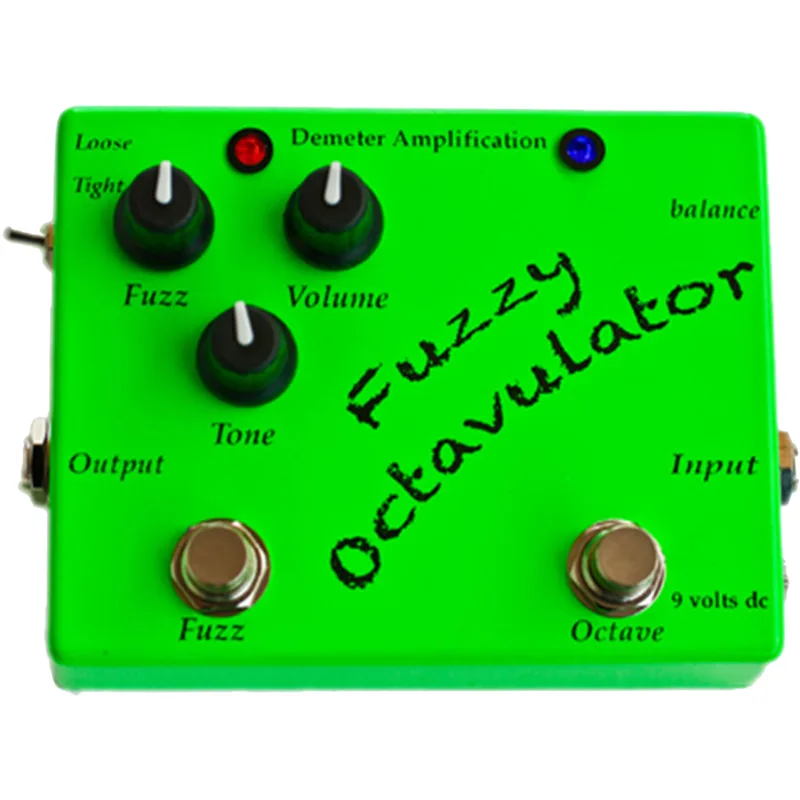


The Demeter FZO-1 Fuzzy Octavulator is a fuzz pedal with an octave-up circuit, made by Demeter Amplification. Premier Guitar described it as a pedal that "takes the much-loved Fuzzulator circuit and adds an independent, vintage-sounding octave-up circuit"12. The fuzz and octave effects are toggled by two independent footswitches, one for Fuzz and one for Octave, and the pedal sits in a neon green painted metal chassis with black silkscreen lettering and rubber feet1.
The two halves are independent. Demeter states that both the Fuzz and Octave effects can be used either in combination or independently of each other, and the pedal carries two footswitches, one per effect21. The octave side has its own character: Demeter says the octave by itself has "an extremely strange, almost ring-mod characteristic, which sounds amazing paired with a reverb"2.
A Fuzzulator circuit with an octave-up added
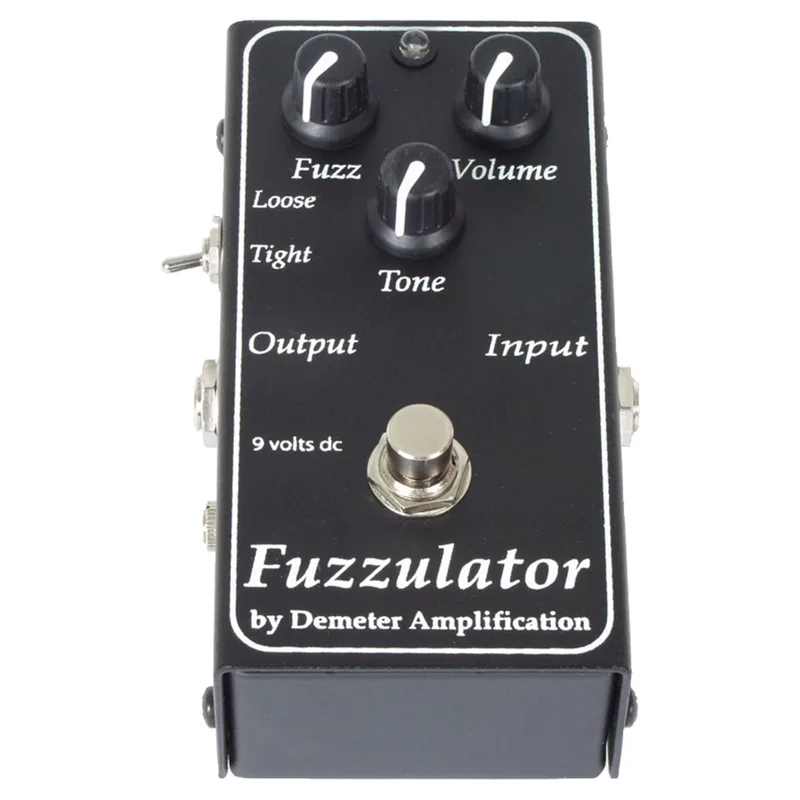
The FZO-1's fuzz circuit is identical to the FUZ-1 Fuzzulator's2. Vintage Guitar called it "Demeter Amplification's highly regarded Fuzzulator circuit"3. The octave-up is the addition, and it is deliberately not a clean one: Premier Guitar's reviewer found "a touch of intentional grime in this circuit that pays tribute to the wilder nature of some of the earliest octavers," without the typical noise of those old units1.
The enclosure is a neon green painted metal chassis with black silkscreen lettering, resting on rubber feet, which Premier Guitar noted "would be pretty hard to miss on a pedal board in the worst light"1. Construction is solid inside too: Vintage Guitar reported that all pots and jacks are chassis-mounted instead of board-mounted, giving the pedal much greater durability3.
The controls
Three rotary controls handle Fuzz, Tone and Volume, plus a mini-toggle for Tight or Loose operation1.
| Control | What it does |
|---|---|
| Fuzz | Increases the gain of the distortion circuit, which increases the distortion and sustain of the unit2 |
| Tone | A high cut filter you can use to make your sound warmer and fatter2 |
| Volume | Sets the overall output of the unit, for level matching between the effected and unaffected signal2 |
| Tight/Loose switch | Switches between LEDs and germanium diodes for the distortion generating devices2 |
Vintage Guitar found all three knobs showed very useable ranges, producing a wide variety of fuzz levels and the ability to match or boost from bypass level3.
There are two internal adjustments. A trim pot on the side of the unit sets the gain of the Fuzzulator's output amplifier: Demeter says to turn it up for the germanium (Loose) setting, and down if the unit is too hot for your system2. Inside, a trim pot labeled Balance ensures the Octave effect produces a symmetrical octave waveform1. Premier Guitar also noted a master gain control for the Fuzz that can be adjusted inside the unit1.
Tight and Loose clipping
The Tight/Loose switch changes the clipping devices in the fuzz circuit. Tight selects LEDs; Loose selects germanium diodes21. Vintage Guitar described it as changing the character of the fuzz via germanium (Loose) and LED (Tight) clipping stages3.
Premier Guitar's reviewer characterized the two modes:
- Tight (LEDs): higher output, a boosted high-end, slightly more compressed and more modern sounding1
- Loose (germanium): dark and punchy, more vintage-sounding1
With the fuzz engaged in Tight mode at noon settings, the reviewer reported "a mid-range rich, slightly compressed, classic rock overdrive" with a big bottom end, and rolling up the Fuzz control produced dirty Muff-like distortion1. The overall verdict on the fuzz was that it is well engineered and "fantastic for big-to-dirty sounds ranging from hard rock overdrive to fuzzy distortion," never abrasive in the highs or too noisy overall1.
"There is a touch of intentional grime in this circuit that pays tribute to the wilder nature of some of the earliest octavers."
Power and battery
The internal 9 volt battery must have at least 7 volts for the unit to work. To access it, remove the four screws on the sides of the unit and pull it apart2.
Videos
Best Guitar Effects
Scorpion Imports Reviews
Questions
Is the Demeter Fuzzy Octavulator true bypass?
Yes. Premier Guitar's review describes both the Fuzz and Octave circuits as independent and true-bypassed, each with its own footswitch. The related FUZ-1 Fuzzulator uses true bypass with an ALCO heavy duty footswitch, and the FZO-1's fuzz circuit is identical to that pedal.
Can I use the Fuzz and Octave sides separately?
Yes. Demeter states that both the Fuzz and Octave effects can be used either in combination or independently of each other. The pedal has two independent footswitches, one for the Fuzz circuit and one for the Octave circuit, so you can bring each effect in on its own.
Does the Demeter Fuzzy Octavulator run on a battery?
Yes. It takes an internal 9 volt battery, accessed by removing the four screws on the sides of the unit and pulling it apart. The battery must have at least 7 volts for the unit to work. External power is a standard Boss type 9 volt DC regulated supply of 100 milliamps or more.
What is the Balance trim pot inside the Fuzzy Octavulator?
An internal trim pot labeled Balance ensures the Octave effect produces a symmetrical octave waveform. It is separate from the side-mounted trim pot, which sets the gain of the Fuzzulator's output amplifier: turn it up for the germanium Loose setting, and down if the unit is too hot for your system.
Sources (3)
- Demeter Amplification Fuzzy Octavulator Pedal Review, Premier Guitar, 2011-06-22
- FZO-1 Fuzzy Octavulator, Demeter Amplification
- Demeter FZO-1 Fuzzy Octavulator, Vintage Guitar magazine, 2014-10-24