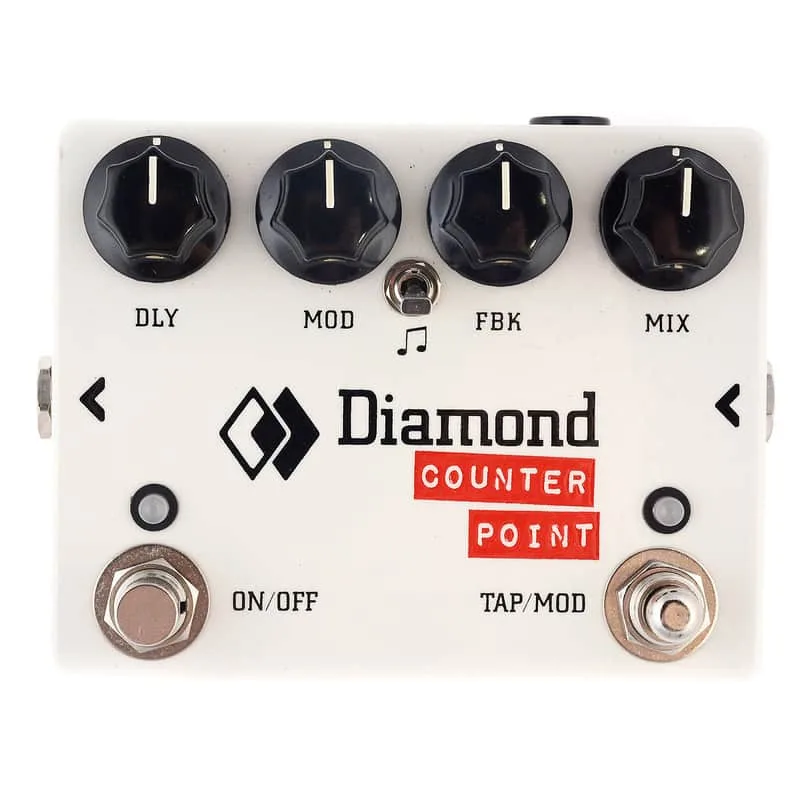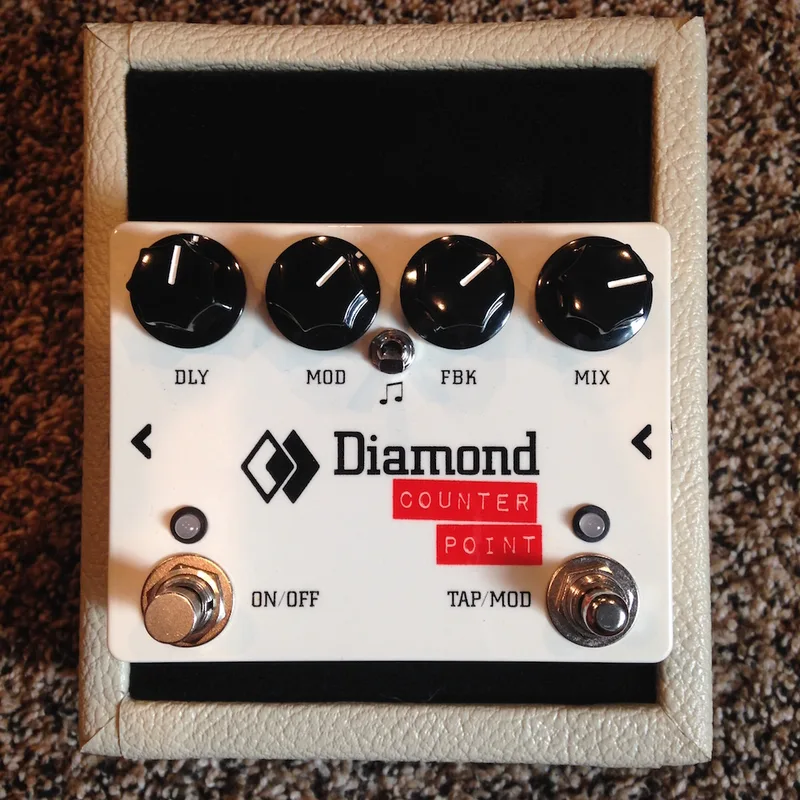


The Diamond Pedals CTP1 Counter Point Delay is a delay pedal built by Diamond. It gives you a MIX knob that adds in or takes out your guitar's Dry signal, which you adjust to taste, and a second footswitch you can use to tap in the delay time and/or toggle the modulation on or off1. Reviewing it at Pedal of the Day, the reviewer summed it up this way: "this is a beast of another kind, with new and wonderful differences from the other two, but still invoking that same sonic structure and delight that Diamond gives out with all of their pedals overall"1.
The CTP1 runs on a standard 9V negative tip adapter and sits in a compact Hammond 1590BB cast aluminum case, approximately 4.7 x 3.7 x 1.2 inches1.
The controls
The CTP1 keeps its front panel to three knobs and a mode toggle, with a second footswitch handling timing and modulation duties1.
| Control | What it does |
|---|---|
| DLY | Controls the amount of delay time |
| MOD | Adjusts how much modulation is added into the effect |
| FBK | Controls the amount the delay signal is repeated, from once to self-oscillation |
| MIX | Adds in or takes out the guitar's dry signal, adjusted to taste |
| MODE toggle | Selects among the four modes |
| Second footswitch | Taps in the delay time and/or toggles the modulation on or off |
Tap tempo comes with a TapView visual indication, and in Vintage mode the pedal applies the AutoDouble tap algorithm, which intelligently sets the delay rate twice as fast when your tapped rate is slower than that mode's maximum delay time of 600 ms1.
The four modes
The MODE toggle switches between four quite different delay characters, each with its own maximum delay time1:
| Mode | Character | Max delay time |
|---|---|---|
| Vintage | Combines elements of the MLJr and the Quantum Leap, with a bright analog filter resembling classic bucket brigade delay tones | 600 ms |
| Extra Faux Tape | Clean and glorious sounding, with deeper modulation presence and variable speed | 1.2 seconds |
| Galloping Eighths | Blends dotted eighth notes with a quieter quarter note | 900 ms |
| Ambient | Brings a spackle of reverb into the mix, using three separate echoes to create the sonic trails | 300 ms |
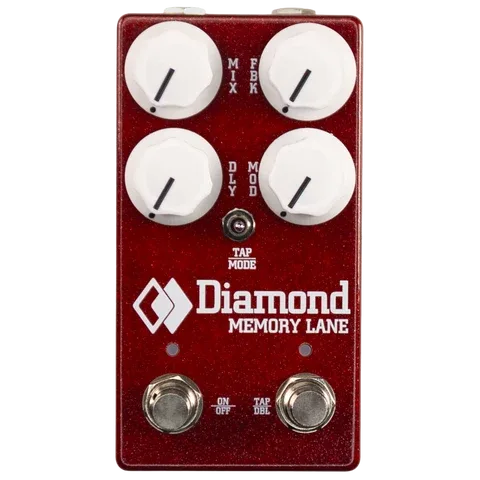
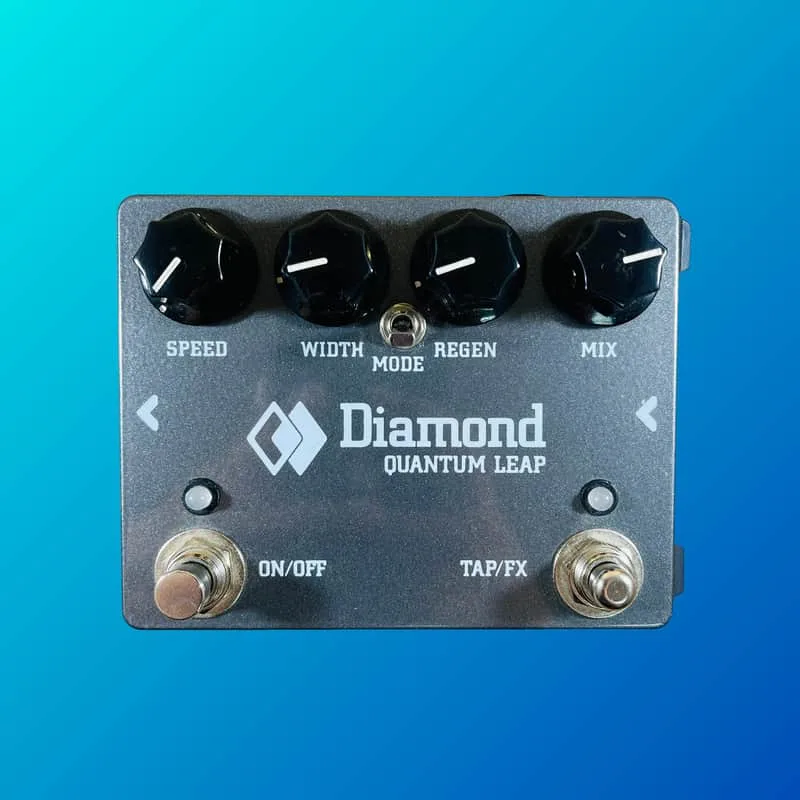
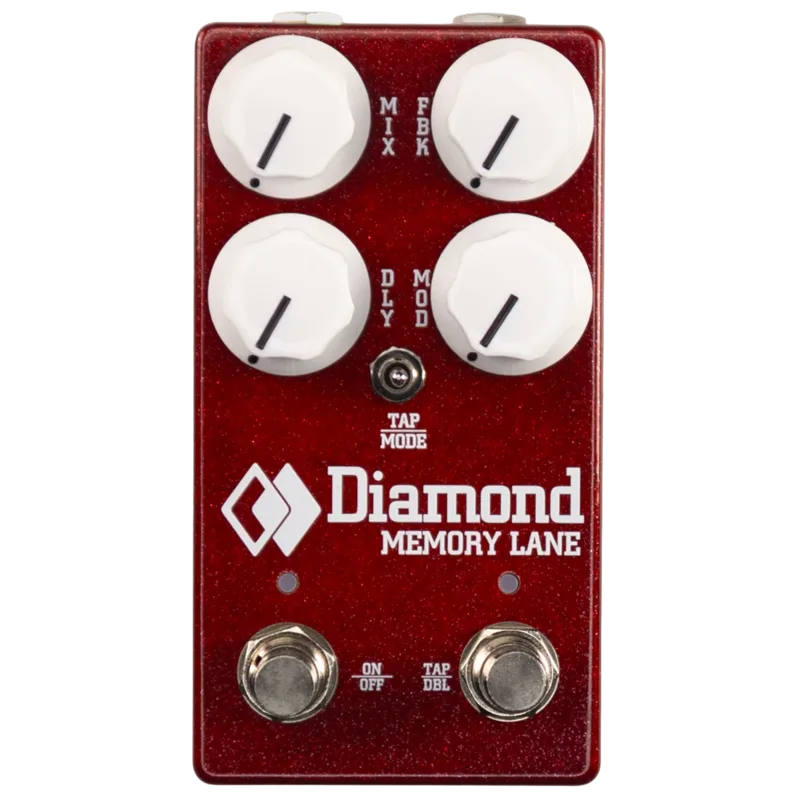
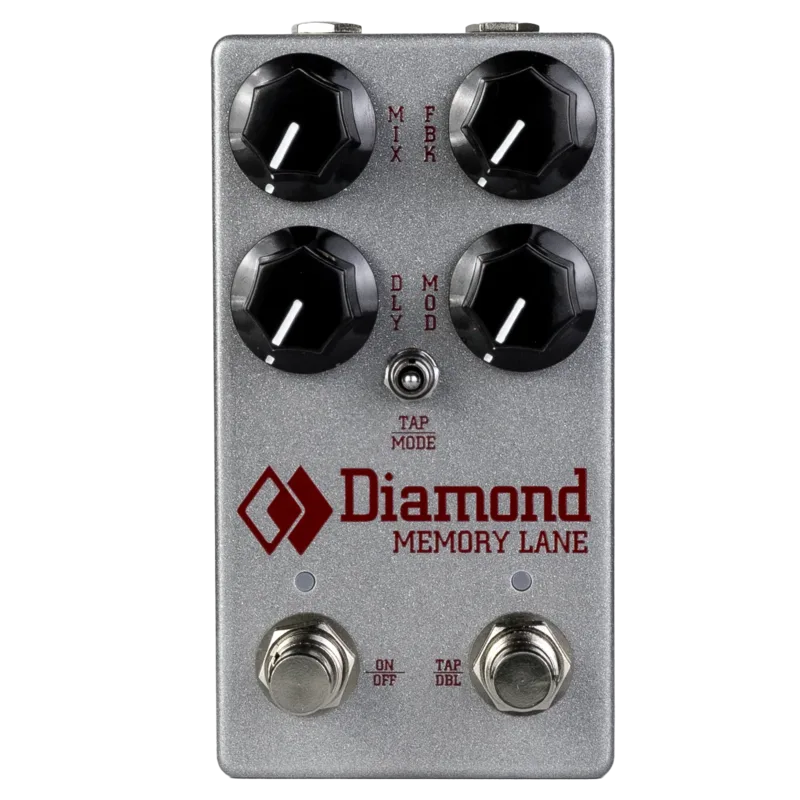
The Vintage mode's bucket brigade flavor ties it to the analog delay tradition; players interested in that lineage can compare it with the Diamond Pedals Memory Lane Analog Delay or the Diamond Pedals Quantum Leap, both of which the reviewer name-checked as relatives of the Counter Point's voicing1. Later Diamond delays carried the design forward: the Memory Lane Deluxe Delay and the current Memory Lane Modulated Delay (STM32 edition) are the modern counterparts in the delay pedal lineup.
Power, bypass and routing
The CTP1 runs on a standard 9V negative tip adapter, with a battery offered as a gig backup good for about 2 hours of power life1. Bypass behavior is user selectable between true bypass and buffered operation with delay trails, so the pedal can be matched to the rest of a board1.
For players running a parallel effects loop, where the dry signal is handled outside the pedal, there is an internal setting that stops the CTP1 from outputting its own dry signal1. Together with the MIX knob, that makes the pedal adaptable to both series and parallel rigs.
Videos
ProGuitarShopDemos
Guitars Rebellion
Pedal of the Day
Questions
Is the Diamond CTP1 Counter Point Delay analog or digital?
It is a hybrid. The CTP1 uses analog signal paths around a sample-delay-playout engine, with specially designed variable sample rate A/D and D/A converters handling the delay itself. In practice that means your dry signal and the surrounding circuitry stay analog while the delayed repeats pass through conversion. The Vintage mode adds a bright analog filter that reviewers compared to classic bucket brigade delay tones.
Does the CTP1 have tap tempo?
Yes. The second footswitch taps in the delay time, with a TapView visual indication, and can also toggle the modulation on or off. In Vintage mode the pedal applies the AutoDouble tap algorithm, which sets the delay rate twice as fast when your tapped rate is slower than the mode's maximum delay time of 600 ms.
Is the Counter Point Delay true bypass?
It is user selectable: you can set the CTP1 for true bypass or for buffered operation with delay trails. Buffered with trails lets the current repeats ring out naturally after you disengage the effect, which many players prefer on a delay, while true bypass suits players who want the pedal completely out of the signal path when off.
Can the CTP1 run on a battery?
Yes, but only as a backup. The pedal runs on a standard 9V negative tip adapter, and a battery is described as a gig backup option with a power life of about 2 hours. For regular use, plan on a 9V DC center negative supply rather than relying on a battery.
What is the longest delay time on the CTP1?
It depends on the mode. Extra Faux Tape offers the longest delay at up to 1.2 seconds, Galloping Eighths reaches a maximum of 900 ms, Vintage mode tops out at 600 ms, and Ambient Mode has only 300 ms available. Switching modes changes both the character and the maximum delay time.
Can I use the CTP1 in a parallel effects loop?
Yes. The CTP1 has an internal setting for use in a parallel effects loop that stops the pedal from outputting a dry signal. Combined with the MIX knob, which adds in or takes out the guitar's dry signal, this makes the pedal workable in series or parallel routing.
Sources (1)
- Diamond Pedals CTP1 Counter Point Delay, Pedal of the Day (www.pedal-of-the-day.com), 2015-08-05