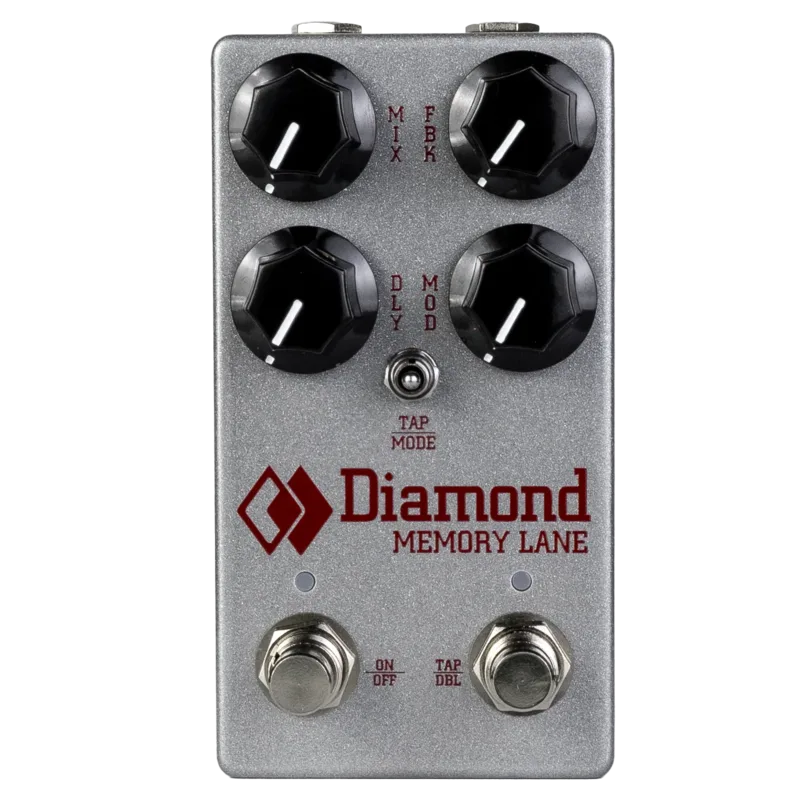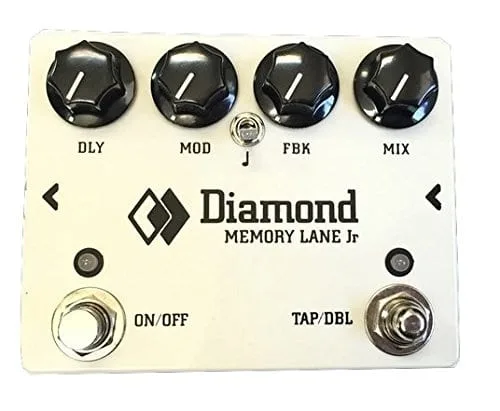


The Diamond Pedals Quantum Leap is a multi-mode delay pedal from Diamond Pedals, the Canadian builder whose Memory Lane delays are among the company's most popular stompboxes1. Diamond describes the Quantum Leap as a delay toolbox: alongside a basic tap-tempo delay it offers modes for flanger and chorus (with tap-tempo capability for the LFO speed), comb filtering, and two more unusual delay voices, Harmonic Delay and Pitch Ramp Delay1. Delay times run up to 600 ms1.
What the Quantum Leap does
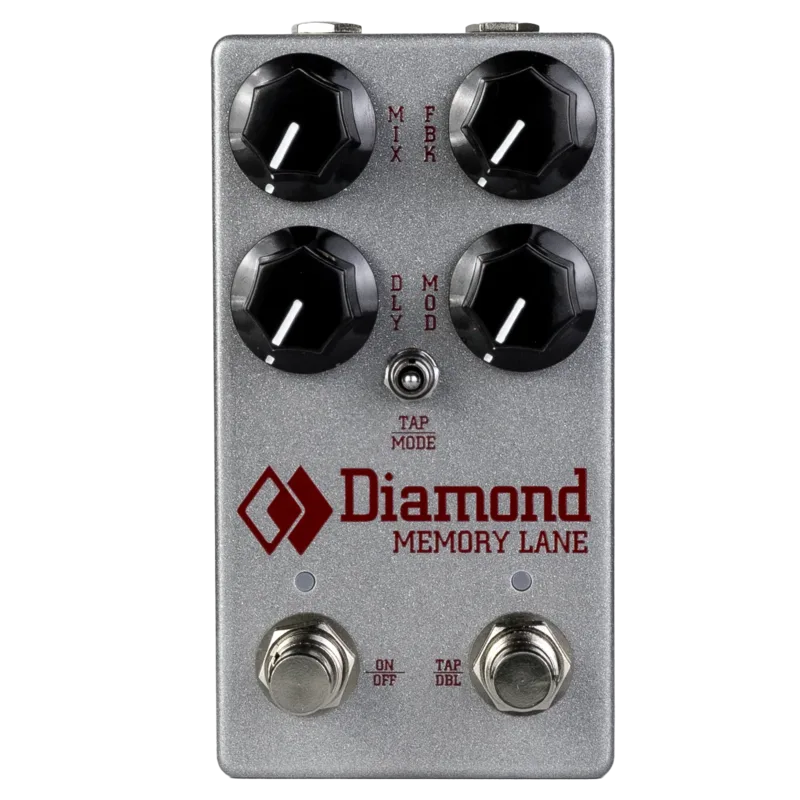
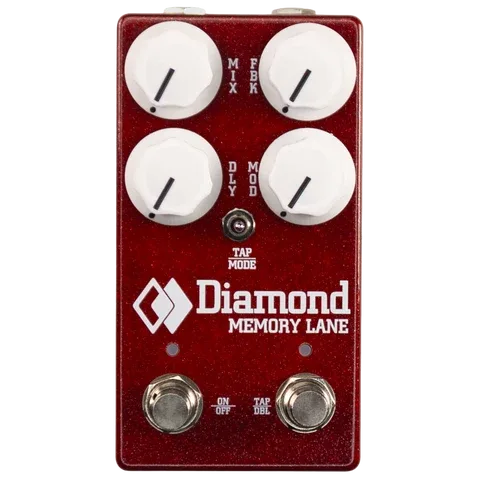
The Quantum Leap is built around one delay engine that can be revoiced several ways. In its basic tap delay mode, Premier Guitar's reviewer found it sounds like a slightly darker variant of Diamond's Memory Lane Junior, which places its core delay sound squarely in the company's analog-filtered delay lineage1. From there the pedal branches out into modulation and pitch-shifting territory that a straight delay pedal does not cover.
The mode list breaks down like this:
- Tap Delay: the basic delay, with delay times tapped in on the TAP/FX footswitch2
- Flanger and Chorus: modulation modes with tap-tempo capability for the LFO speed1
- Comb Filter: a hi-range comb filter frequency mode1
- Harmonic Delay: repeats colored with a tone an octave or a fifth higher1
- Pitch Ramp Delay: a foot-controlled mode where the delayed signal ramps up or down in pitch1
Delicious Audio's reviewer, Gus Green, found the Harmonic Delay mode adds a chimey character to the delayed signal that would work well with shoegaze and ambient rock2. Of the modulation modes, he wrote that the flange, chorus and filter modes sound organic but also very typical, while Pedal of the Day's Mike B found the Flange mode deep and rich, working well with any clean or dirty guitar and amp configuration23.
"But the Quantum Leap's most basic sounds are spectacular."
The controls and mode switching
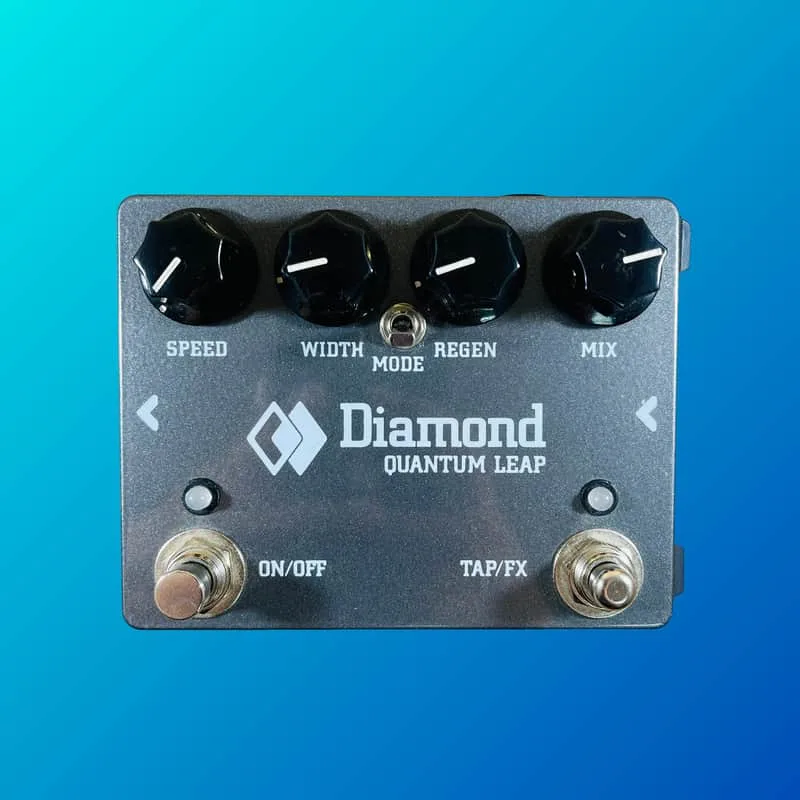
The pedal keeps its panel simple: four knobs, speed, width, regen and mix, which take on different functions depending on which mode is active1. There are two footswitches, on/off and tap/fx1.
| Control | Function |
|---|---|
| Speed | LFO speed for flange and chorus, hi-range comb filter frequency for the filter mode, delay time for the delay modes1 |
| Width | Interval control in Harmonic Delay mode; other functions vary by mode2 |
| Regen | Delay regeneration; increasing it stacks consecutive fifths or octaves in Harmonic Delay mode1 |
| Mix | Wet/dry balance1 |
Mode switching is handled by a momentary Mode switch paired with a multi-colored flashing LED rather than an LCD or LED screen, a design choice Gus Green liked, feeling that screens ruin the immediacy and tactile nature of a stompbox2. The chosen mode is indicated by the color of the light next to the tap/fx footswitch: a green/yellow combination indicates flanger, and green/red indicates chorus1. Green noted the system takes a little getting used to but is simple enough2.
The TAP/FX footswitch does more than set tempo. You can tap in delay times or LFO speeds for flange and chorus, and holding the switch down accesses additional voicings2. In Tap Delay mode, holding the Tap/FX switch down for a few tics enters Harmonic Delay mode2.
Harmonic Delay mode
Harmonic Delay mode colors repeats with a tone an octave or a fifth higher, and by increasing the regeneration you can stack consecutive fifths or octaves1. How you reach those intervals depends on a factory setting:
- The pedal ships in "default octave" mode, where the WIDTH control gives fifth intervals only when turned almost fully clockwise2
- To make fifths the default, hold the TAP/FX knob while powering up until the power-up LED sequence completes two cycles2
- In this "default fifth" setting, octaves are then reached by turning WIDTH fully clockwise2
Pitch Ramp Delay mode
Pitch Ramp Delay is the Quantum Leap's most distinctive voice. The foot-controlled pitch ramping mode lets you manipulate the delay with the tap/fx footswitch so the delayed signal goes up or down in pitch; repeated press and release moves the pitch up then down, or down then up, in sequence1. The initial ramp direction depends on which side of noon the SPEED dial is set: on the PM side, pitch ramping goes up first (to a shorter delay time), and on the AM side it ramps down first, with the ramp reaching a one-octave difference and then holding2.
Because the TAP/FX footswitch is used for the ramp function in this mode, delay time is set only via the SPEED knob2. Tonally, Gus Green found this mode does not use the delay "wash" technique of Tap Delay, keeping transient definition intact, and that without the ramp engaged it is similar in tonality to the Memory Lane Jr's 4th mode, with slightly darker analog filtering and slightly differently voiced modulation2. He also found the Pitch Ramp Delay adds a very modern bit of flare to the repeats2.
Bypass, trails and saving settings
The Quantum Leap ships from the factory set for delay trails rather than true bypass. When you bypass it with the ON/OFF switch, the delay repeats trail off naturally instead of cutting dead2.
If you prefer a hard cut, internal DIP switches let you select either true bypass or buffered bypass with delay trails1. The pedal also auto saves your settings, so your knob positions and mode survive a power cycle1.
What reviewers left out
Premier Guitar's review noted the pedal has no stereo outputs1. For players comparing the Quantum Leap against Diamond's wider line, the review found its most basic sounds spectacular, while another reviewer found the flange, chorus and filter modes organic but very typical2.
Construction is solid with high quality components, per Delicious Audio's review2.
Videos
ProGuitarShopDemos
ProGuitarShopDemos
ProGuitarShopDemos
Questions
Is the Diamond Quantum Leap true bypass?
It can be. Internal DIP switches let you choose between true bypass or buffered bypass with delay trails, so the repeats trail off naturally when you hit the bypass switch. The pedal ships from the factory set for delay trails rather than true bypass.
Does the Quantum Leap have stereo outputs?
No. Premier Guitar's review lists no stereo outputs among the pedal's omissions, so the Quantum Leap is a mono in, mono out design. Players running stereo rigs would need to look at other delay options.
How do you get fifths in Harmonic Delay mode on the Quantum Leap?
The pedal ships in default octave mode, where the WIDTH control gives fifth intervals only when turned almost fully clockwise. To make fifths the default, hold the TAP/FX knob while powering up until the power-up LED sequence completes two cycles. Octaves are then reached by turning WIDTH fully clockwise.
What is the maximum delay time of the Quantum Leap?
Up to 600 ms. That applies to the delay modes, including the basic tap delay and the harmonic and pitch ramp variants. Longer delay times would call for a different pedal in Diamond's line.
Does the Quantum Leap save settings?
Yes. Premier Guitar's review notes auto save for settings, so the pedal remembers where you left it when you power it down and back up again.
Sources (3)
- Diamond Pedals Quantum Leap Review, Premier Guitar, 2012-09-26
- Guitar Pedal Reviews: Diamond Pedals Quantum Leap, Delicious Audio, 2013-03-25
- Diamond Pedals Quantum Leap, Pedal of the Day, 2014-07-10
 Steve Vai