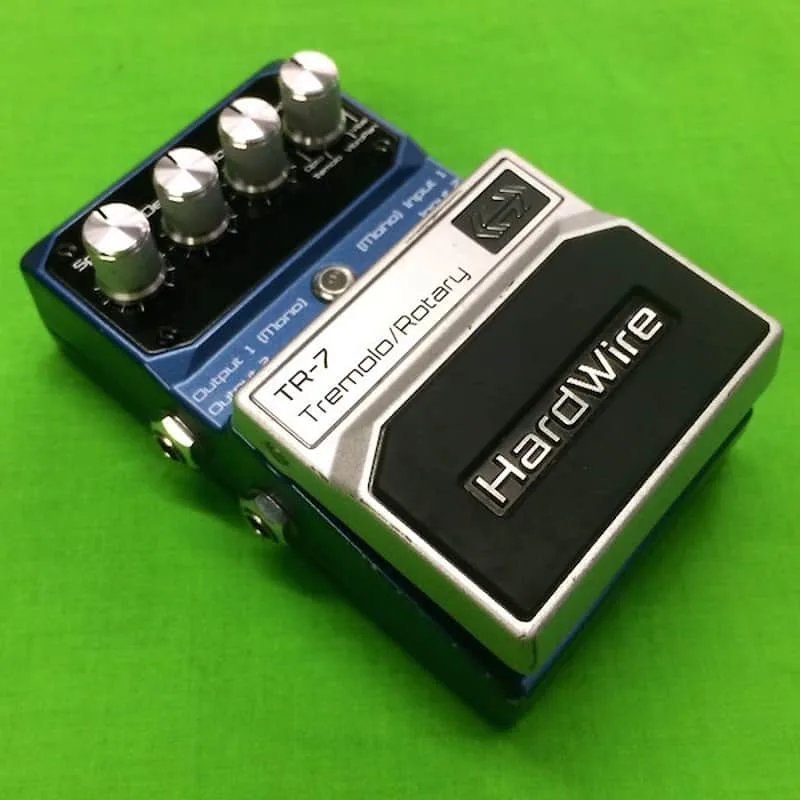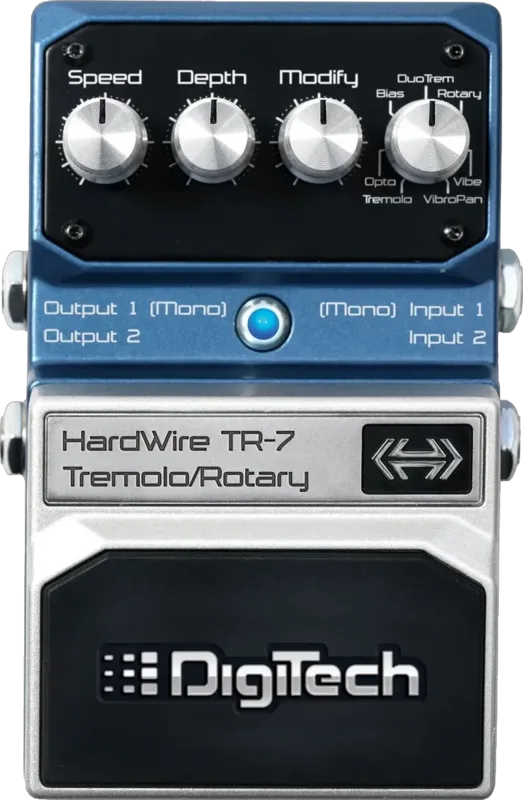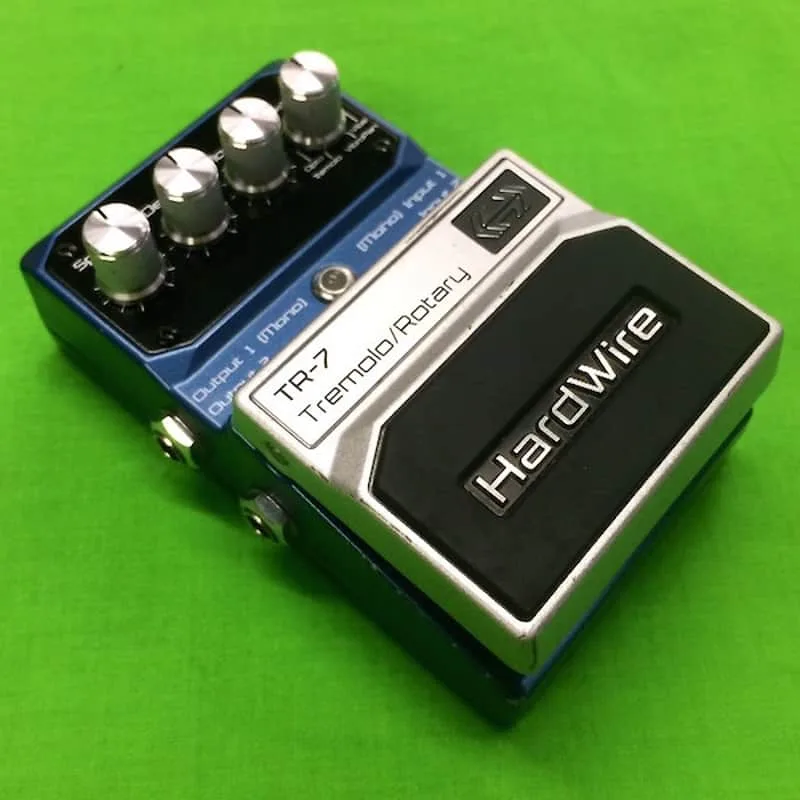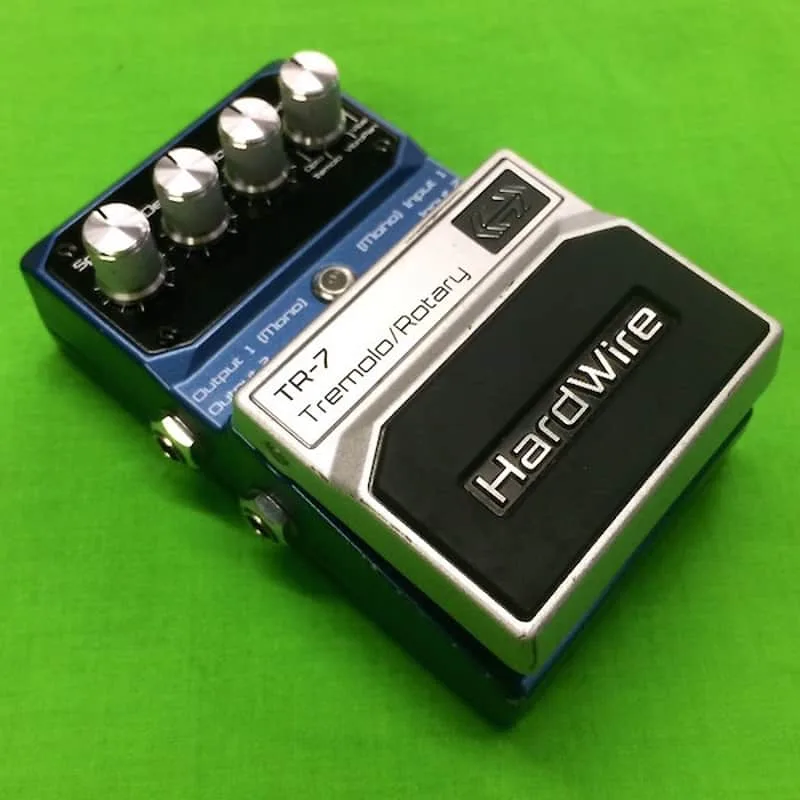


The DigiTech Hardwire TR-7 is a stereo tremolo, rotary and vibrato pedal from DigiTech's HardWire extreme performance series, released in August 2010 with an MSRP of $189.951. It packs seven effects into one box: Tremolo, Opto Tremolo, Bias Tremolo, Duo Tremolo, Rotary, Vibrato and VibroPan2. It is a digital pedal3 with true stereo inputs and outputs, so it can drive two amps, take a second guitar, or produce swirling stereo panning effects from a single box.
The four tremolo types cover a wide range, from what RockBoard's PedalPedia describes as warm amp-like pulses to helicopter chop, or two tremolos running at once3. The Rotary mode is a Leslie-style speaker simulation with a treble and bass rotor that move at different speeds, which RockBoard's PedalPedia describes as producing the sound organ players have enjoyed, complete with extra lushness3. The Ultravibe mode offers what RockBoard's PedalPedia calls slow phasey goodness and a liquid-like vibrato3, and Vibropan gives what RockBoard's PedalPedia describes as a cold shot of swirling stereo sounds3.
The modes and controls
The TR-7's seven effects are selected with a Type Selector knob, alongside four basic knobs: Speed, Depth, Modify and the Type Selector5. Premier Guitar's reviewer described the control set as straightforward, with Speed controlling the speed of the effect, Depth controlling the intensity, and Modify controlling various settings depending on which effect is in play2. MusicRadar's review noted that each mode is controlled by the usual Speed and Depth knobs6.
| Control | What it does |
|---|---|
| Type Selector | Chooses one of the seven effect modes278 |
| Speed | Controls the speed of the effect2 |
| Depth | Controls the intensity of the effect2 |
| Modify | Controls various settings depending on which effect is in play2 |
All of the modes can be controlled via tap tempo3, and Premier Guitar's review confirmed that Tap Tempo can also be engaged2. One thing the pedal does not have is a knob to control the level of the effect, which Premier Guitar's reviewer noted might be a concern to some players2.
The seven modes break down like this:
- Tremolo: a basic tremolo effect2
- Opto Tremolo and Bias Tremolo: models of vintage Fender and Vox tremolo circuits7
- Duo Tremolo: two tremolos at once278
- Rotary: a Leslie-style rotary speaker simulation with treble and bass rotors moving at different speeds3
- Vibrato: pitch-modulated vibrato2
- Vibropan: swirling stereo panning sounds3
Power and connections
The TR-7 powers up with a 9-volt battery or adapter2. On the adapter side it takes 9V DC, center negative, drawing 70mA3, and DigiTech offered the PS200R as an optional power supply5. On battery power it runs on a single 9V battery with a reported life of about 5.25 hours5, with a power consumption of 630mW5.
It is a true stereo effect3 with separate left and right 1/4 inch unbalanced tip-sleeve inputs and outputs5. Premier Guitar's reviewer noted that the two inputs and two outputs let you add a second guitar or amp, and that the true stereo I/O allows for complex connections, creative flexibility, and trippy sounds2. Input impedance is 1 MOhm in stereo and 500 kOhm in mono, with output impedance of 1 kOhm5.
Like other HardWire pedals, it carries the series' standard extreme performance features, including true bypass and high-voltage rails4. Each HardWire pedal also shipped with tour-worthy accessories, including green gaffer tape common to pro pedalboards, Stomplock knob guards and a hook and loop pad1.
Where it came from
The TR-7 was introduced at Summer NAMM 2010 as the newest addition to the HardWire extreme performance series27, and Vintage Guitar reported it as HardWire's new Tremolo/Rotary pedal that June7. It reached stores in August 2010 with an MSRP of $189.951. Guitar World's Paul Riario reviewed it in April 2011 as the latest in the Hardwire series, noting its wide range of tremolo options including opto tremolo, bias tremolo and duo-trem, plus a rotary speaker effect, vibropan and more8.
What reviewers said
Reviews were mixed but generally positive on versatility. Guitar World's Paul Riario called it a gorgeous-sounding pedal8. Pedal of the Day's reviewer felt it can take the place of two or three pedals with all it does, and that it does it all well5. MusicRadar's verdict was that if you're after a versatile trem pedal, give this a look6.
"Can take the place of two or three pedals with all it does and it does it all well!"
Premier Guitar's reviewer was less enthusiastic about the vibe and rotary modes. Of the Uni-Vibe-style sounds, the reviewer wrote2:
"the sounds I got were very disappointing, a cold and digital sounding facsimile"
The same review found the Rotary setting lacked the lush warmth of other pedals that do a better job of emulating that sonic territory, and made the reviewer wish for the real thing2. The reviewer also flagged the lack of a level knob as a possible concern2. For players weighing it against a dedicated tremolo or a standalone rotary simulation, the TR-7's appeal rests on covering both territories, plus vibrato and stereo panning, in one true-stereo box with tap tempo.
Videos
ProGuitarShopDemos
Guitar World
hardwirefx
Questions
Does the DigiTech TR-7 run on a battery?
Yes. The TR-7 runs on a single 9V battery, with a reported battery life of about 5.25 hours, or on a 9V DC center-negative adapter. DigiTech's optional power supply for it was the PS200R.
Is the DigiTech Hardwire TR-7 analog or digital?
It is a digital pedal. The circuit type is listed as digital, which is how it fits seven different effect modes, including modeled vintage opto and bias tremolos and a rotary speaker simulation, into one box.
Can the TR-7 be used in mono?
Yes. It has separate left and right 1/4 inch unbalanced inputs and outputs, so you can plug in a single guitar and amp and run it in mono, or use both inputs and outputs for stereo, a second guitar, or a second amp.
Does the Hardwire TR-7 have tap tempo?
Yes. All of its modes can be controlled via tap tempo, so you can set the speed of the tremolo, rotary or vibe effect in time with the music rather than turning the Speed knob.
What power supply does the DigiTech TR-7 use?
It takes 9V DC, center negative, drawing about 70mA. It can also run on a single 9V battery. DigiTech offered the PS200R as an optional power supply for it.
Sources (8)
- DigiTech Hardwire TR-7 Tremolo, Delicious Audio, 2010-07-30
- HardWire TR-7 Tremolo/Rotary Pedal Review, Premier Guitar, 2010-10-28
- Hardwire TR-7 by DigiTech, RockBoard, 2026
- HardWire TR-7 Pedal Debut at Summer NAMM, Premier Guitar, 2010-06-18
- Digitech Hardwire TR-7 Tremolo / Rotary Simulator, Pedal of the Day, 2014-10-05
- Hardwire TR-7 Tremolo/Rotary review, MusicRadar, 2011-12-02
- HardWire Adds TR-7 Tremolo/Rotary Pedal, Vintage Guitar magazine, 2010-06-18
- DigiTech Hardwire Series TR-7 Tremolo/Rotary Stomp Box, Guitar World, 2011-04-12