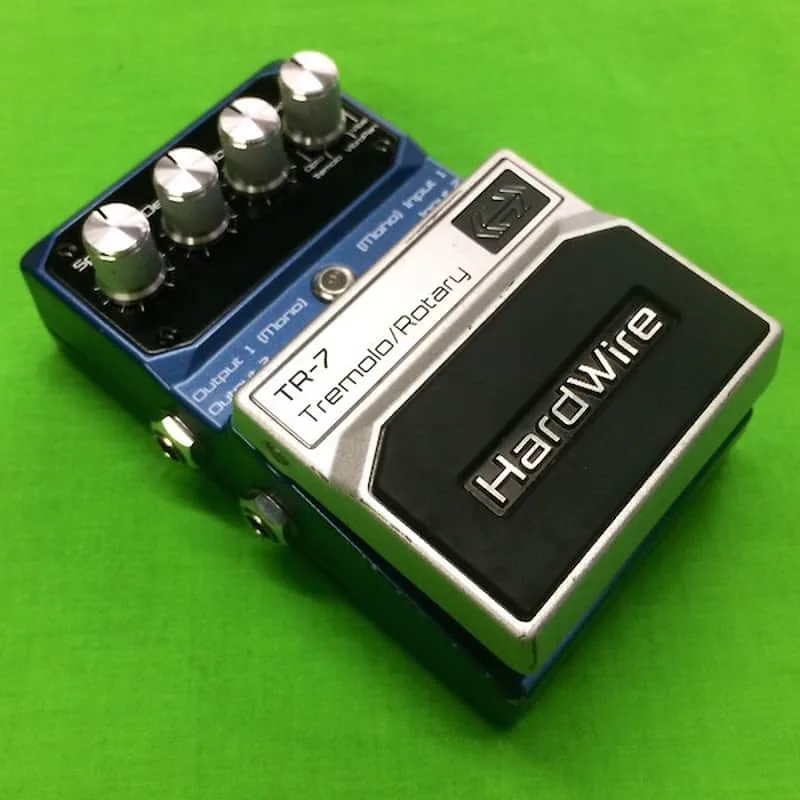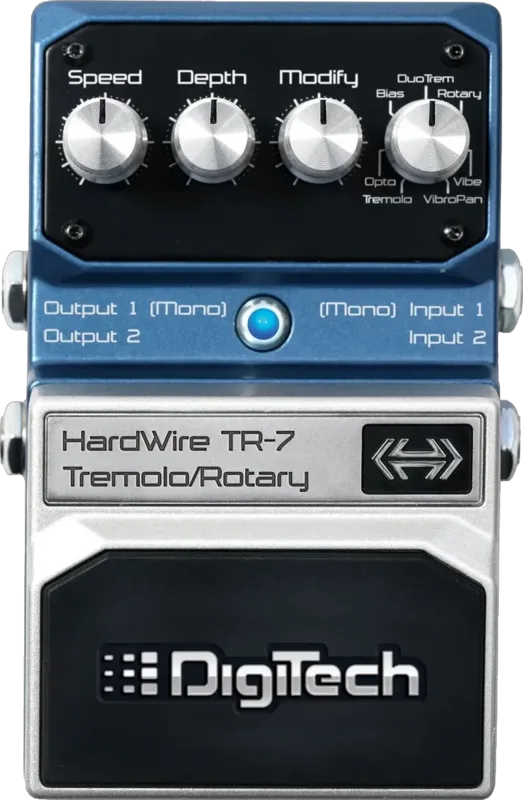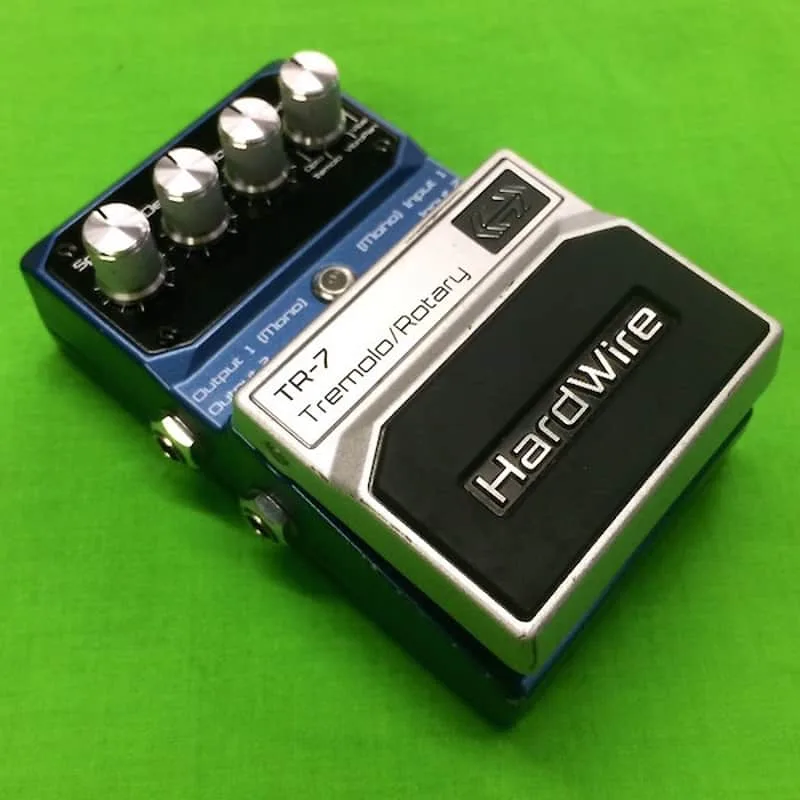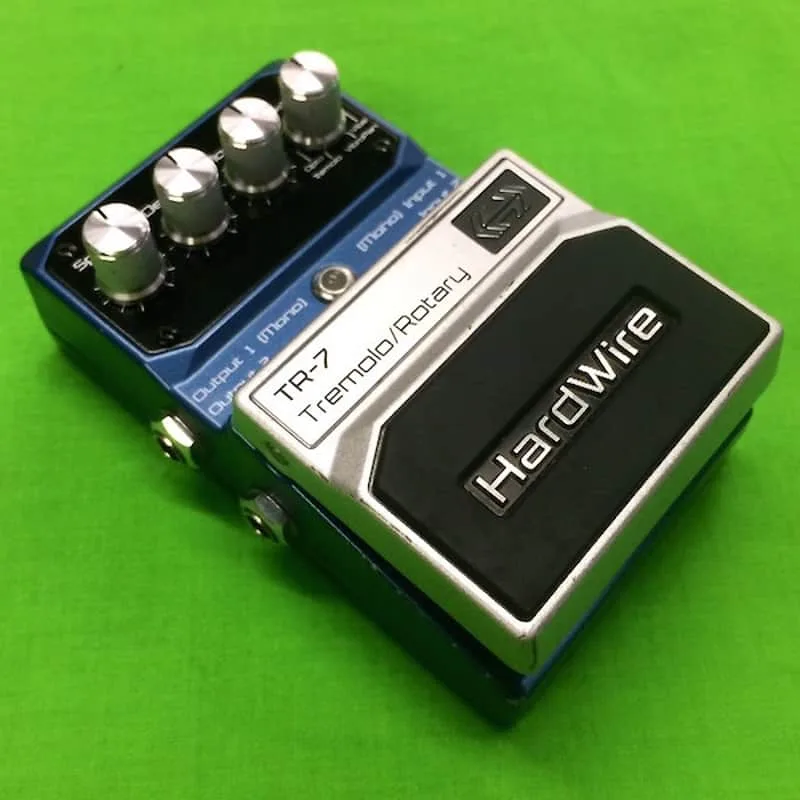


The DigiTech HardWire TR-7 Tremolo/Rotary is a true stereo tremolo, rotary and vibrato pedal that puts seven effects in one box: Tremolo, Opto Tremolo, Bias Tremolo, Duo Tremolo, Rotary, Vibrato and VibroPan1. Made by DigiTech as part of its HardWire extreme performance series, it covers ground from traditional amp-style tremolo pulses to a rotary cabinet simulation aimed at Leslie speaker sounds12.
The range is broader than a basic tremolo pedal. Delicious Audio's Howard Stock described it as providing not just a basic tremolo but models of vintage Fender and Vox tremolos, a Leslie rotary speaker cabinet, Uni-Vibe-style sounds, dual tremolo and stereo panning3. DigiTech's own product page says the four tremolo types emulate anything from warm amp-like pulses to helicopter chop, or let you run two tremolos at once4.
Seven effects in one pedal
The TR-7's Type knob selects between its seven modes1. Each is a different take on amplitude or pitch modulation:
| Mode | What it does |
|---|---|
| Tremolo | Traditional tremolo, from warm amp-like pulses to helicopter chop4 |
| Opto Tremolo | Photoresistor-style tremolo, the type associated with vintage Fender amps3 |
| Bias Tremolo | Tremolo based on the Vox sound1 |
| Duo Tremolo | Two tremolos at once4 |
| Rotary | Emulates a Leslie rotary speaker cabinet1 |
| Vibrato | Pitch vibrato1 |
| VibroPan | Stereo panning between the two outputs3 |
The Opto and Bias modes are where the TR-7 nods to amp history. Premier Guitar's reviewer found both satisfying, noting that the Bias Tremolo "is based on the Vox sound"1. The Rotary mode is designed to emulate a Leslie rotary speaker cabinet, and the UltraVibe mode, in DigiTech's words, offers "slow phasey goodness and a liquid-like vibrato"4. MusicRadar's Stuart heard that mode as Uni-Vibe territory: "UltraVibe gives you the classic vibrato of the UniVibe à la Pink Floyd's Breathe"5.
Controls, stereo connections and high-voltage design
The control panel is four knobs: Speed, Depth, Modify and a Type selector6. Their jobs are straightforward:
- Type: selects any of the seven effects1
- Speed: controls the speed of the effect1
- Depth: controls the intensity1
- Modify: controls various settings depending on which effect is in play1
Because Modify changes function from mode to mode, its label is deliberately vague; what it shapes in Rotary mode is not what it shapes in Duo Tremolo. One thing the pedal does not have is a level knob, and Premier Guitar's reviewer flagged this: "the lack of a knob to control the level of the effect might be a concern to some"1.
The TR-7 is true stereo, with two inputs and two outputs, so you can add a second guitar or a second amp1. Premier Guitar noted that the true stereo I/O allows "complex connections, creative flexibility, and trippy sounds"1, and the same point appeared in the launch press coverage from both Premier Guitar and Vintage Guitar27. In VibroPan mode the stereo outputs become part of the effect itself, moving the signal between amps3.
Internally, the pedal runs constant high-voltage operation, which Premier Guitar's reviewer described as being "for top-notch tonal quality and noise reduction"1. Vintage Guitar's launch coverage likewise cited the pedal's high-voltage rails alongside its true bypass7. The HardWire series positioning, "extreme performance," was DigiTech's framing for the line12.
Where it came from
What reviewers said
Reviews split along the line between the tremolo modes and everything else.
"The tremolo and vibrato sounds on the TR-7 are great, and the Uni-Vibe and Leslie sounds aren’t so great. It gets you in the ballpark, but those with educated ears will have issues and should look elsewhere."1
Premier Guitar's reviewer, on the overall verdict1
The same reviewer was harsher on the Uni-Vibe-style sounds specifically, calling what came out "a cold and digital sounding facsimile"1. The buying advice was blunt: "Tremolo freaks will surely dig it," with the flip side being that players who need deep Uni-Vibe sounds should look elsewhere1.
MusicRadar's Stuart took a more even view, listing a "fine selection of tremolo sounds" among the pedal's pluses5. Guitar World's Paul Riario, reviewing the pedal in April 2011, called it a gorgeous-sounding pedal and noted its wide range of tremolo options, including opto tremolo, bias tremolo and duo-trem, plus the rotary speaker effect and vibropan8.
The pattern across the coverage: the tremolo and vibrato modes drew consistent praise, while the rotary and Uni-Vibe emulations were seen as approximations rather than replacements for the real thing1.
Videos
ProGuitarShopDemos
Guitar World
Premier Guitar
Questions
Is the DigiTech TR-7 true stereo?
Yes. The TR-7 has true stereo I/O with two inputs and two outputs, so you can run a second guitar or a second amp and set up complex stereo connections. In modes like VibroPan the stereo outputs are part of the effect itself, panning the sound between the two amps.
What does the Modify knob do on the TR-7?
The Modify knob changes function depending on which of the seven effects is selected. Speed sets the effect's rate, Depth sets its intensity, and the Type knob chooses the effect. Modify is the fourth control, and its job shifts from mode to mode rather than doing one fixed thing.
Can the TR-7 do Uni-Vibe sounds?
It has an UltraVibe mode that MusicRadar described as giving the classic vibrato of the Uni-Vibe, as on Pink Floyd's Breathe. Premier Guitar's reviewer found the Uni-Vibe sounds disappointing, calling them a cold and digital sounding facsimile, so opinions differ on how close it gets.
Is the Bias Tremolo on the TR-7 based on a Vox amp?
Yes. Premier Guitar's review states that the Bias Tremolo mode is based on the Vox sound, while the Opto Tremolo mode covers the photoresistor-style tremolo associated with Fender amps. The reviewer found both very satisfying.
When did the DigiTech HardWire TR-7 come out?
It was announced at Summer NAMM in June 2010 with availability from August 2010, at an MSRP of $189.95. It was released as part of DigiTech's HardWire extreme performance series of pedals.
Sources (8)
- HardWire TR-7 Tremolo/Rotary Pedal Review, Premier Guitar, 2010-10-28
- HardWire TR-7 Pedal Debut at Summer NAMM, Premier Guitar, 2010-06-18
- Hardwire TR-7 Tremolo/Rotary Pedal, Delicious Audio, 2011-03-07
- Hardwire TR-7 by DigiTech, RockBoard, 2026
- Hardwire TR-7 Tremolo/Rotary review, MusicRadar, 2011-12-02
- Digitech Hardwire TR-7 Tremolo / Rotary Simulator, Pedal of the Day, 2014-10-05
- HardWire Adds TR-7 Tremolo/Rotary Pedal, Vintage Guitar magazine, 2010-06-18
- DigiTech Hardwire Series TR-7 Tremolo/Rotary Stomp Box, Guitar World, 2011-04-12