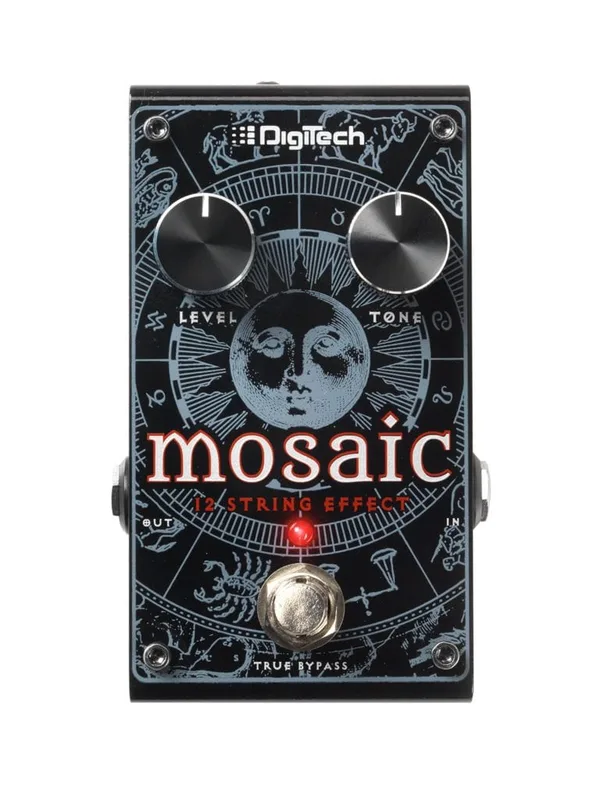


The DigiTech Mosaic is a polyphonic 12-string effect pedal from DigiTech, first available in December 20141. Instead of modulating your signal the way a chorus pedal does, it re-creates the sound of a 12-string guitar from an ordinary 6-string: octave-shifted low strings and doubled high strings, the same layout a real 12-string uses2. DigiTech says it works with both 6-string electric guitars and amplified acoustics2.
DigiTech describes the result as a lush, shimmering chordal effect, with what the maker calls "balanced low-end response with crisp octave shimmer" producing a tone that is lush and articulate2. The pedal sits in a compact, pedalboard-friendly metal enclosure1.
A 12-string sound from a 6-string guitar
A real 12-string guitar pairs each regular string with a second string: the lower courses are tuned an octave up, and the higher courses are doubled in unison. The Mosaic does the same thing electronically. DigiTech says the pedal delivers "immediately identifiable 12-string tones" with octave low strings and doubled high strings2.
Because the effect is polyphonic, it tracks chords rather than single notes only, which is what a 12-string simulation needs: the jangle of a 12-string comes from all six courses sounding at once, slightly detuned and beating against each other. The Mosaic is aimed at players who want that sound without carrying a second instrument, and without the wider neck and heavier string tension a real 12-string demands2.
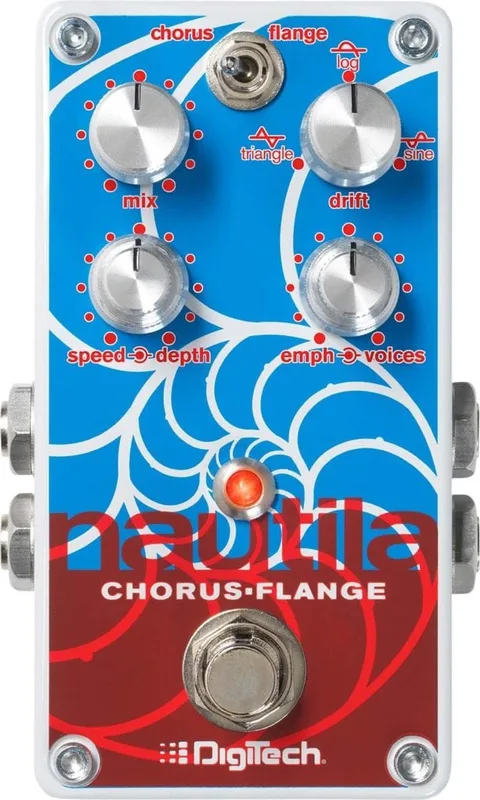
Guitar.com's review placed the pedal in context: "As the Mosaic is basically an application of pitch-shifting technology"4. That is the key to how it differs from a chorus or detune pedal such as DigiTech's own Nautila: a chorus thickens the sound with delayed, modulated copies, while the Mosaic generates new pitched content, an octave below on the bass strings and a doubled unison on the trebles.
The controls: Level and Tone
The Mosaic keeps it simple, with two knobs.
| Control | What it does |
|---|---|
| Level | Changes the intensity of the 12-string effect; clockwise increases it, counter-clockwise decreases it2 |
| Tone | Shapes the tonal balance of the effect45 |
MusicRadar described the effect as shaped by independent level and tone controls5. Guitar.com found the two knobs more capable than their count suggests: "There are only two controls, Level and Tone, but they're interactive, so there's a whole array of sounds and subtleties"4.
"If you're using single coils, the unit seems to perform best with the tone control set to the bassier end of the spectrum"
The same reviewer found humbuckers benefit from a brighter setting, so where you park the Tone knob depends on which pickups are feeding the pedal4.
Inside the pedal: 24-bit pitch shifting
The Mosaic is a digital pedal. It converts your signal with 24-bit A/D/A conversion at a 44.1 kHz sample rate, then applies its pitch-shifting processing to build the extra strings2. Guitar.com characterized the whole pedal as an application of pitch-shifting technology4.
The published measurements point to a clean signal path:
- Frequency response: 20 Hz to 11 kHz with the effect enabled2
- Signal to noise ratio: better than -105 dB (A weighted), referenced to max level, 22 kHz bandwidth2
- THD: 0.004% at 1 kHz, referenced to 1 dBu with unity gain2
The pedal is true bypass, which DigiTech says preserves your tone when the pedal is not in use2. It runs on a 9V DC power supply, which the maker notes makes it easy to integrate into an existing pedalboard2; Guitar.com's review listed a 9V adapter as supplied4. The enclosure is a compact, pedalboard-friendly metal box1, made in China4.
Prices and availability
The Mosaic was announced at a suggested retail price of $187.44 MSRP3 and became available in December 20141. UK pricing was reported differently at different times: Guitar.com listed £109 RRP in its 2015 review4, while MusicRadar in 2020 reported UK availability at £1295. The two figures come from different dates and publications, so treat UK pricing as having shifted over the pedal's run.
Videos
ProGuitarShopDemos
Sweetwater
Eirik Stordrange
Questions
Is the DigiTech Mosaic true bypass?
Yes. DigiTech states the Mosaic is true bypass, so it preserves your tone when the pedal is not in use. That makes it safe to leave on a pedalboard without coloring your dry signal when it is switched off.
Does the DigiTech Mosaic work with an acoustic guitar?
Yes. DigiTech says the Mosaic creates 12-string sounds with either a 6-string electric or an amplified acoustic guitar. Any acoustic you run through a pickup or preamp into the pedal's 1/4 inch input can get the doubled-string effect.
What power supply does the DigiTech Mosaic need?
The Mosaic runs on a 9V DC power supply, which DigiTech says makes it easy to integrate into an existing pedalboard. A 9V adapter is supplied with the pedal, according to Guitar.com's review.
Can the DigiTech Mosaic run on a battery?
The published specifications for the Mosaic list a 9V DC power supply only, with no battery option mentioned. Plan on a 9V power source on your pedalboard rather than a battery.
Sources (5)
- DigiTech Debuts Mosaic Polyphonic 12-String Effect Pedal for Guitar, Guitar Interactive Magazine, 2014-11-27
- Mosaic - DigiTech, DigiTech, 2026-01-02
- New DigiTech Mosaic 12-String Effect Pedal Launched, Premier Guitar, 2014-11-26
- Digitech Mosaic & Polara Pedals Review, Guitar.com, 2015-05-26
- DigiTech unveils Mosaic 12-string simulator pedal, MusicRadar, 2014-11-26