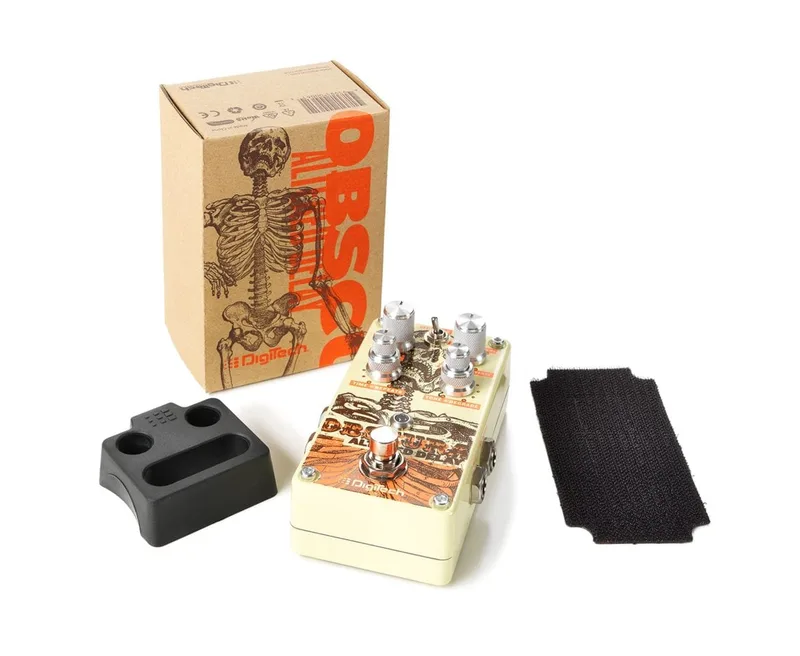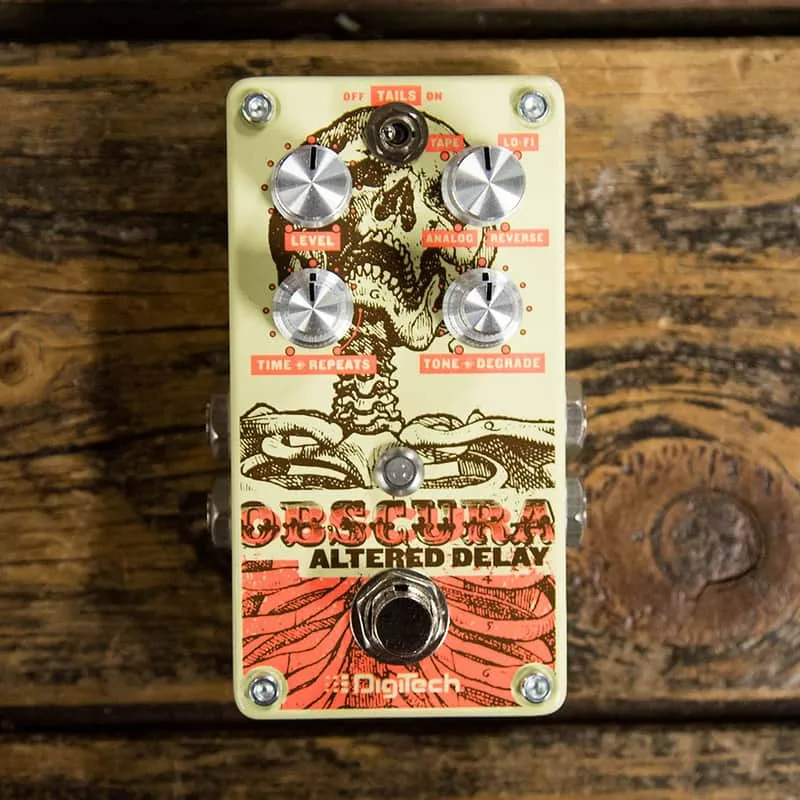


The DigiTech Obscura Altered Delay is a compact delay pedal from DigiTech, introduced in 2015. It is a digital delay with analog simulations, designed, in DigiTech's words, "with the legendary functionality and flaws of the early tape-based delay/reverb units of yesteryear in mind"12. Where a standard delay pedal gives you clean repeats, the Obscura is built around the idea that the imperfections of old echo machines are part of the character: it aims, as the announcement put it, "to re-create the distinctive sonic signatures of early tape-based echo and delay units and all their aural idiosyncrasies"3.
The pedal offers four delay modes, analog, tape, lo-fi and reverse, with the reverse mode emulating the sound of playing a recording backwards13. A Degrade control pushes the modes further: with it advanced, the analog mode creates a receding filter effect around your playing, and tape produces synthesized impersonations of wow and flutter for a dense, chorus-like vibe4. It was shown at the 2015 Summer NAMM Show in Nashville, Tennessee56, and DigiTech announced immediate availability on May 15, 20156.
The four delay modes
The Obscura's modes are where its character lives. Each one models a different flavor of echo:
| Mode | What it does |
|---|---|
| Analog | Analog-style repeats; Guitar.com found it "has little top end"4 |
| Tape | Emulates tape echo; "quite true to the original signal, but warmer and more rounded"4 |
| Lo-fi | Gritty, degraded repeats; "bright and clean" at low Degrade settings4 |
| Reverse | "Emulates the dizzying psychedelic sound of playing a recording backwards"3 |
Guitar.com's review went further on how the modes behave once the Degrade knob comes into play. In analog mode with Degrade advanced, "Analogue creates a beautiful receding filter effect that surrounds your playing with warm pulsations," while in tape mode "tape goes off into synthesised, but realistic, impersonations of wow and flutter to create a dense, chorus-like vibe"4. Lo-fi "piles on the grit, making it sound as if a distortion pedal has processed the repeats"4.
The controls
The Obscura keeps its control set small by pairing functions on concentric dual dials: "one outer and one inner dial to control the corresponding feature"2. There are two of these stacked pairs, Time/Repeats and Tone/Degrade, plus a Level knob and a mode selector.
| Control | What it does |
|---|---|
| Time | Increases your delay amount2; with Repeat, controls the length of repeats1 |
| Repeat | Controls the number of repeats1 |
| Tone | Darkens or brightens the delayed signal2; controls the high-frequency content of the repeats1 |
| Degrade | Controls the amount of signal degradation, "just like on the old machines"1 |
| Level | Adjusts the wet/dry effect blend1 |
Two extra functions are worth knowing about:
- Repeat hold: turning the repeats knob fully clockwise engages a repeat hold function, holding the repeats so you can play over them4.
- Tails switch: a "Tails" switch gives you the option of having the decay of the effect remain when the pedal is switched off, instead of cutting the repeats dead1.
The footswitch is not only used to bypass the Obscura's signal, it can also become a tap tempo switch2, so you can set delay times in time with the music on the fly.
Bypass, power and connections
The Obscura runs with true-bypass operation, housed in DigiTech's tried-and-true durable metal enclosure1. It has mono and stereo inputs and outputs3, so it works in a stereo rig, and it takes a 9V DC external power supply4. Pedal of the Day noted it is "housed in a small enclosure, still offering the tones and sounds of some of the big boxes, but with a smaller pedalboard" footprint2, which matters if you are building a compact board.
The skeleton artwork
The distorted skeleton on the top panel is not random heavy-metal art. It is an illustration commissioned by the 16th century anatomist Andreas Vesalius for his De humani corporis fabrica series of books4. The anatomical drawing gives the pedal its distinctive look and fits its theme of exposing the inner workings, and flaws, of old echo machines.
Where it came from and what reviewers said
A UK review found real character in the modes once Degrade was advanced: the analog mode has little top end, tape is quite true to the original signal but warmer and more rounded, and lo-fi is bright and clean4. Delicious Audio's take on its creative reach:
"You can literally twist, turn, chew, and spit out any kind of demented delay you can imagine."
Delicious Audio1
Pedal of the Day's review covered the four delay types, the dual-concentric controls, the tap tempo footswitch, infinite repeat looping, stereo operation and true bypass wiring, calling out the small footprint as a practical plus for pedalboard builders2.
Videos
ProGuitarShopDemos
Sweetwater
Sweetwater
Questions
Is the DigiTech Obscura true bypass?
Yes. The Obscura runs with true-bypass switching, so when it is off the signal passes through without the pedal's circuitry in the path. It is housed in DigiTech's durable metal enclosure, the same style of housing the maker uses across its compact pedal line.
Does the Obscura have tap tempo?
Yes. The Obscura has tap tempo, and the main footswitch does double duty: it bypasses the pedal's signal, and it can also become the tap tempo switch. That means you can set your delay time in time with the music without bending down to turn a knob.
What does the Degrade knob do on the Obscura?
Degrade controls the amount of signal degradation in the repeats, just like on the old tape machines the pedal is modeled on. Turn it up and the repeats get progressively more worn and lo-fi. Guitar.com found that with Degrade advanced, the analog mode creates a receding filter effect and tape mode produces realistic wow and flutter.
Does the Obscura Altered Delay work in stereo?
Yes. The Obscura has both mono and stereo inputs and outputs, so it can sit at the end of a stereo rig or take a stereo feed from another pedal. Stereo operation was one of the features reviewers highlighted alongside the tap tempo and true bypass.
What is the skeleton artwork on the Obscura?
The distorted skeleton on the top panel is an illustration commissioned by the 16th century anatomist Andreas Vesalius for his De humani corporis fabrica series of books. DigiTech used the historical anatomical drawing as the pedal's distinctive face.
Sources (6)
- Digitech Obscura Altered Delay, Delicious Audio, 2025-06-30
- Digitech Obscura Altered Delay, Pedal of the Day, 2015-09-23
- DigiTech Releases the Obscura Altered Delay, Premier Guitar, 2015-04-17
- Review: DigiTech Obscura Altered Delay pedal, Guitar.com, 2015-06-24
- Summer NAMM 2015 Video: DigiTech Obscura Altered Delay Pedal, Guitar World, 2015-07-22
- DigiTech Obscura Altered Delay Pedal Now Available, Guitar Interactive Magazine, 2015-05-15