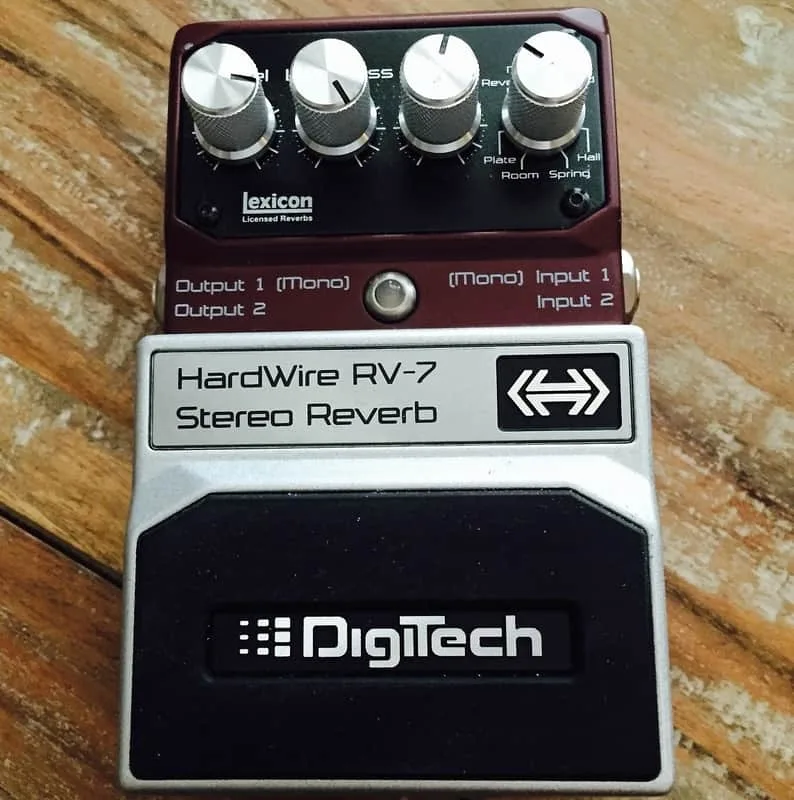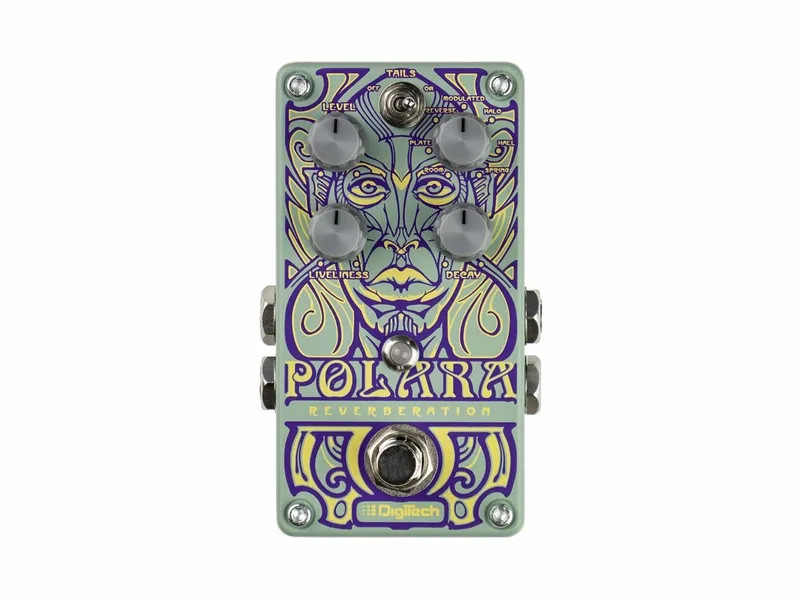


The DigiTech Polara is a compact stereo reverb pedal from DigiTech, announced on November 4, 2014 and available from mid November that year1. Its selling point is the reverb engine: seven Lexicon reverbs, the same lineage of algorithms DigiTech had already used in its HardWire RV-7, packed into a smaller enclosure with a soft-touch vacuum-style footswitch21. DigiTech no longer makes it; the maker's own product page lists it as a past product, no longer in production2.
The seven types cover the standard spaces (Room, Hall, Plate, Spring) plus three more colored modes: Modulated, Reverse and Halo21. Halo was new at launch, and Delicious Audio described it as "a great tone akin to what many reverb pedals describe as their 'shimmer' tone"3. When new it carried a suggested retail price of $187.44 in the US1.
The Polara is discontinued. DigiTech's product page marks it as a past product no longer in production2, and Guitar Pedal X's 2021 roundup listed it as discontinued, noting DigiTech sold them for as little as $170 before they were discontinued4.
Seven Lexicon reverb types
The Polara's reverb types are Lexicon algorithms, and the press material around the launch traced them to work DigiTech did with Lexicon on the HardWire RV-7: the reverbs were "co-developed with Lexicon for the HardWire RV-7"1, and Delicious Audio noted the Polara's "primary reverb settings were initially co-designed with Lexicon, the pioneer of digital reverb, to ensure consistency and studio reliability"3. The earlier RV-7 was itself praised for "its Lexicon chip giving it the quality of vintage PCM rack units"8.
| Type | What reviewers said it does |
|---|---|
| Room | "Provides intimate warmth" per the launch announcement1; Guitar.com found it creates believable live spaces6 |
| Hall | "Offers a vast soundspace"1; MusicRadar said it captures the space "with a pristine sheen"9 |
| Plate | Guitar.com: "delivers the classy but unnatural sheen of '60s/'70s production"6 |
| Spring | Recreates the "drip" of surfy amp-reverb sounds6; MusicRadar called it "solid if a little overexcitable"9 |
| Modulated | "Swilling, chorussy vibes" per Guitar.com6 |
| Reverse | Eliminates the dry signal for psychedelic ambiences6 |
| Halo | A shimmer-style tone, new at launch3 |
MusicRadar's reviewer put the modes in player terms: "Plate is a dream for Jeff Buckley-style arpeggiated chords, while fans of My Bloody Valentine will swoon over the reverse mode"9.
The controls
The control set is deliberately small: four knobs (Level, Liveliness, Decay, Type) plus the footswitch and the Reverb Tails toggle210. There is no pre-delay control; as MusicRadar put it, "With no pre-delay control, DigiTech has kept the Polara simple: select a mode, dial in the liveliness and decay, and you're away"9.
| Control | What it does |
|---|---|
| Level | Adjusts the amount of reverb mixed with the dry signal1 |
| Liveliness | Shapes the character of the reverb tail10 |
| Decay | Sets how long the reverb lasts10 |
| Type | Selects the reverb type1 |
| Footswitch | Soft click, vacuum style; the launch announcement called it reliable and noise-free21 |
| Tails toggle | Reverb Tails On/Off switch10 |
The Polara also shipped with DigiTech's gen2 Stomplock knob guard, which locks the settings in place to prevent accidental changes onstage, and a custom-cut hook and loop pad for pedalboard mounting1.
Power and connections
The Polara requires a 9 VDC external power supply and does not run on a battery; the adapter was sold separately26.
DigiTech's specifications list a 9 VDC external power supply as required, with a typical current draw of 125 mA at 9V DC and power consumption of 675 mW2. The recommended adapters, sold separately, were the PS0913DC-01 (US, JA, EU) and PS0913DC-02 (AU, UK), each with a 9 VDC 1.3 A output2. That current draw is modest by modern standards, but the 125 mA figure is worth checking against a small daisy-chain supply's per-output rating.
Connections are stereo throughout: separate left and right ¼" unbalanced tip-sleeve inputs and outputs27. Input impedance is greater than 1 MΩ in stereo and greater than 500 kΩ in mono with the effect on; output impedance is 1 kΩ with the effect on and true hardwire bypass with it off72. The pedal is true bypass, which DigiTech says preserves your tone when the pedal is not in use21.
History: between the RV-7 and the Supernatural
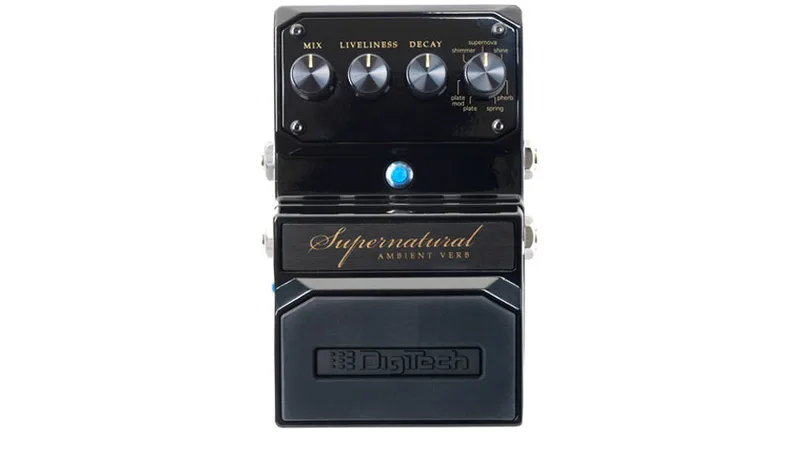
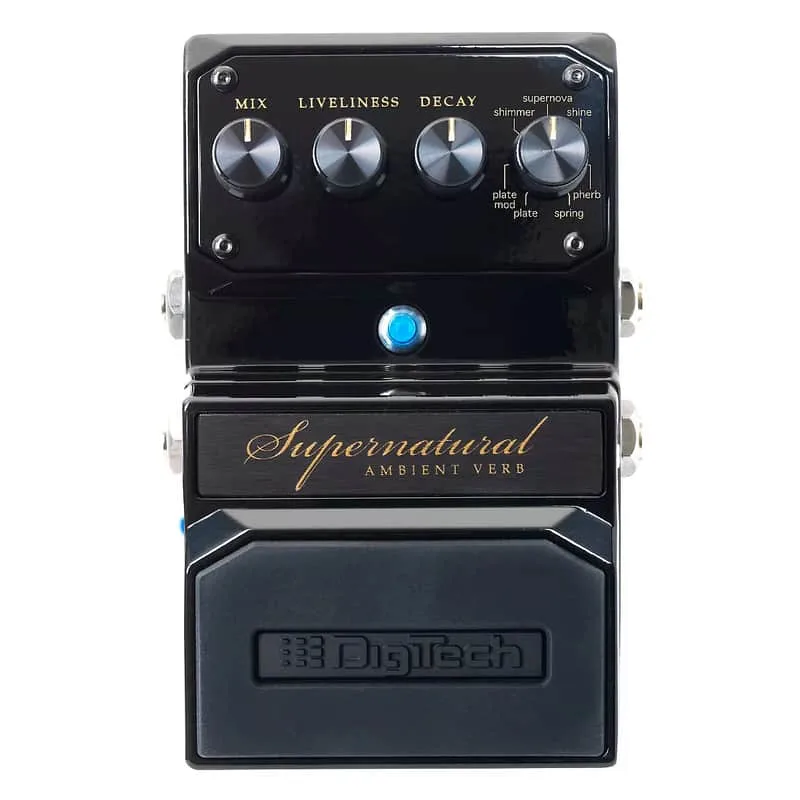
MusicRadar's review placed the Polara in DigiTech's reverb lineage: it "bridges the gap between the discontinued HardWire RV-7 and the HardWire Supernatural, by serving up the usual reverb suspects alongside ambient settings"9. The RV-7 carried the same seven-mode Lexicon approach in the larger HardWire enclosure11, while the Supernatural Ambient Reverb leaned toward ambient textures. Guitar.com's reverb guide noted that "Lexicon tech incorporated into later units such as the Digitech RV-7" continued a line of much-loved Lexicon reverbs12.
The Polara arrived in November 20145, in what Delicious Audio called "a notably hallucinatory design" for the enclosure artwork3. It was built in China6 and represented, in DigiTech's words, "the latest evolution in DigiTech pedal design" with its compact size and soft-touch vacuum-style footswitch2.
What reviewers made of it
Guitar.com's 2015 review of the Polara and the Mosaic 12-string simulator found the core modes practical: Room and Hall "will create believable live spaces around your tone or help bring software simulations to life," while Reverse mode was described as "bonkers - and loads of fun. The dry signal is eliminated, so it's off to a psychedelic realm you go"6.
MusicRadar's later verdict was positive with one caveat:
"While ambient fans may be left wanting, anyone after a versatile compact reverb won't be disappointed."
That matches the pedal's position in the range: it does the standard reverb types well, but players after deep ambient options were pointed toward the Supernatural instead9.
Videos
ProGuitarShopDemos
Sweetwater
DigiTech
Questions
Is the DigiTech Polara still made?
No. DigiTech lists the Polara as a past product that is no longer in production, and a 2021 buying guide also describes it as discontinued. It was launched in November 2014 and sold new for a suggested retail price of $187.44, with street prices around $150 to $170. It is now found on the secondhand market.
Is the DigiTech Polara true bypass?
Yes. DigiTech specifies true bypass circuitry that preserves your tone when the pedal is not in use, and the launch announcement described it as true bypass operation that keeps the unaffected tone of the instrument intact. Output impedance is 1 kΩ with the effect on and true hardwire bypass with it off.
Does the Polara have reverb trails?
Yes. The Polara has a Reverb Tails On/Off toggle switch, so you can choose whether the reverb decays naturally when you switch the pedal off or cuts immediately. The same tails switch appeared on the earlier HardWire RV-7.
What power supply does the DigiTech Polara use?
It requires a 9 VDC external power supply, which is not included. Typical current draw is 125 mA at 9V DC, and power consumption is 675 mW. DigiTech sold the PS0913DC-01 (US, JA, EU) and PS0913DC-02 (AU, UK) adapters separately, each with a 9 VDC 1.3 A output. There is no battery option.
Are the Polara reverbs really Lexicon?
Yes. The Polara carries seven Lexicon reverb algorithms: Room, Plate, Reverse, Modulated, Halo, Hall and Spring. The press described the reverbs as co-developed with Lexicon for the earlier HardWire RV-7, and the RV-7 was noted for its Lexicon chip giving it the quality of vintage PCM rack units.
Is the Polara stereo?
Yes. It has separate left and right quarter-inch unbalanced tip-sleeve inputs and outputs, so it runs in full stereo. Input impedance is greater than 1 MΩ in stereo and greater than 500 kΩ in mono with the effect on.
Sources (12)
- DigiTech Unveils the Polara Stereo Reverb Pedal, Premier Guitar, 2014-11-04
- Polara - DigiTech, DigiTech, 2022-09-14
- New Pedal: The DigiTech Polara Stereo Reverb, Delicious Audio, 2014-12-08
- Guitar Pedal X, Guitar Pedal X, 2021-08-16
- DigiTech announces the Polara compact reverb pedal, MusicRadar, 2014-11-06
- Digitech Mosaic & Polara Pedals Review, Guitar.com, 2015-05-26
- DigiTech Polara Stereo Reverb, Pedal of the Day, 2015-12-21
- What does a Dumble ODS-100 Overdrive Special built to Alexander “Howard” Dumble's personal specs sound like? Pretty, pretty good..., MusicRadar, 2023-10-20
- DigiTech Polara review, MusicRadar, 2015-04-15
- DigiTech Unveil New Polara Pedal, Guitar Interactive Magazine, 2014-11-10
- DigiTech HardWire RV-7 Stereo Reverb, Pedal of the Day (pedal-of-the-day.com), 2019-01-18
- All About… Reverb, Guitar.com, 2015-08-06