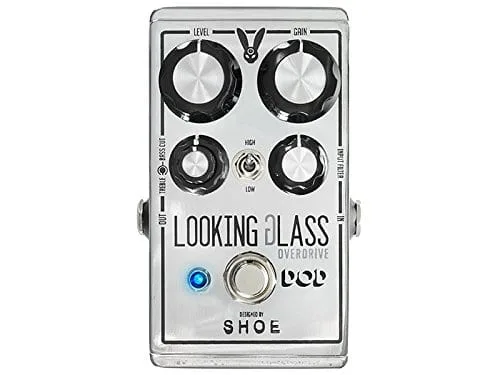


The DOD Looking Glass is a Class-A FET overdrive pedal from DOD, built in collaboration with boutique designer Christopher Venter of SHOE Pedals1. It uses asymmetrical clipping in a Class-A discrete FET circuit, and DOD says that clipping is responsive enough to move from one end of the gain spectrum to the other with a flick of a switch or with pick attack alone1. The range runs from tone shaping, glassy boost and light overdrive to what DOD describes as "the raw, psychedelic sounds of a vintage amp pushed to the brink of failure"1.
Premier Guitar's reviewer called it "a flexible, responsive boost and overdrive with lots of transparency and headroom," and noted that DOD and Venter deliberately aimed for tones outside the Tube Screamer and Klon sphere of influence2. Gearnews reported at launch that the touch-sensitive design is meant to react to playing dynamics as well as any good quality tube amp, without masking the guitar's tone3.
Designed by Christopher Venter of SHOE Pedals
The Looking Glass came out of a collaborative effort between DOD and Shoe Pedals designer Christopher Venter2. Venter is known, in DOD's own words, for "his unique circuits, colorful perspective on classic effects, and minimalist design aesthetic"1. A JHS Pedals history article credits Tom Cram and Christopher Venter as the two who collaborated on the pedal in 20167. The pedal reached stores in February 2016, priced in the UK at £129 RRP ex VAT4.
The enclosure is finished in a chrome-like mirror finish, which MusicPlayers.com's reviewer found made the name appropriate6. A standard heavy-duty footswitch handles on and bypass, with a blue indicator light when the effect is engaged6. A one-year warranty is included, which that reviewer felt was short compared with other popular pedals6.
The controls and the two gain modes
The control set is Level, Gain, Treble, Bass Cut, an Input Filter knob, and a High/Low mode toggle5. Two internal DIP switches sit inside the enclosure1.
| Control | What it does |
|---|---|
| Level | Sets the output level of the pedal1 |
| Gain | Sets the amount of overdrive5 |
| Treble | Gets the output just right for your amp8 |
| Bass Cut | Shapes the bottom end, tightening things up and taking flab out of humbuckers8 |
| Input Filter | Tames overly bright guitars or introduces woolier textures ahead of the gain stage2 |
| Mode toggle | Selects Low or High gain mode12 |
The Input Filter is the control that sets the Looking Glass apart from most overdrives. MusicRadar's reviewer Trevor Curwen described it, together with the internal DIP switches, as setting "the guitar/pedal interfacing just right" and subtly smoothing off unwanted ice-pick-y edge8. Premier Guitar's reviewer found it useful both for taming bright guitars and for introducing woolier textures ahead of the gain stage2. The Bass Cut works at the other end: Curwen found it great for tightening things up and taking some of the flab out of humbuckers, and useful placed before other overdrives in the signal chain8.
The two internal DIP switches each do a specific job. The left switch increases the input impedance of the pedal, which Premier Guitar noted makes it work better with buffered pedals or particularly bright signals12. The right switch engages a darker voicing of the Input Filter1.
Low and High mode
The mode toggle selects two voices2. In DOD's description, the Low mode is used for clean tone shaping, light compression and lower gain overdrive, while the High mode picks up roughly where Low leaves off by boosting the pedal, allowing low to high gain overdrive sounds that remain highly touch sensitive all the way through the range1. Premier Guitar's reviewer put it more simply: with the toggle down the pedal functions much like a clean boost, and the up setting provides more gain2.
What reviewers said
Reviews across the press were broadly positive about the pedal's flexibility and touch response, with one mixed overall rating.
- Premier Guitar found that in clean boost and low gain modes the pedal "adds a pleasant bit of compression, sparkle, and presence that's magical for pared-down rigs"2.
- MusicPlayers.com's reviewer noted the pedal was very responsive to dynamics, and that pick attack had a lot to do with the final sound6. The same review gave it an overall rating of 3.2 stars, which that outlet's scale places in its "worth considering" band6.
- MusicRadar's Trevor Curwen concluded that "Clever controls for adjusting to any guitar plus a wide gain range equals incredible flexibility," and found very few reasons to avoid the pedal8.
"In clean boost and low gain modes, Looking Glass adds a pleasant bit of compression, sparkle, and presence that's magical for pared-down rigs."
MusicPlayers.com also described the circuit as "the lowest-noise circuit obtainable"6. The pedal was originally sold with a user manual, and an identical one is available online6.
Where it sits among DOD overdrives
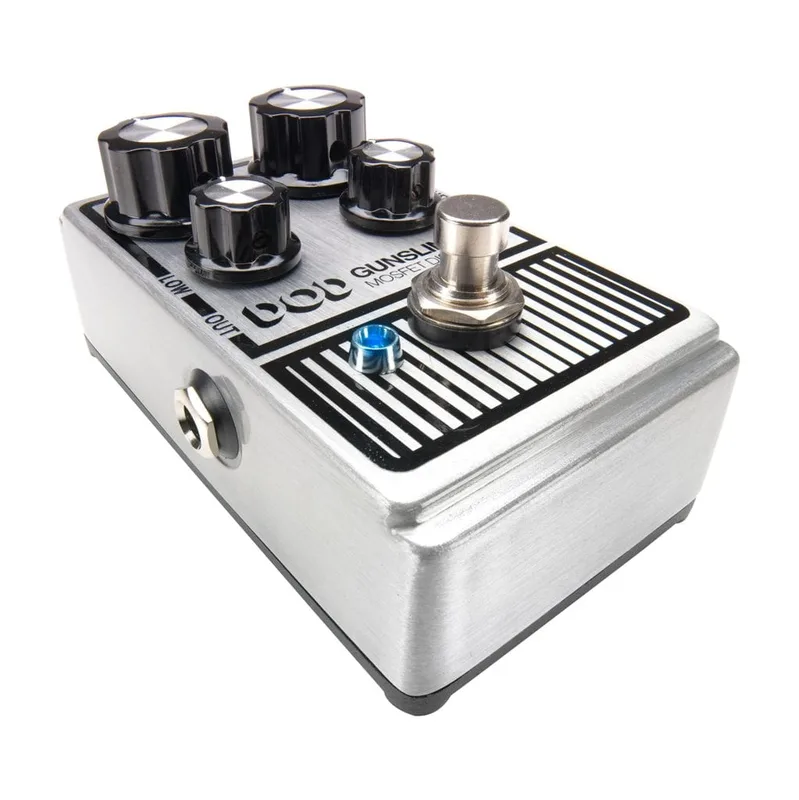
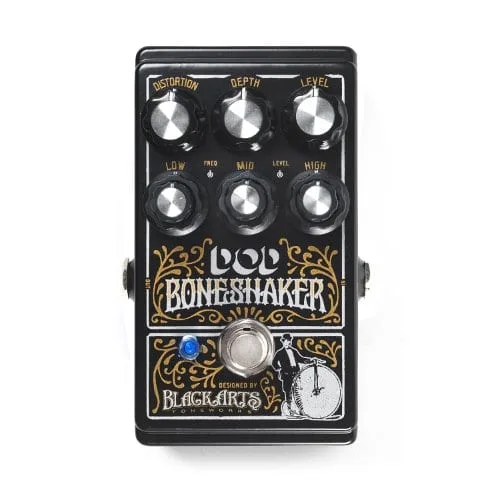
The Looking Glass stands apart from DOD's simpler classic fare such as the DOD Overdrive 250, aiming instead at the transparent, touch-sensitive end of the overdrive and boost spectrum62. Guitar Pedal X listed it among overdrives back in circulation as of 2024, at a list price of $2195. For players comparing it against other distortion and overdrive options in the DOD range, such as the DOD Gunslinger or DOD Boneshaker, the Looking Glass is the company's collaboration-built take on a low-noise, dynamically responsive FET design rather than a high-gain distortion61.
Videos
ProGuitarShopDemos
Andertons Music Co
Andertons Music Co
Questions
Is the DOD Looking Glass true bypass?
Yes. The Looking Glass is a true bypass pedal, so with the effect switched off your guitar signal passes through without buffering or coloration. It also has a 9V power supply jack, which makes it pedalboard friendly, and runs on a 9VDC alkaline battery that is not included.
Does the DOD Looking Glass take a 9V battery?
Yes. The pedal runs on a 9VDC alkaline battery, which is not included, or on the optional PS0913DC power adapter through its 9V power supply jack. Current draw is a low 4 mA, so a battery lasts a long time at typical use.
What does the Input Filter knob do on the Looking Glass?
The Input Filter shapes how your guitar interacts with the pedal before the gain stage. It can tame overly bright guitars and smooth off an ice-pick edge, or be rolled the other way for woolier textures. Two internal DIP switches work alongside it: the left raises input impedance for buffered or bright signals, and the right engages a darker voicing of the filter.
What is the difference between Low and High mode on the Looking Glass?
Low mode is for clean tone shaping, light compression and lower gain overdrive, and functions much like a clean boost with the toggle down. High mode picks up where Low leaves off, boosting the pedal so you can dial in low to high gain overdrive sounds that stay touch sensitive across the whole range.
Sources (8)
- DOD Looking Glass Effect Pedal, DOD (digitech.com), 2025-05-27
- DOD Looking Glass Overdrive Review, Premier Guitar, 2016-10-03
- NAMM 2016: DOD Looking Glass Overdrive pedal, gearnews.com, 2016-01-22
- NAMM 2016: DigiTech launches new DOD Looking Glass pedal, Guitar.com, 2016-01-26
- Guitar Pedal X, Guitar Pedal X, 2024-01-26
- DOD Looking Glass Overdrive, MusicPlayers.com, 2016-09-12
- WHY SPIRAL ELECTRIC FX DESERVE A LOOK, JHS Pedals, 2016
- DOD Looking Glass review, MusicRadar, 2016-06-16