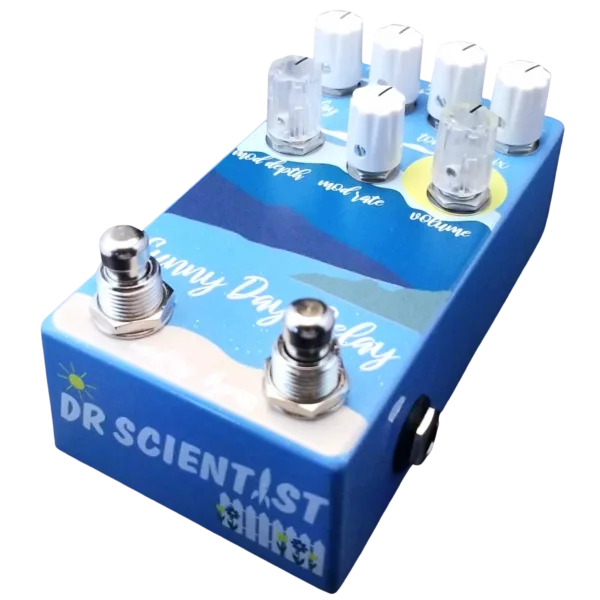


The Dr. Scientist Sunny Day Delay is a compact delay pedal from Canadian builder Dr. Scientist, designed and handmade in B.C., Canada1. It is the latest revision of a classic Dr. Scientist design based on the PT2399 delay chip, and Dr. Scientist describes it as offering "classic, warm delay tones and ambient, modulated washes of repeats"1. The newest version adds a brand new Tone control, a Mix knob and an expression input, all in a smaller form factor than previous versions1.
The original Sunny Day Delay dates back to 2005, and the V2 update covered by Delicious Audio in 2023 was described as a compact revision of that design, almost half the size of the original2. The current pedal carries an MSRP of $199 USD1.
A modulated PT2399 delay
The Sunny Day Delay is built on the PT2399 delay chip, the same chip found in a huge number of compact delay pedals. Dr. Scientist calls it "the famed PT2399 delay chip" and pairs it with what the maker describes as a uniquely designed circuit1. The PT2399 provides smooth delay effects with a maximum delay time of approximately 600 milliseconds, with possible subtle artifacts at maximum that vary with each chip's tolerance3.
Dr. Scientist describes the circuit and controls as all analog1, while Delicious Audio characterizes the V2 as "analog-voiced (but actually based on the PT2399 chip)"2. In practice, the repeats are voiced warm and retro, and the built-in modulation section adds warble to the repeats for ambient washes of sound1.
The modulation is a core part of the design rather than an afterthought. Two knobs govern it: Mod Rate sets the speed of the modulation, and Mod Depth increases the amount of warble in the repeats2. Set shallow and slow, it adds a subtle chorus-like movement to the repeats; pushed harder, it heads into seasick tape-wobble territory.
The controls and footswitches
The Sunny Day Delay keeps its control set simple, with six knobs and two footswitches.
| Control | What it does |
|---|---|
| Delay | Sets the delay time from nearly instant to just over a second1 |
| Repeats | Sets the number of repeats from 1 to oscillating1 |
| Mix | Adjusts the balance between the input signal (Dry) and the effect (Wet) signal1 |
| Tone | New tone control added in the newest version1 |
| Volume | Controls the overall signal level1 |
| Mod Rate | Sets the speed of the modulation1 |
| Mod Depth | Increases the amount of warble in the repeats2 |
| Footswitch | What it does |
|---|---|
| Bypass | Engage or disengage the effect1 |
| Mod/Osc | Either turns the modulation on/off or can be held for maximum repeats1 |
The second footswitch is the pedal's most performance-friendly feature. Delicious Audio describes it as a switch that "can trigger the modulation section or, used as a momentary switch, ramp up the repeats to the maximum setting"2. Holding it floods the pedal with repeats for as long as you keep it down, then lets go when you release.
One change from the original: the new version replaces the delay Level knob with a dry/wet Mix knob2, which makes it easier to set the repeats at a precise level against your clean signal.
Self-oscillation and expression control
The Repeats knob runs from a single repeat all the way to oscillation1, so the pedal can be pushed into runaway feedback like a tape echo with the feedback cranked. Combined with the momentary Mod/Osc footswitch, you can bring the oscillation in and out on demand rather than living with it permanently.
The TRS expression input gives remote control over the Mix knob1, so an expression pedal can sweep the wet signal up from a subtle slapback to a full ambient wash while you play. Dr. Scientist specifies a 500kΩ/1kΩ value for the control and recommends a TRS cable with an expression pedal in the 10k to 25k Ohm range, ideally1.
Power and connections
The Sunny Day Delay runs on 9V DC from a 2.1mm center negative plug, drawing 100mA1.
At 100mA, the Sunny Day Delay draws more current than many compact analog pedals, so check that your power supply has the headroom before daisy-chaining it with several other pedals.
Connections are simple: a mono input, a mono output, and a TRS expression input on the side1. Despite the true bypass switching, the pedal also has buffered input and output1, which Dr. Scientist lists alongside the relay-based true bypass1.
What reviewers said
Pedal of the Day reviewed the pedal in March 2024 and was positive overall, writing:
"We love all things Dr. Scientist, and this blue beauty is no exception."
The reviewer highlighted the pedal's blend of vintage and modern delay tones and its blue enclosure4. Delicious Audio's 2023 coverage of the V2 focused on the compact update, the new Mix, Tone and Volume knobs, the second footswitch and the expression input2.
Videos
Dr. Scientist Sounds
Milan Miller
Do Noise
News
Questions
Is the Sunny Day Delay analog or digital?
Dr. Scientist describes it as an all analog circuit and controls, but the delay itself is based on the PT2399 delay chip, which Delicious Audio characterizes as analog-voiced rather than a true analog bucket-brigade design. The repeats are warm and retro in character, with modulation added on top.
What does the expression pedal control on the Sunny Day Delay?
The TRS expression input gives remote control over the Mix knob, letting you sweep the balance between dry and wet signal with your foot. Dr. Scientist recommends a 10k to 25k Ohm expression pedal, connected with a TRS cable.
Is the Sunny Day Delay true bypass?
Yes. It uses true bypass with soft touch relay switching, so the effect engages and disengages without a mechanical click, and your dry signal passes untouched when the pedal is off.
Can the Sunny Day Delay self-oscillate?
Yes. The Repeats knob sets the number of repeats from 1 all the way to oscillating, and the Mod/Osc footswitch can be held momentarily to ramp the repeats up to the maximum setting for self-oscillation on demand.
Sources (4)
- Sunny Day Delay, Dr. Scientist, 2026
- Dr. Scientist Sunny Day Delay V2, Delicious Audio, 2023-08-10
- NostalgiTone-Space-Modulator, GuitarPCB, 2024-09
- Dr. Scientist Sunny Day Delay, Pedal of the Day, 2024-03-29