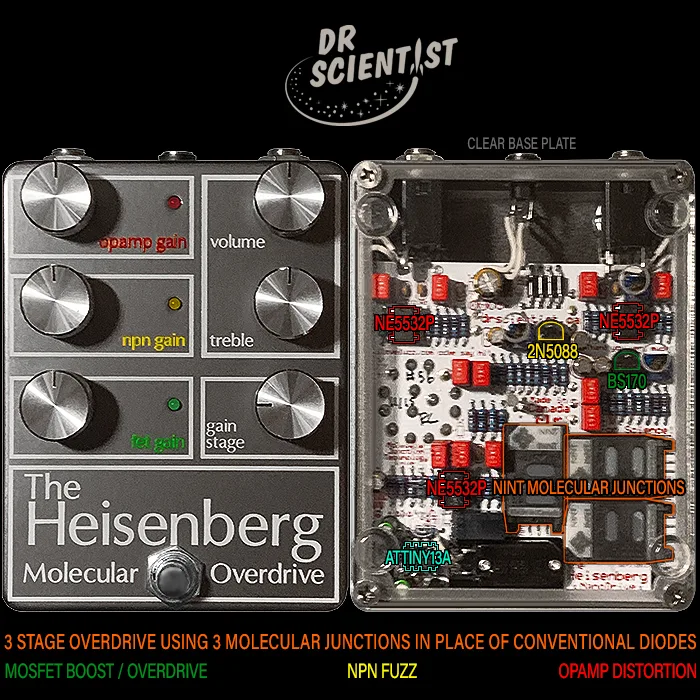

Dr Scientist The Heisenberg is an overdrive pedal built around an unusual clipping device: the molecular junction diode, a microscopic carbon filament developed at a university nanotechnology lab rather than a conventional silicon or germanium part. Dr Scientist designer Ryan Clarke collaborated with the NINT Laboratory at the University of Alberta in Edmonton on the pedal, pairing each of its three gain-stage topologies with an early NINT Laboratory molecular junction diode.1
What the molecular junction diode is
A molecular junction diode uses microscopically thin active carbon filaments to filter and break up electrical signals in a way broadly similar to conventional germanium and silicon diodes, the parts that shape how an overdrive clips. The technology came out of quantum tunnelling and molecular junction research at the NINT Laboratory, and Nanolog Audio's Adam J. Bergren has published a scientific paper on the subject.13
Dr Scientist described its molecular junction as "a new kind of diode that saturates in a slower, smoother, more pleasing way" than conventional silicon diodes, according to Guitar.com's Richard Purvis.4 Nanolog, which commercialized the same technology, calls the part a "nano molecular sandwich," housed in a small plastic frame with a tiny wafer resembling a SIM card.3
The three gain stages
The Heisenberg uses three well-known gain-stage topologies, each combined with its own molecular junction diode, so the pedal covers ground normally spread across separate overdrive, fuzz and distortion pedals1:
| Stage | Topology | Active part |
|---|---|---|
| Boost/Overdrive | FET/MOSFET | BS170 transistor1 |
| Fuzz | NPN | 2N5088 transistor1 |
| Distortion | OpAmp | NE5532P chip1 |
Two further NE5532P chips are used for controlling the Treble, Input and Output, and an ATTiny13A microcontroller handles switching.1
Guitar Pedal X's Stefan Karlsson singled out one stage as his favorite: "my favourite Heisenberg breakup texture really is the NPN / Fuzz variety."1
Sound and character
The molecular junction clipping gives the Heisenberg what Guitar Pedal X describes as a distinctly smoother and more glassy output profile than conventional overdrives, with some players describing it as a little Hi-Fi because of its native clarity.1 That places it apart from the soft-clipping and hard-clipping designs familiar from mainstream overdrives, where the diode material largely determines the compression and edge of the breakup.
Designer and production run
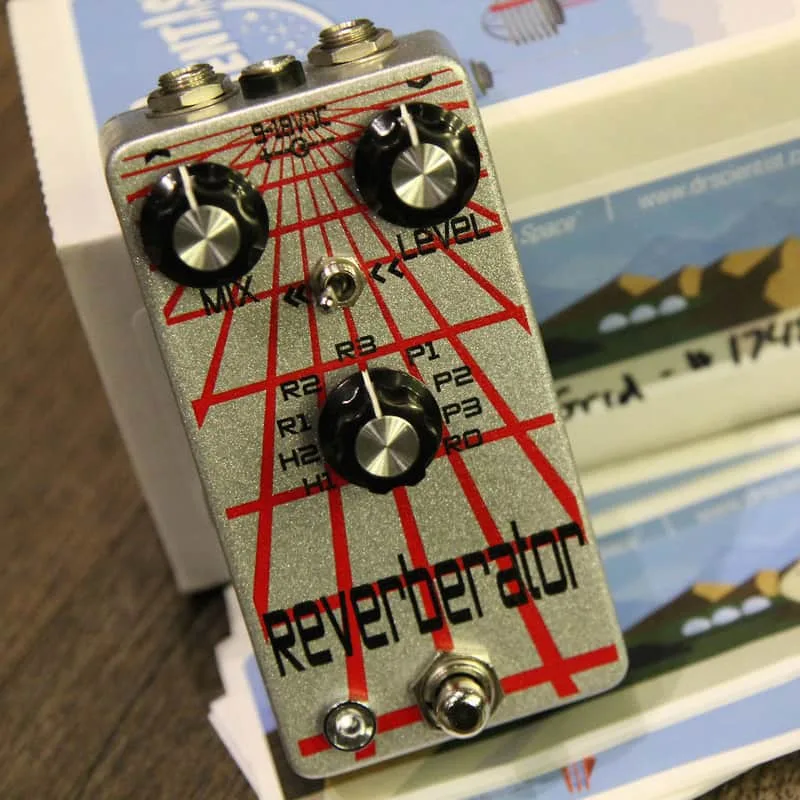
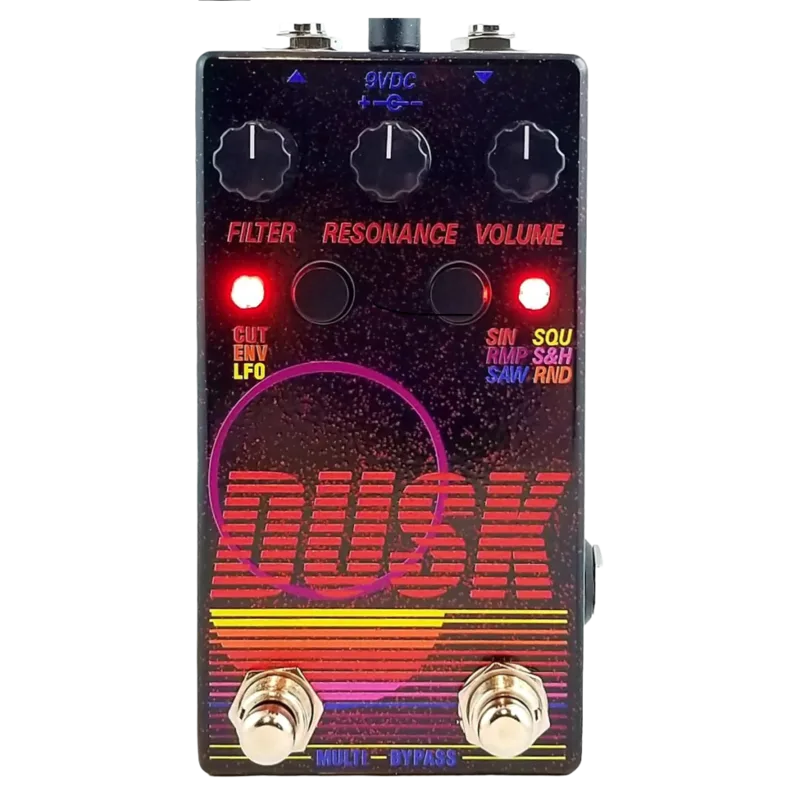
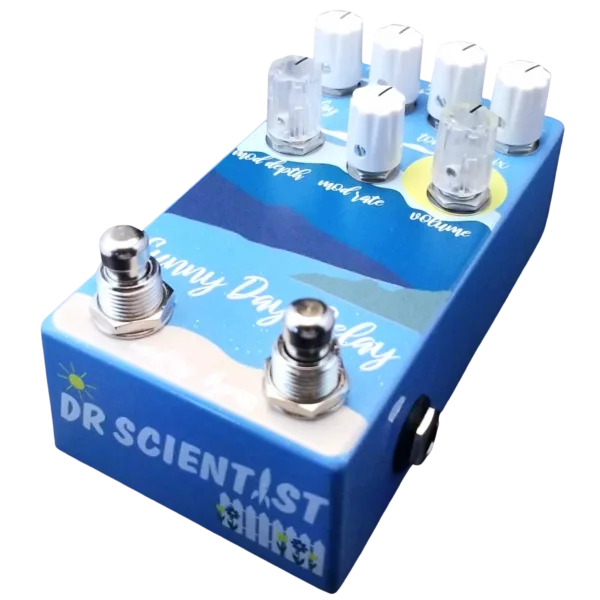
Ryan Clarke is the designer behind Dr Scientist, a Canadian builder whose range has included the BitQuest Multi-FX-Fuzz, described by Guitar Pedal X as the maker's most popular pedal, along with the Reverberator, Dusk Analog Filter and Sunny Day Delay.1 Pedal of the Day, reviewing the Sunny Day Delay, noted that "we've always loved the effects pedals that Ryan and the Dr. Scientist crew have sent our way over the years."2
The Heisenberg itself is a rare piece. Guitar Pedal X's Stefan Karlsson wrote in November 2021 that he was not sure how many were made, but felt "there may only be 100 or so units out there."1 No official production figure has been published, so the 100-unit figure stands as one writer's estimate rather than a maker's record.
Videos
Gray Bench Electronics
Questions
How many Dr Scientist Heisenberg pedals were made?
No official production figure exists. Guitar Pedal X's Stefan Karlsson, writing in November 2021, said he was not sure how many were made but felt there may only be around 100 units out there. That makes the Heisenberg one of the rarer pedals in the Dr Scientist range, which also includes the BitQuest, Reverberator, Dusk Analog Filter and Sunny Day Delay.
What did the Heisenberg cost new?
The Heisenberg was priced around $399 when new, according to Guitar Pedal X's 2021 retrospective on the pedal. Because production was small and the pedal is no longer a current catalog item, second-hand prices are set by the used market rather than a manufacturer list price.
What transistors are in the Heisenberg?
The three gain stages use different active parts: a BS170 transistor for the FET output stage, a 2N5088 transistor for the NPN fuzz stage, and an NE5532P op-amp chip for the distortion stage. Two further NE5532P chips handle the Treble, Input and Output controls, and an ATTiny13A microcontroller is used for switching.
What does the Heisenberg sound like?
Guitar Pedal X describes its output as distinctly smoother and more glassy than conventional overdrives, with some players calling it a little Hi-Fi because of its native clarity. That character comes from the molecular junction diodes, which Dr Scientist said saturate in a slower, smoother, more pleasing way than silicon.
Sources (4)
- Guitar Pedal X, Guitar Pedal X, 2021-11-15
- Dr. Scientist Sunny Day Delay, Pedal of the Day, 2024-03-29
- Nanolog Audio The WaveFunction Review, Premier Guitar, 2018-02-19
- Review: Nanolog Audio Classic Overdrive & Orbital Fuzz, Guitar.com, 2019-01-09