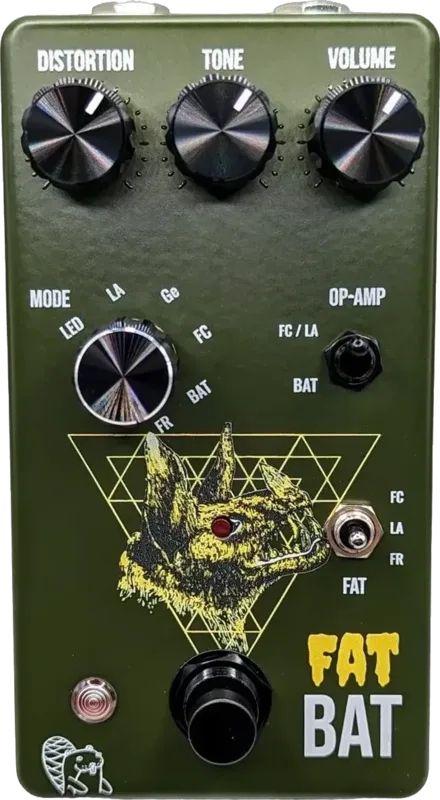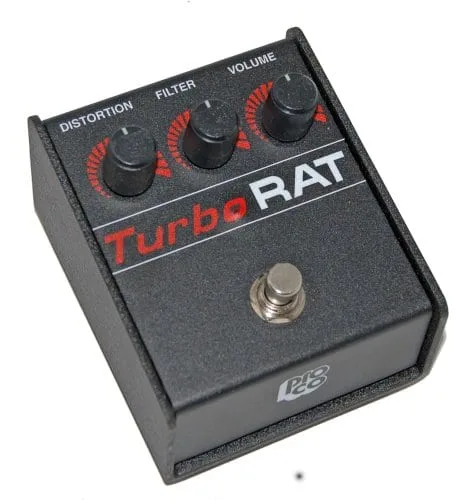


The Drunk Beaver Fat Bat Rat Distortion is an analog distortion and overdrive pedal from Drunk Beaver. Its clipping selector offers a red LEDs clipping option, described by RockBoard's PedalPedia as being like a Turbo Rat1, so a player can change the pedal's clipping character without swapping pedals.
What the mode switch does
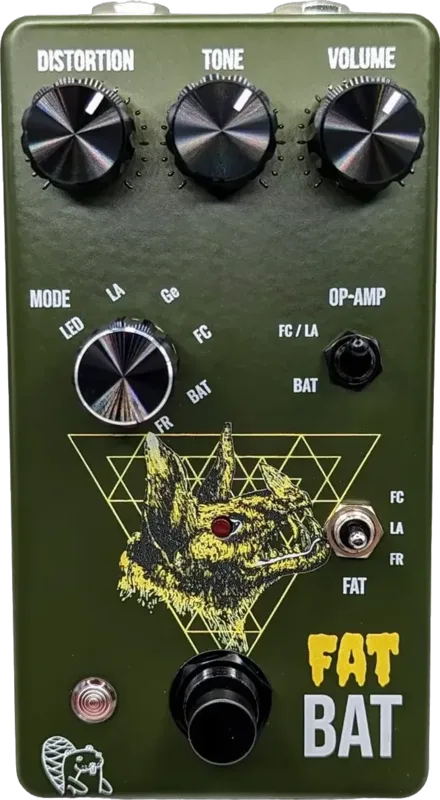
The Fat Bat has four controls: Distortion, Tone, Volume, and Mode. The Mode switch is the heart of the pedal, offering six clipping options: LED, LA Metal, Germanium, Fat Cat, Bat, and Fat Rat. The op-amp also changes with the mode: Fat Cat and LA Metal use an RC5234, Bat uses a CA741, and the Fat (Low Boost) setting draws on the Fat Cat, LA Metal and Fat Rat voicings2. RockBoard's PedalPedia notes that the red LED clipping option works like the Turbo Rat1.
The underlying chip pair is part of the character: Drunk Beaver used NOS (new old stock) NE5534 and NOS 741 operational amplifiers1.
| Control | What it does |
|---|---|
| Distortion | Sets the amount of gain |
| Tone | Shapes the treble response |
| Volume | Sets the output level |
| Mode | Selects one of six clipping voicings: LED / LA Metal / Germanium / Fat Cat / Bat / Fat Rat2 |
Where the circuit comes from
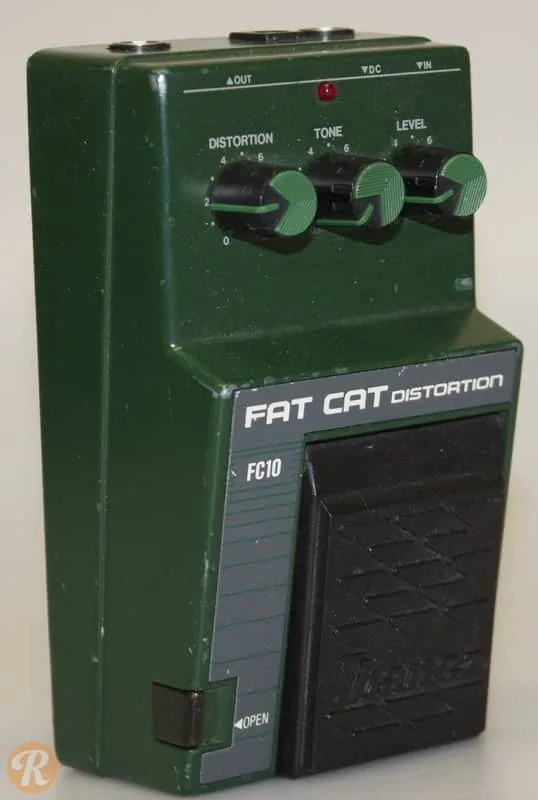
The Fat Cat lineage matters to how the pedal behaves. The Ibanez FC10 Fat Cat was Ibanez's first take on the Pro Co Rat3, and TONEHOME describes the FC10 as delivering "a wide range of distortion sounds, a fat sound, and plenty of sustain", noting that unlike typical overdrives, the fatness remains at high gain settings, making it effective on lead or rhythm guitar4. TONEHOME's advice for the original also carries over: to get the Fat Cat's "growling" distortion sound, turn the distortion control up high while keeping the level control low enough to limit extra overdrive at the amp's input4.
The Fat Rat side of the switch reaches back to Jack Orman's AMZ modification, which revised the circuit toward his Fat Gnat design and increased bias filtering tenfold "for less hum and noise"5.
"You can explore different voicing selecting between 6 clipping options"
Where it sits in the Drunk Beaver range
The Fat Bat is Drunk Beaver's take on the Rat formula, and it sets itself apart with its clipping selector, which includes a red LEDs clipping option like a Turbo Rat1. That makes it the Turbo Rat-flavored member of the Drunk Beaver range rather than a straight Rat clone.
The Fat Bat draws 7mA at 9V DC center negative1, a light load by pedal standards, so it can share a supply with other pedals without issue.
Videos
Mind the G.A.S.
PALESAMA MUSIC AND GEAR DEMOS
Questions
What circuit is the Drunk Beaver Fat Bat based on?
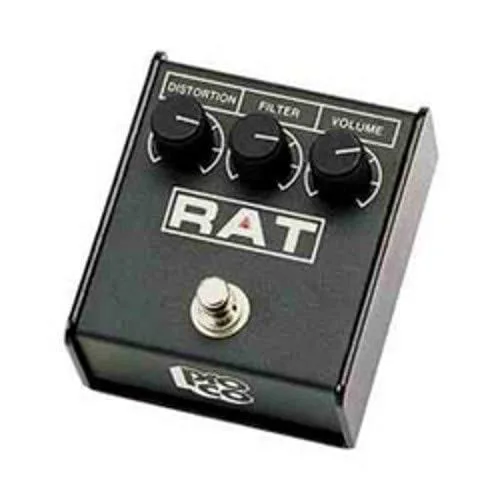
Drunk Beaver describes the Fat Bat as its take on the Ibanez FC10 Fat Cat circuit, with the ability to enter Ibanez LA Metal and Fat Rat territory. The Fat Cat itself was Ibanez's first take on the Pro Co Rat, so the Fat Bat sits in the Rat family of distortion circuits. It uses NOS NE5534 and NOS 741 operational amplifiers.
What power supply does the Fat Bat need?
The Fat Bat runs on 9V DC, center negative, the standard pedal supply polarity used by most modern power supplies and daisy chains. It draws 7mA, which is a light load that any 9V pedal power source can handle.
Is the Drunk Beaver Fat Bat analog?
Yes. Drunk Beaver lists the circuit type as analog. There is no digital processing or modeling in the signal path.
How much current does the Fat Bat draw?
Drunk Beaver lists the current draw at 7mA at 9V. That is low enough that the pedal can share a power supply output or daisy chain with other pedals without stressing the supply.
Sources (5)
- Fat Bat by Drunk Beaver, RockBoard PedalPedia, 2026
- Guitar Pedal X, Guitar Pedal X, 2024-08-30
- TONEHOME, TONEHOME - the World of Vintage Guitar Effects Pedals
- TONEHOME, TONEHOME
- Fat Rat - Modifying the ProCo Rat, AMZ Guitar Effects Blog (muzique.com), 2003