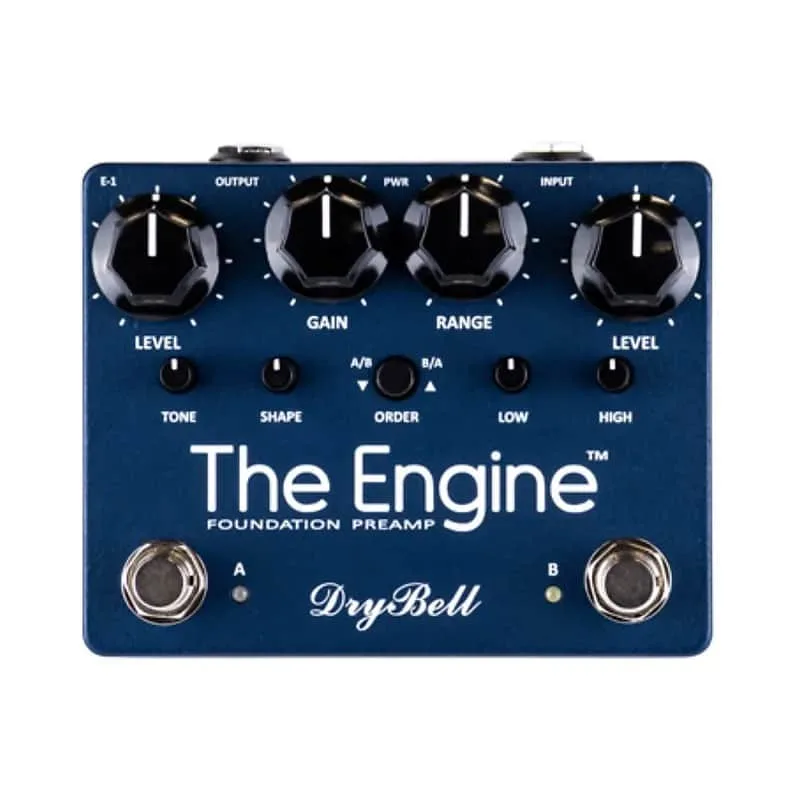


DryBell The Engine is a two-channel analog preamp and overdrive pedal that puts two classic British sounds in one box: the crunch of a vintage Marshall amp on one side, and the spank of a Rangemaster treble booster on the other1. DryBell describes it as a "British Amp in a Box & EQ/Rangemaster Boost"2, and the two channels can be run separately or stacked together3.
The pedal was released in November 2020 as the Engine Foundation Preamp, a fully analog two-sided preamp with a distortion side and a clean boost side3. It is made in Croatia by DryBell, in a deep Prussian blue enclosure measuring 120 x 98 x 51mm13.
A Plexi overdrive and Rangemaster boost in one pedal
The Engine's premise is to combine two circuits that shaped British rock guitar: the "Plexi" era Marshall amp and the Dallas Rangemaster treble booster, the pedal players used in front of those amps in the late 1960s. Guitar.com's reviewer, Richard Purvis, wrote that "the Engine aims to capture both the crunch of a vintage Marshall amp and the spank of a Rangemaster treble booster"1.
Each side has its own controls and its own footswitch, and DryBell states that both channels can be used simultaneously, so the boost side can push the overdrive side the way a Rangemaster pushed a cranked amp3. DryBell calls the result "a fully analog, high headroom, extremely versatile dual preamp"3.
For a player, that means the pedal can serve several roles at once: a foundation preamp shaping your core tone, a Marshall-flavored overdrive for riffs and leads, and a mid-focused boost for solos, all without rewiring the board. Two players on DryBell's testimonials page describe exactly that setup: Greg Milioto keeps "the RangeMaster side on all night when I play out and the Plexi side for lead work and Marshall flavored riffs," and Herb Genelly calls the boost side "an 'always on' side for me" before "hitting the Plexi side" for leads4.
"I keep the RangeMaster side on all night when I play out and the Plexi side for lead work and Marshall flavored riffs."
The controls
The two sides have different control sets, reflecting their different jobs.
Side A, the Plexi/foundation side, carries Level, Gain and Tone, plus a Shape control. Pedal of the Day explains that the first three "work as you'd expect," while the Shape control "allows you to adjust the overall character and level of the mid frequencies," which the review calls "a key feature for setting the voice of and fine-tuning your foundation tone"5. DryBell's own material describes the shape knob as tuning the pedal's built-in tone and response to the amplifier you pair it with, and the tone knob as a high-cut4.
Side B, the Rangemaster side, has bass and treble controls plus a volume control with a lot of tuning range, and a range control that sets the low-cut frequency4. Pedal of the Day highlights the Range feature as the heart of this side: it "controls specific mid-frequencies whose complex overtones are great for pushing through the mix, ala the famous Rangemaster Treble Booster"5. There is also a rangemaster boost switch4.
| Control | Side | What it does |
|---|---|---|
| Level | A | Output volume5 |
| Gain | A | Drive amount, from almost none to plenty4 |
| Tone | A | High-cut4 |
| Shape | A | Overall character and level of the mid frequencies, matched to your amp54 |
| Bass | B | Low EQ on the boost side4 |
| Treble | B | High EQ on the boost side4 |
| Range | B | Sets the low-cut frequency, focusing the mid push54 |
| Volume | B | Boost output level4 |
On the gain knob, one player on DryBell's testimonials page reports the "real magic in the lower settings around 10 o'clock where you get sparkle with picking and breakup when digging in"4. Guitar.com's awards feature adds that "the Plexi side of this unit can go almost completely clean"6, so the overdrive side can double as a slightly colored clean preamp.
Power comes from a 9V mains supply only, which rules out a battery1. DryBell notes the option to run the pedal at 9 to 18 volts as "a plus for increased headroom"4.
What reviewers said
The Engine collected an unusual set of honors from the guitar press. It earned a "Premier Gear" badge in Premier Guitar's review, an "Editor's Choice" badge from Guitar Magazine, a "Vintage Guitar Approved Gear" badge from Vintage Guitar Magazine, and a 5-star review from Bonedo3. GuitarPedalX named it one of the best new overdrive/distortion pedals of 20203, and included it again in a 2025 buying guide of extended-range Marshall-style pedals at €272 / $299 / £2497.
Guitar.com's Richard Purvis scored it 9 out of 10 and summarized:
"An array of top-class Plexi overdrive and boost tones in one luxury package."
In that review he found the drive circuit "pushes out classic Marshall grind, with that familiar tight bass and sweetly rasping edge," and that with the range control at full and some cut to the low EQ, the boost channel delivers "a clonking slap around the chops that's pure first-generation Brit rock"1. He also described the enclosure as "immaculately finished in deep Prussian blue"1.
Bjørn Riis, of the band AirBag and the Gilmourish.com site, gave DryBell a stronger verdict still8:
"This is probably the best overdrive pedal I've tried in many many years! It really feels like I'm playing a real tube amp."
DryBell's own review roundup frames the appeal for lead players: "the combination of Marshall and Rangemaster colors, and all their sonic variables, makes The Engine a guitar soloist's" tool3.
Videos
Pete Thorn
DryBell Guitar Effects
R.J. Ronquillo
Questions
Can both channels of DryBell The Engine be used at the same time?
Yes. The Engine is a dual preamp with two channels, and DryBell states that both channels can be used simultaneously, letting you stack the Plexi overdrive side and the Rangemaster boost side together. Several players describe running the Rangemaster side always on and switching the Plexi side in for lead work.
Is DryBell The Engine true bypass?
No. Guitar.com's review lists The Engine as having a buffered bypass rather than true bypass. It is also powered by a 9V mains supply only, with no battery option, and DryBell notes it can run at 9 to 18 volts for increased headroom.
Where is DryBell The Engine made?
The Engine is made in Croatia, by the Croatian pedal maker DryBell. Guitar.com's review describes it as an overdrive/preamp and boost pedal made in Croatia, finished in a deep Prussian blue enclosure measuring 120 x 98 x 51mm.
Can the Plexi side of The Engine go clean?
Almost. Guitar.com's best-pedals-of-2020 feature notes that the Plexi side of the unit can go almost completely clean, so it works as a foundation preamp as well as an overdrive. Players also report finding sparkle and light breakup at lower gain settings.
Sources (8)
- Review: DryBell The Engine, Guitar.com, 2020-09-08
- Gwyn Ashton's Blues-Rock Tone with DryBell Guitar Effects, DryBell, 2026-09-29
- DryBell The Engine: Awards, Press Reviews & Artist Picks, DryBell, 2024-06-21
- DryBell The Engine: Customer Reviews & Testimonials, DryBell, 2026-04-20
- DryBell The Engine Foundation Preamp, Pedal of the Day, 2020-11-07
- Gear Of The Year: Best guitar effects pedal of 2020, Guitar.com, 2020-12-03
- Guitar Pedal X, Guitar Pedal X, 2025-11-21
- DryBell The Engine: British Amp in A Box + EQ/Boost, DryBell Guitar Effects, 2026-09-24